Skip to content
Updated November 2026

What Is Hogmanay? Meaning, First-Footing and Traditions

Hogmanay is Scotland's New Year's Eve, and it comes with its own rules: clean the house, first-foot the neighbours with coal and black bun, cross arms for Auld Lang Syne. It was Scotland's big winter night for centuries, and in towns like Stonehaven it still ends in fire.

2
places
4.4
avg Google rating
Edinburgh
Scotland
── hogmanay · scotland

What is Hogmanay? Scotland's New Year, and the customs that come with it

Hogmanay is simply the Scots word for New Year's Eve, 31 December. For centuries it was Scotland's big winter celebration, because the Reformation pushed Christmas out, and it comes with its own customs: clean the house before the bells, sing Auld Lang Syne at midnight, then go first-footing, carrying coal, shortbread or a dram to the neighbours so that the first visitor of the year brings luck.

My short answer on where to see it: in Edinburgh, go to the Torchlight Procession on the 29th and the Street Party on the 31st, and our Edinburgh Hogmanay guide has the 2026/27 programme and tickets. On a budget, First Footin' on New Year's Day is free. If you want the old fire customs and can be in Aberdeenshire for midnight, Stonehaven's fireballs are the one I'd plan a trip around; if you're in Perthshire, Comrie's flambeaux. Missed the 31st? Burghead burns the Clavie on 11 January. And 2 January is a public holiday in Scotland too, so nobody expects much of you that day.

Tron Kirk

What the word means

In Scots, Hogmanay is the last day of the year, and the party that goes with it. It has also meant a New Year's gift, especially the oatcakes, bread or biscuits children went door to door asking for, plus the drink you pour a guest at New Year and the tip you gave tradesmen on the day. Children in the poorer parts of town used to wrap themselves in big sheets folded into pockets, shout 'Hogmanay!' at the better-off houses and come away with oatcake, sometimes with cheese.

The word turns up in Scots from 1604. The likeliest source is a northern French dialect word for a New Year's gift, which probably came over with the alliance with France around 1560. The exact route is disputed, so don't bet on it in a pub quiz.

How to say it

HOG-muh-nay, or hog-muh-NAY. Both stresses are correct, and you'll hear both in Scotland, so don't worry about it.

Why Scotland made more of New Year than Christmas

After the Reformation in 1560 the Kirk had no room for Yule: it abolished every holy day except Sunday in 1575, and Parliament abolished the Yule holiday in 1640 and again in 1690. The kirk sessions meant it, and people were punished for keeping Christmas. So the winter party moved to New Year, and Christmas wasn't a public holiday in Scotland until 1971.

You'll also hear Hogmanay linked with the winter solstice and Viking midwinter feasts. That's a fair reason to party in the dark of the year, but there's no straight line from a Norse feast to a Royal Mile street party, so take any very specific 'ancient origin' story with a pinch of salt.

Hogmanay in Edinburgh before the festival

Long before there were tickets, Edinburgh's Hogmanay happened on the High Street. Crowds gathered outside the Tron Kirk to hear its bells at midnight, and people danced impromptu reels outside St Giles' Cathedral a few hundred metres up the Royal Mile. The quieter side of the night was going round friends', family's and neighbours' houses to see the bells in together.

Tron Kirk

Go to the Tron by day: it's where the Royal Mile meets North and South Bridge, a church built between 1636 and 1647 and long out of use for worship, and it trades as Tron Kirk Market now, a free-to-wander Scottish craft and design market. The catch is that the market is only a temporary use while its trust decides the building's future, so it won't necessarily be there for ever. Stand outside afterwards and picture the crowd that used to pack the street at midnight, then carry on with our Royal Mile guide.

landmark · Old Town & Royal Mile
Tron Kirk
4.3 Google (1,610)
122 High St, Edinburgh EH1 1SG, UK
Price: Free to browse (currently trading as Tron Kirk Market)
  • Before the modern festival, this is where Edinburgh came to hear the bells at midnight
  • A 17th-century church on the Royal Mile, now a free-to-browse market
Tip

Step in by day: it's a free craft and design market inside now, and the 17th-century church is the one Edinburgh used to gather outside for the bells.

St Giles' Cathedral

The customs, in the order they happen

Redding the house. Before the bells, you clean. Starting the year in a dirty house is bad luck, so the 31st is for a proper going-over, paying off debts, and, in the days of open fires, clearing the ashes and laying a fresh fire. Some places worried about the opposite too, and kept the fire in on Hogmanay, because letting it go out was very unlucky.

The bells and Auld Lang Syne. At midnight someone puts on the bells, or you hear them from the church or the town, and the room sings Auld Lang Syne, the old song Robert Burns collected and reworked (he first mentions it in a letter in 1788). The tune almost everyone sings was paired with his words after he died. It means roughly 'old long since', or for old times' sake. Stand in a circle holding hands, and only cross your arms for the last verse, taking the hands of the people either side. In harbour towns, the boats sound their horns at midnight.

First-footing. Then you go visiting. The first person over the threshold after midnight, the first-foot, brings the household its luck for the year. The ideal one is a dark-haired man, which is why coal-men and chimney sweeps were once welcome callers. If you're first-footing, go after the bells and take something: a lump of coal, shortbread, black bun, salt or a bottle of whisky. Arriving empty-handed is rude and, worse, unlucky. Some Scots still do it, mostly between family and neighbours.

Black bun. The traditional Hogmanay cake, and one of the first-foot's gifts: a dense, very dark fruit cake baked inside a pastry crust. It's heavy going, so a thin slice is plenty.

New Year's Day, and the day after. In Scotland both 1 and 2 January are public holidays, so the visiting, the eating and the recovering get two days instead of one.

St Giles' Cathedral

St Giles' is the old High Kirk on the Royal Mile, and on Hogmanay nights it was the backdrop to the dancing. Look at it by day, and check whether it's on the New Year's Day programme: on 1 January 2026 it was a free venue on First Footin', the official festival's unticketed music trail.

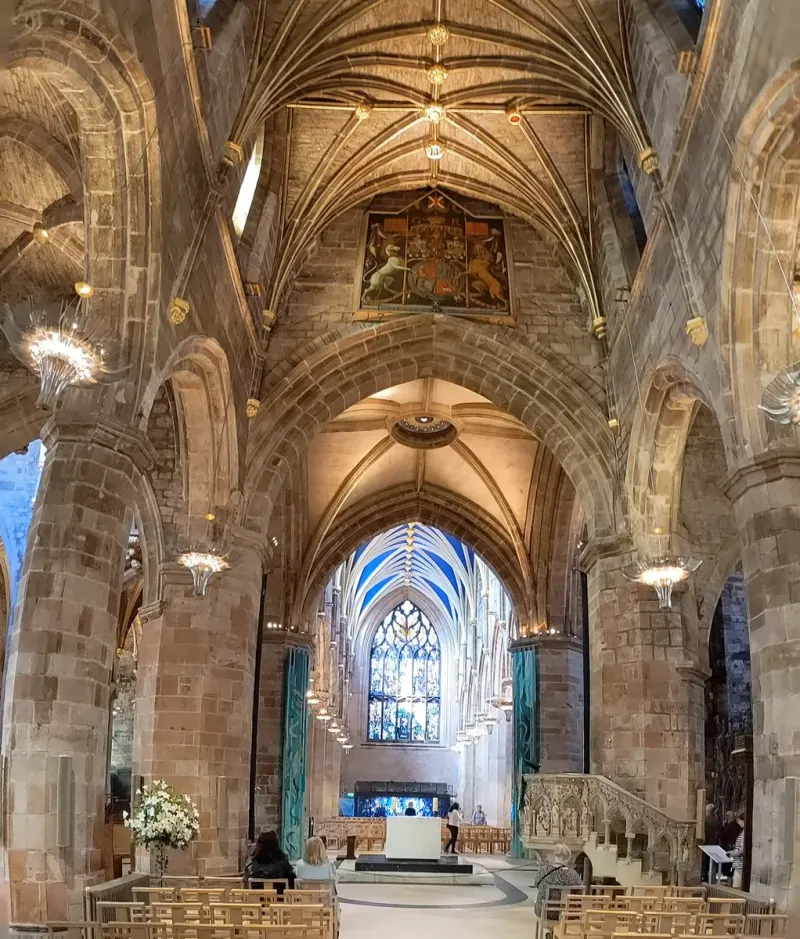
St Giles' Cathedral
attraction · Old Town & Royal Mile
St Giles' Cathedral
4.6 Google (13,627)
High St, Edinburgh EH1 1RE, UK
  • People used to dance impromptu reels outside it after the bells
  • A venue for First Footin', the free New Year's Day music trail
Tip

It was a free First Footin' venue on 1 January 2026. Check the official Hogmanay site after Christmas before you plan New Year's Day around it.

── around scotland

Which fire festival to go to

If you only go to one, make it Stonehaven: it's free, it's right at midnight, and it's the most spectacular of the lot. The others suit you if you're already nearby.

Stonehaven Fireballs, Aberdeenshire. At midnight on 31 December, fireballs are swung down the High Street for about 20 minutes, then there are fireworks. It's free, with a donation on the way in. The catch is the crowd: people start gathering from 10pm, and access may close once it's full, which can be any time after 11pm. Be there by 10pm, and book a bed in town so you're not leaving at 1am.

Comrie Flambeaux, Perthshire. As the bells ring midnight, the flambeaux, long thick birch poles with tarred rags bound to the tops, are lit and paraded round the village behind the pipe band, then thrown off the Dalginross Bridge into the River Earn to cast out evil spirits. It's the one to pick if you're spending Hogmanay in Perthshire.

Biggar Bonfire, South Lanarkshire. A huge bonfire in the town centre, lit on New Year's Eve. Go if you're already in the area; it's not one to travel for.

Burning of the Clavie, Burghead, Moray. Burghead keeps its New Year on 11 January, known as 'old Hogmanay', so this is the one if you missed the 31st. A flaming barrel, the clavie, is carried round the town and up a nearby hill, where it burns into the next day.

Up Helly Aa, Shetland. Not a Hogmanay custom, but Shetland's Viking fire festivals are part of the same winter run. You don't need to go to Shetland for a taste: the South Mainland Up Helly Aa' Jarl Squad lead Edinburgh's Torchlight Procession on 29 December.

── in edinburgh

Seeing it in Edinburgh

Edinburgh runs Hogmanay as a four-day festival, from the Torchlight Procession on 29 December to First Footin' on New Year's Day. The Street Party on the 31st starts with a Scottish welcome and ceilidh hour of massed pipes, drums and Highland dancers, and ends with Auld Lang Syne at the bells, so it's the easiest way to see the whole tradition in one night. For the 2026/27 programme, tickets, the free fireworks viewpoints and where to eat, see our Edinburgh Hogmanay guide.

Staying longer? Our Edinburgh in winter guide covers the whole season, and Scotland's other big winter night, Burns Night on 25 January, has its own guide, with a Burns Supper and more Auld Lang Syne.

Planning your trip to Edinburgh? Save these places to your itinerary with Tourli, the app that turns travel guides into actionable day plans.

── frequently asked

Frequently asked questions.

What does Hogmanay mean?
Hogmanay is the Scots word for the last day of the year, 31 December, and for the celebrations that go with it. It has also meant a New Year's gift, especially the oatcakes children used to go door to door asking for, and the drink offered to a guest at New Year. The word turns up in Scots from 1604 and most likely comes from a northern French word for a New Year's gift.
How do you pronounce Hogmanay?
HOG-muh-nay or hog-muh-NAY. Both stresses are correct, and you'll hear both in Scotland. The 'a' in the middle is a soft 'uh'.
What is first-footing?
First-footing is the custom that the first person to cross your threshold after midnight sets your luck for the year. Tradition says the best first-foot is a dark-haired man, and he should bring a gift: a lump of coal for the fire, shortbread, black bun, salt or whisky. Turning up empty-handed is bad luck. Some Scots still do it, usually by visiting family and neighbours in the small hours.
Why does Scotland celebrate New Year more than Christmas?
Because the Kirk stamped on Christmas for centuries. After the Reformation of 1560 the Church of Scotland dropped Yule as a holy day, the General Assembly abolished all holy days except Sunday in 1575, and Parliament abolished the Yule holiday in 1640 and again in 1690. New Year became the main winter celebration instead, and Christmas only became a public holiday in Scotland in 1971.
What is black bun?
Black bun is a very rich, dark fruit cake baked inside a pastry case. It's the traditional Hogmanay cake and one of the gifts a first-foot brings.
Why do people cross arms for Auld Lang Syne?
It's how the song is sung at Scottish gatherings: everyone stands in a circle holding hands, then crosses their arms and joins hands with the people either side for the final verse. Robert Burns collected and reworked the old song, sending a version in a letter in 1788; the tune most people sing today was paired with his words after his death.
── save these to your edinburgh trip

Stop reading lists.
Start the trip.

Tourli turns any guide into an actionable day plan — pinned to a map, walking directions and offline access included. One tap to save every place on this page.

── travel inspiration, weekly

One short email, every Sunday.

New guides, off-the-radar places and the occasional discount. No spam, unsubscribe anytime.