── tickets · 2026 prices
What it costs, and why you can't book
Adult: £10. Students, NHS staff, over-60s and visitors with disabilities: £6.50 (bring ID; the museum doesn't accept Blue Light Cards). Child (5-15): £5.50. Under-5s: free. Carers and personal assistants supporting a disabled visitor go free. Family tickets run from £17 to £25, so a family of four pays £25 rather than £31.
You can't book an ordinary visit online, so just turn up and pay at the Level 3 museum reception. The ticket is valid from 10am to 5pm on the day you buy it, so you can leave and come back. If you live nearby or plan to return, an annual ticket is £26 for an adult and £15 concession, which pays off on your third visit.
The one thing you do book ahead is the Blood and Guts walking tour, through Eventbrite from the museum's walking tours page. It's about 70 minutes on Edinburgh's medical history, recommended for ages 10 and up, and it includes museum entry on the day, so I'd book it if you want the museum and a walk for one price. In 2026 it ran at 2pm on weekends until 29 November, plus Fridays in summer; the 2027 dates come out on the walking tours page.
── opening hours
Hours and the Christmas closure
Open seven days a week, 10am to 5pm, last entry 4.30pm. Over Christmas and New Year it shuts completely: in 2026 it closes at 5pm on Wednesday 23 December and reopens at 10am on Tuesday 5 January 2027. If your trip falls in that gap, pick from Edinburgh's other museums instead, and check their own holiday hours.
I'd arrive late morning. You need the full two hours, and arriving after 3pm leaves you rushing the pathology galleries, which are the part worth slowing down for.
── inside the museum
What's inside, gallery by gallery
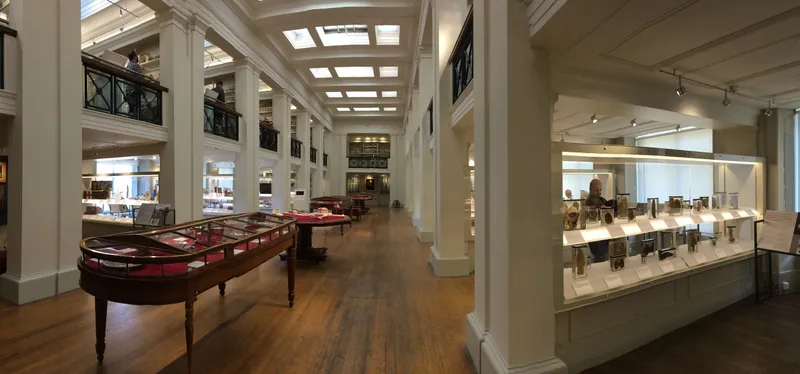
The Wohl Pathology Museum is the centrepiece and the reason the place has its reputation. It's a huge collection of human pathological anatomy, shown in a purpose-built 19th-century hall designed by William Henry Playfair, with his original shelving still on the upper floor. The ground floor runs from 1500s cabinets of curiosity to how human remains were preserved for teaching, body donation and consent, and military surgery from Waterloo to the Second World War. Upstairs is organised by surgical speciality: heart and lungs, face and jaw, blood vessels. These are real organs and tissue in glass, displayed to teach surgeons, and that's exactly why it stays with you. Take the upper floor slowly.
The History of Surgery Gallery is where the stories are, and the room I'd start in with anyone nervous. It covers James Syme's surgery before anaesthesia, Joseph Lister's antiseptic technique and James Young Simpson's pioneering use of chloroform as an anaesthetic. There's an anatomy theatre with an interactive dissection table that recreates Scotland's first public dissection, in 1702. And there's a section on Arthur Conan Doyle, who studied in Edinburgh and credited the surgeon Joseph Bell as his model for Sherlock Holmes.
Burke and Hare are here too, in that same gallery, which covers the darker side of medicine, including dissection used as a punishment. In 1828 William Burke and William Hare murdered people in the city and sold the bodies for anatomy teaching. The museum displays a pocketbook said to be made from Burke's skin, and his death mask. It's told as history, which makes it more chilling than any version you'll hear on a ghost tour.
The Dental Collection is built around a bequest from the Glasgow dentist and historian John Menzies Campbell: instruments from Britain and around the world, plus prints, paintings and models. It's an odd, compelling half-hour; skip it if you're short of time. Body Voyager brings it up to date with computers and robotics in modern surgery, and is the lightest room in the building.
The temporary exhibition, Edinburgh City of Medicine: 300 Years of Edinburgh Medical School, runs until Easter 2027, so catch it if you're here before then.
── content warnings · age guidance
Who it's too much for
This is real human tissue, organs and bone, shown to teach surgeons, and it can be distressing. Decide for your group before you go in, not at the door of the pathology hall.
Age guidance: it isn't recommended for under-10s, but that's a guideline, so younger children can come if you think they're ready. Under-16s must be with an adult. In my view, a curious 11-year-old who likes science will probably love it, and a squeamish adult may not. If you're unsure, the History of Surgery Gallery and Body Voyager are the gentler rooms; the Wohl Pathology Museum is the one to think about.
Photography is restricted because of the human remains and needs the museum's approval, so don't plan on photos for social media. Sketching with dry materials is fine, and the desk lends folding stools.
── practicalities
Getting there, access and the small print
The museum is inside the Royal College of Surgeons of Edinburgh on Nicolson Street, EH8 9DW, on the Southside. It's about ten minutes' walk from Waverley station, and buses 3, 5, 7, 8, 14, 29, 30, 31, 37 and 49 stop nearby. There's no car park, and the old NCP discount has ended. Greyfriars Kirkyard is a short walk west, so it pairs well with Greyfriars Bobby and the kirkyard or the Old Town.
Access: every level is reached by lift. One section of the Wohl Pathology Museum's upper gallery may not fit wheelchairs wider than 66cm. Guide and assistance dogs are welcome.
Bags and food: there are no lockers, so leave the big bag at your hotel. There's no café inside either, but your ticket gets 10% off at Café 1505 by the entrance to the museum gardens, which is where I'd take the lunch break.
── the verdict
Is Surgeons' Hall worth it?
Yes, at £10 it's one of the best-value paid museums in the city, and nothing else in Edinburgh is like it. The National Museum of Scotland is free and bigger; Surgeons' Hall is the one people still talk about at dinner. Nearly 5,000 Google reviewers give it 4.7, so I'm not alone.
Skip it if anyone in your group is genuinely uneasy around medical material, or if your children are young and easily upset. Otherwise, go late morning, give it two hours, and don't rush the Wohl.
More Edinburgh guides
For the rest of the city's collections, free ones included, see the best museums in Edinburgh. If the weather has turned, things to do on a rainy day in Edinburgh has more indoor plans, and if Burke and Hare have you hooked, Edinburgh's ghost tours take the darker side of the Old Town after dark.
Planning your trip? Save Surgeons' Hall and everything around it into a day-by-day plan with Tourli, the app that turns travel guides into actionable itineraries.