── admission · 2026
What it actually costs, right now
St Giles' Cathedral runs on donations, not tickets. Its own visitor-information page says plainly: 'St Giles' Cathedral is run by donations. Please give as you are able, our suggested donation is £10.' That's still the live policy as of my re-check against stgilescathedral.org.uk on 4 September 2026 — you can walk straight in without paying anything, and nobody stops you at the door.
Don't take that as the settled answer for your own trip, though. In the first week of June 2026, The Scotsman, the Edinburgh Evening News, the Scottish Sun and the Daily Mail all reported that the cathedral had announced a genuinely new policy: a £12 entry charge for tourists, starting in September 2026, with Scottish residents and under-16s staying free. That's not speculation, it's the cathedral's own announced plan, covered by multiple outlets in the same week. What I can't tell you with total certainty is whether it's live on the exact day you're reading this: as of my re-check on 4 September 2026, just past the announced September start, the £10-suggested-donation wording was still the only thing published on the official page, with no £12 figure or start date anywhere on the site.
So here's the practical version. Check stgilescathedral.org.uk/visitorinformation directly before you go, especially for any visit from September 2026 onward. If the £12 charge has gone live, expect Scottish residents and under-16s to be exempt, per the original announcement. If it hasn't, the £10 suggested donation still applies, and it genuinely is a suggestion rather than a barrier — nobody is turned away for not paying. I'll be rechecking this the moment the change lands and updating this page, so don't let an older write-up (including a future stale version of this one) simply tell you it's 'free to visit' without checking first.
One more thing I looked for and couldn't confirm: several older travel write-ups mention a separate photography permit or fee for taking pictures inside. I checked the current official visitor-information page directly and found no mention of a photography charge or permit anywhere on it. For ordinary personal photos there's nothing published requiring a fee today; for a tripod, or anything professional or commercial, I'd ask at the welcome desk rather than assume either way.
── hours & services
When you can (and can't) get in
Opening hours: Monday-Friday 10am-6pm, Saturday 9am-5pm, Sunday 1pm-5pm. Saturday mornings, 9-10am, are set aside as a dedicated Quiet Hour, with sensory stimulation deliberately reduced for visitors who need a calmer visit.
Services: St Giles' is a working church, and Sunday worship happens at 9:30am and 11am, both comfortably before the 1pm sightseeing opening, so a Sunday visit won't run into a service. The one exception is a 15-minute weekday prayer service at 12pm, held during otherwise-open hours — expect the immediate area to be off-limits to sightseeing for that quarter of an hour, not the whole building.
Guided tours are currently paused for staff training and due back in mid-October 2026, per the cathedral's own site. Until then, there's a self-guided audio tour by QR code (£5.50 at the front desk, about 25 minutes, available in English, German and Ukrainian, with pre-purchase online), plus a free digital visitor guide with an interactive map, in nine languages, also accessed by QR code at the Welcome Desk.
── the thistle chapel
The one room I'd never skip
Tucked into the south-east corner and reached through a low, vaulted vestibule off the Preston Aisle, the Thistle Chapel was designed by the architect Robert Lorimer and completed in 1911, as the permanent home for Scotland's Order of the Thistle. The order itself traces roots to the Middle Ages, but the present-day version was largely established in 1687 under James VII; before that, its knights met at Holyrood Abbey until it was damaged in the civil unrest of 1688 and the order lost its meeting place for over two centuries.
It's a genuinely small space, three bays with a polygonal eastern apse, but every surface earns a slow look: a stone vault thick with carved ribs and bosses, including angels carved playing bagpipes, and stalls for 16 knights plus the sovereign and royal stalls, each one topped with an elaborately carved canopy bearing the relevant knight's helm and crest. Heraldic and figurative stained glass fills in the rest of the light. It's included in the normal cathedral visit, no separate ticket, but it does have 4 steps at the entrance with no step-free alternative route in.
── inside the cathedral
The steeple, John Knox, and 900 years of history
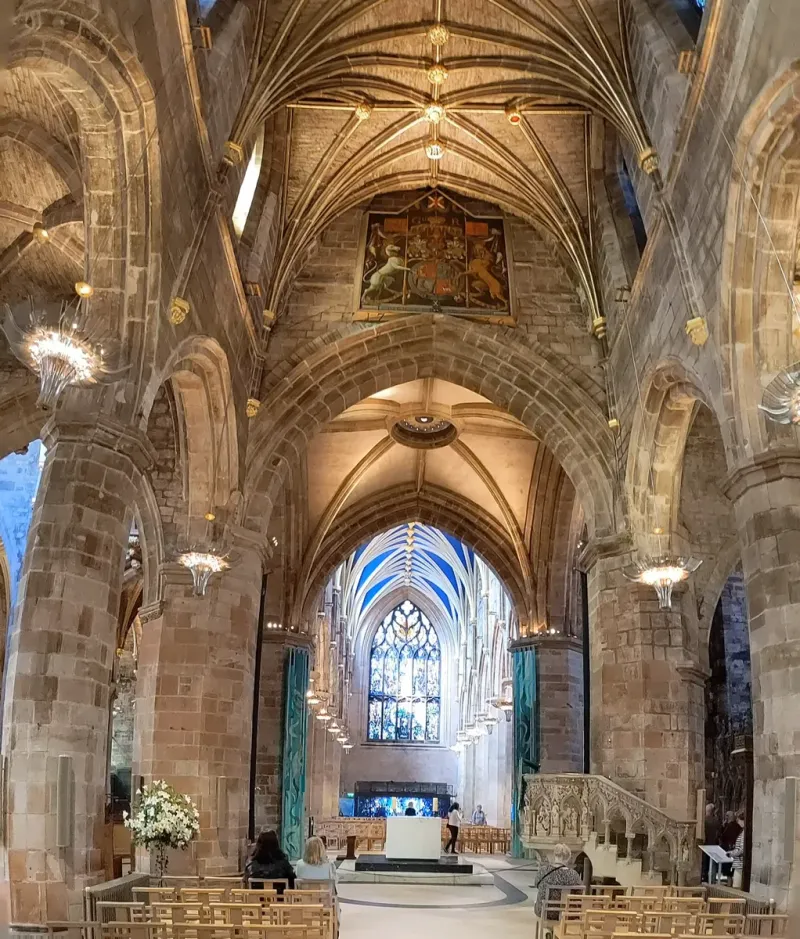
St Giles' was founded in 1124 by King David I as a Romanesque parish church, and it's been in continuous use for worship ever since, predating most of the Old Town that grew up around it. The building you see today is largely the product of centuries of rebuilding and restoration, most visibly the Victorian work of the 1870s and 1880s, which is also when stained glass returned to the church for the first time since the Reformation.
The crown steeple is the building's defining silhouette and one of Edinburgh's most recognisable landmarks: dendrochronological dating puts its timber structure at 1460-1467, and it's unusual even among Scotland's surviving medieval crown steeples for its eight-buttress design. You'll spot it from most vantage points along the Royal Mile and from Princes Street Gardens below.
John Knox, the leading figure of the Scottish Reformation, first preached at St Giles' on 29 June 1559, the same day the Lords of the Congregation's army entered Edinburgh unopposed, and he went on to serve as the church's minister. He preached his final sermon here on 9 November 1572 and was buried in the kirkyard outside, now the site of Parliament Square. A statue of Knox by the sculptor James Pittendrigh Macgillivray stands inside the cathedral, and his likeness also appears among the carved figures on the Victorian west doorway.
The stained glass includes a Robert Burns memorial window, installed in 1985, part of the wider run of glass the cathedral has added since the Victorian restoration reintroduced it. It's one more reason to look up as you walk through, alongside the crown steeple and the Thistle Chapel's own heraldic glass.
── accessibility
Getting around: the honest version
The main cathedral is genuinely accessible: a ramp at the exterior entrance, another just inside, and a level floor and main walkway throughout. Two manual wheelchairs are available on request if you need one, and there's a hearing loop fitted in the building (switch a hearing aid to the T-setting to use it).
The clearest limit is the Thistle Chapel, which has 4 steps at its entrance and no step-free route in; the cathedral offers a video or guided description as an alternative for visitors who can't manage the stairs. Some side aisles and the shop are also stepped and not wheelchair accessible. There's no accessible toilet on site — the nearest is at the National Library of Scotland, a short walk away on George IV Bridge, with accessible facilities on the ground and first floors. Accessible and sensory tours, and quiet visit times, can be arranged on request, and service animals are welcome. There's no cloakroom, so plan on keeping any luggage with you.
── the verdict
Is St Giles' Cathedral worth it?
Yes, and easily, if you're already walking the Royal Mile, which runs right past its door. This isn't a half-day attraction like the Castle; budget 30-45 minutes, closer to an hour if you take the audio tour or catch a lunchtime organ recital, and you'll have covered the crown steeple, the Thistle Chapel, the John Knox story and nine centuries of continuous history for the price of a donation you choose yourself.
The one thing that actually matters for your specific trip is timing the entry-charge question correctly, not taking either 'free' or '£12' on faith from an old post. Check stgilescathedral.org.uk directly before you go, particularly for any visit from September 2026 onward, and you'll know exactly what to expect at the door rather than guessing.
Practically: it's an easy stop to fold into a Royal Mile walk in either direction, roughly midway between the Castle at the top and the Palace of Holyroodhouse at the bottom, and it sits inside the wider medieval streetscape covered in our Old Town guide.
More Edinburgh guides
For the full length of Royal Mile this cathedral sits on, see our Royal Mile guide, and for the wider medieval district around it, the closes, restaurants and pubs, our Old Town guide. At the top of the same street, our Edinburgh Castle guide covers the anchor attraction it's easiest to pair this with. For the city's fuller spread of sights, start with things to do in Edinburgh, or, if you're keeping the day cheap, our free things to do guide, since St Giles' still costs nothing but a donation today.
Planning your trip? Save St Giles' and everything around it into a day-by-day plan with Tourli, the app that turns travel guides into actionable itineraries.