── tickets · 2026 prices
Admission: what it actually costs
Adult: £9. Concession or child: £7. Family ticket: £26. If you're also planning Calton Hill, there's a combined ticket covering the Scott Monument, the Nelson Monument, and the Nelson Monument's own tower for £14 — worth knowing if you're doing both viewpoints on the same trip.
The one thing that catches people out: there's no pre-booking and no online ticket. You buy at the kiosk at the base of the monument on the day, and it's card payments only — no cash. Under-5s aren't permitted on the climb at all.
This is a genuine price rise from what's floating around online — some older write-ups (including, honestly, an older page on this site) still quote £8/£6. £9/£7/£26 is the figure I checked directly against the operator's own site on 29 August 2026, so treat anything lower as out of date.
── opening hours · 2026
Hours, and how the climb actually works
Open 7 days a week, 10am to 5pm. But you don't just turn up and start climbing whenever you like: ascents run as guided groups departing roughly every 30 minutes, from 10:30am, with the last one at 4:30pm. It's a narrow one-way staircase, so pacing people onto it in batches is the only way it works.
Closed daily for lunch, 12:30pm-1:45pm. If you're building this into a tight itinerary around midday, plan around that gap rather than arriving at 12:45 and finding the kiosk shut.
Budget 30-45 minutes for the whole thing, queue aside — that's the ascent, a look from the top, and the descent. Add extra if you want to properly read the museum room at the base rather than skim past it.
── the climb
287 steps, four platforms, and where it gets tight
The climb is 287 steps up a spiral staircase, broken into four viewing platforms at increasing heights. The first one or two are an entirely ordinary stone stairwell — nothing that would bother most people. Above that, the staircase narrows noticeably, and by the upper platforms it's genuinely tight: close to shoulder-width in places, with people passing each other on the way up and down.
Be honest with yourself about this one. If you're a larger build, or claustrophobic, or just not keen on narrow enclosed stairwells with other people squeezing past, the upper stretch is where that actually matters — not a minor inconvenience, a real physical pinch point. The lower platforms still give you a decent view over the gardens if you'd rather stop there than push all the way to the top.
There's no shortcut and no lift, so this is a fitness-and-comfort call more than a money one at £9. If in doubt, the ground-floor museum room (see below) gets you the history without a single step of the climb.
── the views
What you actually see from the top
From the summit platform you get a genuinely different angle on the city than the more famous hilltop viewpoints: straight down onto Princes Street Gardens and the Ross Fountain, across to the Old Town ridge with the Castle at its head, and out towards Arthur's Seat and Calton Hill on a clear day. Because you're standing inside a Gothic spire rather than on open ground, the foreground — the tiered stonework and pinnacles of the monument itself — frames the shot in a way that Calton Hill or Arthur's Seat simply can't.
It's a fair trade-off against our wider best views in Edinburgh picks: those are free and don't involve 287 steps, but none of them put you inside a landmark the way the Scott Monument does. Go on a clear day if you can — haze and low cloud flatten the panorama fast at this height.
── the museum room · the history
Sir Walter Scott, and the statue at the base
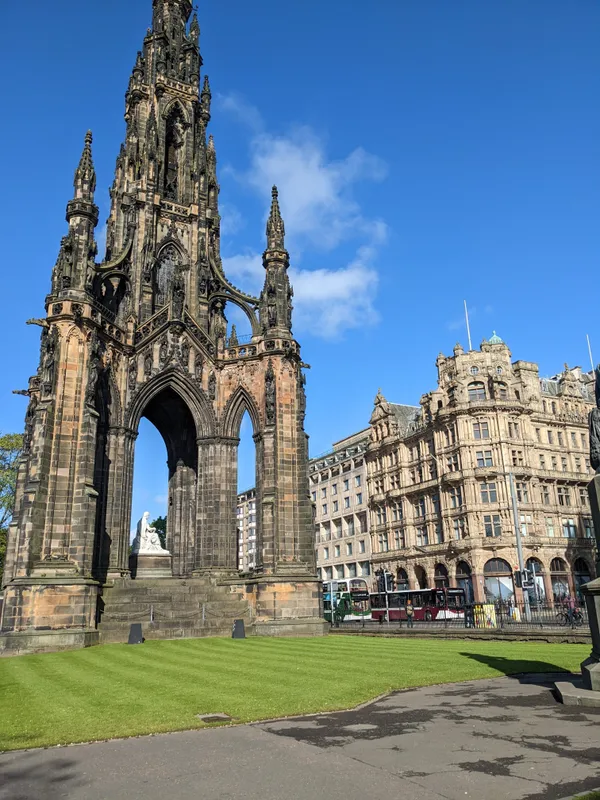
The ground-floor museum room covers Scott's life and legacy and the story of building the monument itself — a good option if you'd rather skip the climb, or want context before you start it. At the base sits the monument's centrepiece: a seated statue of Sir Walter Scott with his dog Maida, carved by Sir John Steell from a single 30-ton block of Carrara marble, a job that took the sculptor six years.
The monument was designed by George Meikle Kemp in the Victorian Gothic style and built between 1840 and 1844. Kemp never saw it finished — he drowned in the Union Canal in March 1844 — and it officially opened to the public on 15 August 1846, Scott's own birthday. At 61 metres, it's genuinely one of the largest monuments ever built to a writer anywhere in the world (Havana's José Martí Memorial is the only one bigger).
For more of Scott's own belongings, The Writers' Museum — a short 7-minute walk from the monument — holds a dedicated display with original artefacts, and is free to visit.
── accessibility
Getting around: the honest version
This one deserves a plain answer rather than a hedge: the Scott Monument is accessible by stairs only. There is no lift at any point above ground level, on the operator's own account of the building — a direct result of it being a load-bearing 19th-century stone spire, not a design choice that could easily be retrofitted.
Step-free access reaches Princes Street Gardens and the ground-floor entrance desk and museum room — so the history and the statue are genuinely accessible without climbing a step — but the climb itself, all 287 steps and all four platforms, is not. Some parts of the interior also have low lighting, worth knowing if that affects you.
A complimentary ticket is available for a personal assistant accompanying a visitor who needs one — ask a member of the team on arrival rather than assuming you'll need to pay twice.
── the verdict
Is climbing the Scott Monument worth it?
Yes, with an honest caveat. At £9 for roughly 30-45 minutes, it's one of the cheaper paid viewpoints in the city, and the vantage point — inside a Gothic landmark rather than on a hilltop — is genuinely different from anything else on the best views list. Reviewers back that up: a 4.7 average across more than 7,800 Google ratings, with the panoramic views and the architecture the most repeated praise. As one reviewer put it after booking the climb: 'Lots of stairs, so definitely not for people with mobility issues' — which is really the whole trade-off in one line.
Skip it, or stop at a lower platform, if narrow enclosed stairwells genuinely aren't for you — there's no shame in that, and the museum room at the base still gets you the history for free once you're inside. For most people who are reasonably comfortable on stairs, it's a worthwhile 30-45 minutes, especially paired with a wider look around the New Town or a stop in Princes Street Gardens either side of the climb.
More Edinburgh guides
The Scott Monument also shows up as a photo subject — the spire itself, not the view from inside it — in our Edinburgh Instagram spots guide. For the wider New Town it sits in, with George Street, the galleries and where to eat, see our New Town guide. For the full spread of things to see in the city, start with things to do in Edinburgh or our pick of free things to do in Edinburgh, which covers the gardens the monument stands in.
Planning your trip? Save the Scott Monument and everything else in this guide into a day-by-day plan with Tourli, the app that turns travel guides into actionable itineraries.