── tickets · 2026 prices
Admission: what it costs
Adult: £22 booked online in advance, £26 at the gate, per Royal Collection Trust's own pricing as I checked it against rct.uk on 14 August 2026 while researching a companion Tourli itinerary guide. Child, concession and family rates are all published on rct.uk's own booking page. I'd confirm the exact current figures there directly before you book: rct.uk blocked a fresh automated re-check on my most recent pass, and I'd rather send you to the primary source than guess at numbers I can't stand behind today.
One thing worth asking about at the desk, though I couldn't independently confirm it's still current for 2026: Royal Collection Trust sites have historically let you convert your ticket into a free 1-Year Pass by opting into Gift Aid, letting you return within the year at no extra charge. I know this from RCT's general ticketing pattern rather than a fresh check against rct.uk today, so treat it as a question worth asking the ticket desk, not a guaranteed current perk, and check rct.uk's own ticket page if it matters to your plans.
The King's Gallery, showing changing Royal Collection exhibitions in a separate building at the palace's western entrance, is a separate ticket, not included in Palace admission. It's the smaller, more specialist half of a Holyroodhouse day: Google rates it 4.4 across roughly 700 reviews, against the Palace's own 4.6 across more than 23,000.
── opening hours · the Royal Week gotcha
Hours, and the closure most guides bury
As of my 29 August 2026 check, the live listing sourced from RCT shows the Palace open daily 9:30am-6pm, which reads as the summer schedule. Royal palaces of this kind typically run shorter winter hours with an earlier last entry, so if you're planning a Nov-Mar visit, confirm the exact current winter times on rct.uk rather than assuming the summer hours above carry over.
The closure that actually catches people out isn't seasonal, it's royal. The Palace of Holyroodhouse is a genuinely working residence, and it shuts to the public for Royal Week, usually the last week of June or the first week of July, while King Charles III is in official residence in Edinburgh. It can also close at short notice, outside that window, for state visits and official functions. This isn't a rare edge case: it's the one detail that separates a smooth visit from an arrived-and-turned-away one, and it's the single most common mistake I see in guides to this place. Check rct.uk's own opening calendar for your specific travel dates before you build a day around Holyroodhouse, especially if you're travelling in late June or early July.
How long to spend: budget 1.5 to 2 hours for the State Apartments and Holyrood Abbey ruins if you take the included audio guide, which is genuinely worth having rather than skipping. Add 45-60 minutes on top if you're also doing the King's Gallery, since it's a separate building on a separate ticket.
── inside the palace
What's actually worth seeing
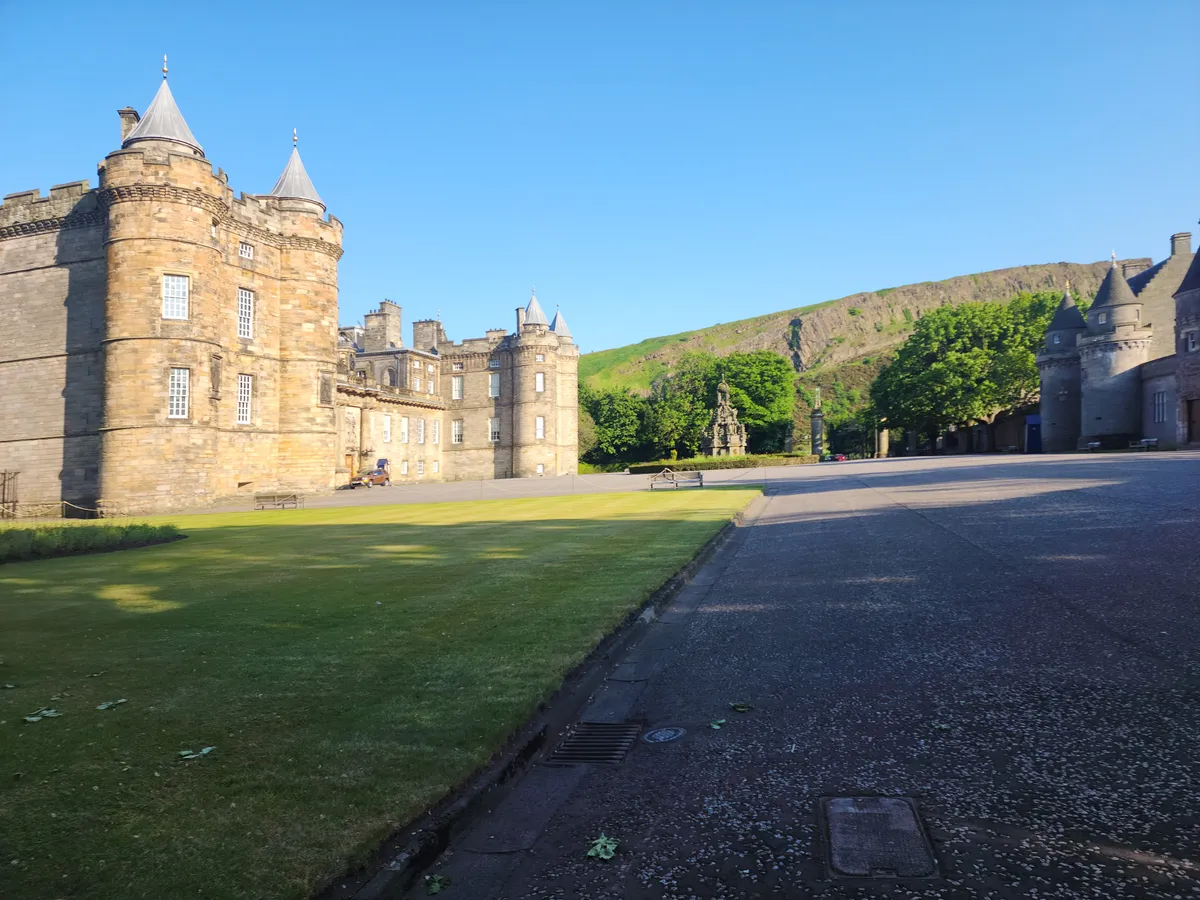
The Palace reads less like a single grand hall and more like a run of distinct rooms each carrying its own piece of the story, and it's worth knowing which ones earn a slower look.
The State Apartments are the working ceremonial rooms, still used for official functions when the King is in Scotland: state dining rooms, drawing rooms and the throne room, laid out much as they'd be for a real royal occasion rather than frozen as a museum set.
Mary Queen of Scots' historic apartments, up a narrow spiral stair in James V's Tower, are the most atmospheric rooms in the building. This is where she lived through the mid-1560s, and where, in March 1566, a group led by her husband Lord Darnley murdered her secretary David Rizzio in front of her, in rooms you can still walk through today.
The Great Gallery is the palace's largest room, lined with portraits of (mostly legendary or invented) Scottish monarchs commissioned by Charles II in the 1680s to assert an unbroken royal lineage. It's also where formal receptions and investitures still happen.
Holyrood Abbey, the roofless ruin behind the palace, is what's left of the abbey David I founded here in 1128. It fell into disrepair after the roof collapsed in 1768, and what remains, bare stone arches open to the sky, is genuinely one of the most atmospheric spots in the city. Don't skip it because it looks like an afterthought from the palace exit; it's the opposite.
The Palace Gardens, opened up to visitors as part of the wider grounds, sit behind the Abbey ruins with Arthur's Seat rising directly behind them, and they're worth the extra ten minutes if the weather's holding.
── the king's gallery
The King's Gallery: worth adding, but a separate visit
Right at the palace's western entrance, The King's Gallery is a purpose-built exhibition space showing changing displays from the Royal Collection, art, drawings, jewellery and objects that rotate rather than a fixed permanent display like the Palace's own rooms. It's a separate ticket, so decide before you arrive whether you're doing one or both.
Treat it as an add-on rather than a must: Google's own numbers back that up, at 4.4 stars across roughly 700 reviews versus the Palace's 4.6 across more than 23,000. If the current exhibition happens to be one you care about, it's a worthwhile 45-60 minutes; if not, the Palace and Abbey ruins alone are the fuller, higher-rated half of the visit.
── accessibility
Getting around: the honest version
The State Apartments and the Great Gallery, on the main level, are step-free. The genuine limitation is Mary Queen of Scots' historic chambers, reached only by a narrow spiral staircase at the top of James V's Tower with no lift alternative, so that specific part of the visit isn't accessible to wheelchair users or anyone who can't manage a tight, winding stair.
One limit worth stating plainly: the Royal Collection Trust's site blocks re-checking, so there's no way to confirm RCT's full current accessibility policy, parking or assistance arrangements against the primary source today. If accessibility is a firm requirement for your visit, call the Palace directly or check rct.uk's access page before you book, rather than relying on this paragraph alone.
── the verdict
Is the Palace of Holyroodhouse worth it?
Yes, with the honest caveat that it's a different kind of visit to Edinburgh Castle, not a smaller version of the same one. The Castle is a 900-year fortress you can spend half a day in; Holyroodhouse is a tighter, more intimate 1.5-2 hour visit built around one continuous royal story, from a medieval abbey through Mary Queen of Scots' murdered secretary to a palace the King still actually uses. A 4.6-star average across more than 23,000 reviews isn't why you should go, but it's a reasonable sign that people who make the stop don't regret it.
The one thing that can turn a good visit into a wasted trip is the Royal Week closure, so that's the one fact worth checking before anything else: confirm on rct.uk's own calendar that the Palace is actually open on your travel dates, especially if you're in Edinburgh in late June or early July.
Practically: it sits right at the bottom of the Royal Mile, an easy downhill walk from the Castle, with the Old Town closes and wynds passing on either side the whole way down. Pair it with a climb up Arthur's Seat directly behind it, or fold it into a fuller day using things to do in Edinburgh or our best museums guide, which covers what else is worth seeing nearby.
More Edinburgh guides
For the full length of street this palace sits at the end of, see our Royal Mile guide, walked top to bottom from the Castle. For the wider medieval district around it, our Old Town guide covers the closes, restaurants and pubs properly. For the city's fuller spread of sights, start with things to do in Edinburgh or our best museums guide, and if you're squeezing Holyroodhouse into a single day, our one day in Edinburgh itinerary shows where it fits.
Planning your trip? Save the Palace and everything around it into a day-by-day plan with Tourli, the app that turns travel guides into actionable itineraries.