The Witches' Well
Castlehill, Royal Mile, Edinburgh EH1 2ND, UK
Price: Free Hours: Always visible; outdoor wall fixture
Access: Street-level, step-free
15 Edinburgh spots I'd actually call hidden: verified against the source, not just labelled 'secret'. A locked Victorian tower, a tidal island, a free poetry library most Royal Mile visitors walk straight past, and where each one has a real catch.

Most 'hidden gems Edinburgh' lists aren't hidden at all. Dean Village, Circus Lane, Victoria Street: gorgeous, real, and so heavily photographed they're arguably mainstream now. This list is narrower on purpose. Every entry below is something I checked against a genuine source rather than repeating whatever a blog said, and I dropped anything that turned out to be closed, unbookable, or simply unconfirmable. Two candidates I researched, Gilmerton Cove and the Secret Herb Garden, are both currently shut, one permanently, and neither made the cut. That's the trade-off with a list this specific: fewer padded entries, more that are actually true and actually open.
This is deliberately not our things to do in Edinburgh guide, which owns the Castle, Arthur's Seat and the other marquee sights, and it's not our free things to do in Edinburgh guide either, which covers Calton Hill, the National Museum and the big free-to-enter names. A couple of these do sit near places in those guides, because Edinburgh isn't that big, but nothing here is a repeat: every pick below is something I'd genuinely expect a first-time visitor, or most Edinburgh residents for that matter, to have never heard of.
I've grouped these by area: Old Town, the Royal Mile and Calton Hill first, then Stockbridge and Dean, then south to Duddingston, then out to the western edge of the city where four of the best ones are clustered within a couple of miles of each other. String two or three together on foot where they're close, and budget a whole afternoon, or a car, for the western group.
Thousands of people walk past the Witches' Well every day without noticing it. It's a small bronze wall fountain on Castlehill, right at the top of the Royal Mile by the Castle Esplanade, commissioned in 1894 by the town planner Sir Patrick Geddes and designed by his friend John Duncan. The spout doesn't run any more, but the relief is worth stopping for: a foxglove, a serpent coiled round the heads of Hygieia and Asclepius, and an evil eye symbol, with the numerals 1479 and 1722 marking the span of Scotland's worst period of witch persecution. It's a memorial to the roughly 300 people, mostly women, executed for witchcraft near this spot.
It's free, step-free, and visible any time of day, so there's no planning required, just look for it on the wall as you approach the Castle from the Lawnmarket. Pair it with the Vennel below for a five-minute detour that most Castle-bound crowds skip entirely.
The Vennel is a steep, narrow flight of steps off the Grassmarket, easy to miss unless you know to look for the gap between the buildings. Climb it and you're walking alongside a genuine 17.2-metre stretch of the old Flodden and Telfer town wall, complete with crosslet gunloops and a 19th-century window punched through later. It's a scheduled monument, not a rebuilt or themed version, and locals treat the top of the steps as one of the better places to catch the Castle without fighting the crowds on the Esplanade itself for a photo.
It's free and always accessible, but it is steps, not a ramp, so it's not an option if you need step-free access. Give it two or three minutes each way. The lane connects through to Lauriston Place, so it also works as a shortcut if you're heading toward the Meadows.
Down Crichton's Close off the Canongate, a two-minute walk from the Scottish Parliament, the Scottish Poetry Library is free, quiet, and almost never on a first-timer's list. Inside there's free workspace, an accessible entrance, and a collection that spans English, Scots, Gaelic, Shetlandic and BSL poetry, with more than 3,000 poems browsable online by language, mood, occasion and place if you want to dig in before you visit.
The honest catch: it only opens Monday to Thursday, 10am to 3pm, and is closed Friday through Sunday, so this isn't a weekend rescue plan if it's raining on a Saturday. Time a weekday visit around the Royal Mile and you'll have a genuinely calm half hour that costs nothing.
Everyone photographs Calton Hill's monuments from the ground. Almost nobody realises the Nelson Monument itself, the 32-metre tower shaped like an upturned telescope, is open to climb. It's 143 steps up a spiral staircase to a viewing gallery above the other monuments, and along the way there's a small exhibition on Charles Piazzi Smyth, the Astronomer Royal for Scotland who rigged the tower's time ball, still dropped at 1pm daily, to fire in sync with the One O'Clock Gun at the Castle.
It's open 7 days a week, 10am to 3:30pm. There's a small entry fee, but I couldn't pin down the exact current price from the official page when I checked, so confirm it at cultureedinburgh.com before you go rather than trusting a number here. Not wheelchair accessible, given the spiral stairs.
Old Calton Burial Ground sits just off Waterloo Place, a few minutes from the Nelson Monument, and most tourists never go in. David Hume is buried here, in a cylindrical mausoleum designed by Robert Adam that reportedly needed eight days of guarding after his death because of public hostility to his atheism. The American Civil War Memorial, with Abraham Lincoln and a freed slave in bronze, is the only monument to that war outside the United States and the first US presidential statue erected abroad.
It's free, publicly accessible, and Category A listed, managed by the council. The paths slope with the hill, so it's not confirmed step-free throughout. If you only have five minutes, the Hume mausoleum and the Lincoln memorial are the two to find.
People walk past Old College on South Bridge every day and never clock that the University of Edinburgh runs a free contemporary art gallery inside it. Talbot Rice Gallery changes its exhibitions regularly, runs sensory-friendly mornings for visitors who need them, and doesn't charge admission. When I checked, an exhibition called Anne Hardy was showing, running through 27 September 2026, so whatever's up when you visit will likely be different.
Hours run roughly 10am to 5pm, but the exact open days shift month to month, so check before you go rather than assuming daily opening. One real catch right now: the lift to the upper floors is out of service while it's replaced, no end date given, so anyone needing lift access should check ahead.
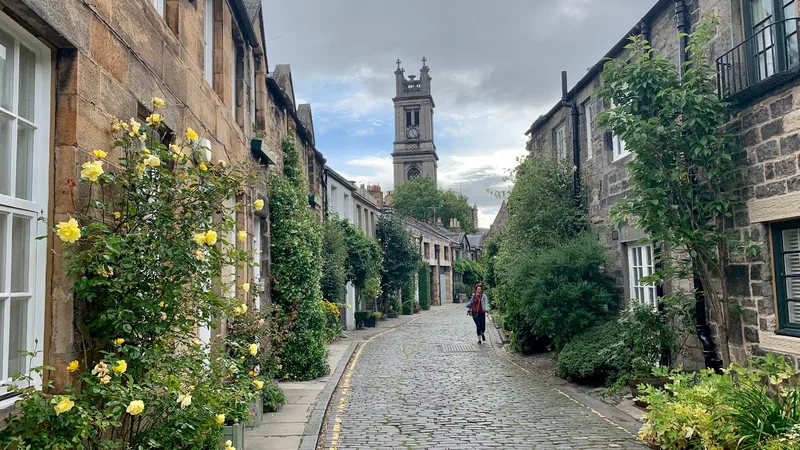
Circus Lane is the cobbled mews street in Stockbridge that shows up on every Edinburgh Instagram account, and I'm including it here because it's still genuinely easy for a first-time visitor to miss, tucked behind Circus Place with no obvious signage pointing to it. Converted Georgian stable buildings, ivy-covered walls, and a quiet, almost village-like feel a five-minute walk from the busier Stockbridge streets.
The one thing every version of this list should say and most don't: people actually live here. It's a residential street, not an attraction, so keep it quiet, don't block doorways for photos, and treat it the way you'd want a stranger to treat your own street.
Dean Cemetery, just north of Dean Village, is one of Edinburgh's best-kept Victorian Gothic spaces, and almost nobody visiting Dean Village itself walks the extra few minutes to see it. It's privately owned by the Dean Cemetery Trust, with graves and monuments by sculptors including Steell, Brodie and Frampton. Notable burials include the photography pioneer David Octavius Hill, the traveller and Royal Geographical Society Fellow Isabella Bird, and the pioneering doctor Elsie Inglis.
It's free to enter, with a main gate on the east side and a quieter route in from Ravelston Terrace. Thirty-nine Commonwealth war graves are maintained here by the CWGC. The grounds aren't confirmed step-free throughout, so expect gravel paths and some uneven ground.
Dr Neil's Garden sits on the shore of Duddingston Loch, next to one of Scotland's oldest churches, and it's far enough south that most visitors doing a standard Edinburgh itinerary never make it here. It's a genuine hidden find: a free, volunteer-run walled garden with a Physic Garden and Thomson's Tower, run by the Dr Neil's Garden Trust with National Lottery Community Fund support, and it hosts workshops and craft exhibitions through the year.
Open daily, 10am to dusk, free with donations welcomed. Pair it with the Innocent Railway Tunnel below: it's a short, flat walk between the two, so you can turn a single trip south into a proper afternoon away from the Old Town crowds.
The Innocent Railway Tunnel is a genuine piece of railway history hiding as a cycle path. At 518 metres, it's Scotland's earliest tunnel on a public railway, built between 1827 and 1830, bored through volcanic rock and lined with Craigleith sandstone. It got its nickname because the line stayed horse-drawn in an era that thought steam engines were dangerous, not because it was safer in practice; there were fatalities.
It's permanently lit, free, and in constant use, connecting Duddingston, Niddrie and Craigmillar in the east to Newington and St Leonard's near the centre. Flat and surfaced throughout, so it's an easy add-on to a Dr Neil's Garden visit or a straightforward way to walk or cycle south without dealing with traffic.
The Colinton Tunnel is Scotland's largest historical mural, painted along 140 metres of a disused railway tunnel on the old Balerno branch line, linking Colinton Village to Craiglockhart Dell. Local artist Chris Rutterford led the project for the charity The Colinton Tunnel, finishing in summer 2021 after starting in 2019 and working through Covid delays and winter weather stoppages. The whole thing illustrates Robert Louis Stevenson's poem 'From a Railway Carriage', chosen because Stevenson spent childhood summers in Colinton visiting his grandfather, the parish minister.
It's free and part of the Water of Leith walking route, funded in part by Sustrans, the Armed Forces Covenant and the Turtleton Trust, and the charity relies on roughly £7,500 a year in donations to keep it maintained. Worth building a whole afternoon around if you're doing the Colinton stretch of the Water of Leith Walkway anyway.
This is the sharpest catch on the whole list. Corstorphine Hill Tower, a Victorian folly with views toward the Pentlands and the Forth, is only unlocked by Friends of Corstorphine Hill volunteers on Sunday afternoons, 2pm to 4pm, from May to the end of September, weather permitting. Turn up on a Tuesday, or in November, and you'll find a locked door at the bottom of a 100-step spiral staircase.
Entry is free, donations go toward upkeep, and the council owns the land the tower sits on. Sturdy footwear matters: the climb up is a proper spiral stair, and the woodland approach paths from Clermiston Road or Kaimes Road aren't paved. If you're only ever in Edinburgh on a Sunday afternoon in summer, this is one of the few genuinely locals-only spots you can actually get into.
Cammo Estate is a semi-wild council-run nature reserve on Edinburgh's western fringe, the kind of place where you can walk for twenty minutes and not see another tourist, or often anyone else at all on a weekday. It's genuinely open 24 hours and completely free, which is unusual for a former estate this size.
There's no cafe, no gift shop, no signage pushing you toward a specific route: just paths through what used to be a country estate. Wear proper shoes, the ground is uneven in places and there are no facilities on site. It pairs naturally with Cramond Island and Lauriston Castle below if you're spending an afternoon on this side of the city.
Lauriston Castle overlooks the Firth of Forth near Cramond, and most visitors to Edinburgh have never heard of it, let alone visited. The grounds are free and open all year round: proper parkland, good for a slow walk regardless of whether you go inside. The castle interior is a different matter. You can only see it on a booked guided tour, and 2026 marks the centenary of the castle being left to the nation, with a 1920s-themed events programme running through October.
One honest gap: I couldn't find the exact current tour price on the official page, so book online at cultureedinburgh.com and check the figure there rather than trusting a number here. The grounds alone are worth the trip even if you skip the tour.
Cramond Island is a genuine adventure rather than a quick photo stop: a tidal island reached by a causeway lined with WWII anti-boat concrete pylons, about a mile offshore from Cramond village. It's free, and the walk itself, past the wartime defences, is half the reason to go.
The catch is real, not decorative: coastguards recommend crossing only within roughly two hours either side of low tide, and people genuinely get stranded here and need rescuing by the RNLI when they misjudge it. Don't guess the timing from this article. Check RNLI Queensferry's published crossing times for the actual day you're going, and turn back with margin to spare. It's uneven underfoot and not an option for anyone needing step-free access.
Old Town in one loop: Start at the Witches' Well on Castlehill, detour down the Vennel steps for the Castle view and the wall fragment, then walk down to the Scottish Poetry Library on Crichton's Close (weekdays before 3pm only). Finish with Talbot Rice Gallery on South Bridge, a five-minute walk from the Poetry Library.
Calton Hill add-on: If you're already walking up Calton Hill for the view, budget an extra 30-45 minutes to actually climb the Nelson Monument and walk through Old Calton Burial Ground on the way. Both sit within a couple of minutes of each other near Waterloo Place.
South of the centre: Dr Neil's Garden and the Innocent Railway Tunnel are a short, flat walk apart in Duddingston. Combine them with a visit to Holyrood Park if you're already south of the Old Town.
The western cluster: Colinton Tunnel, Corstorphine Hill Tower, Cammo Estate, Lauriston Castle and Cramond Island are all on the western half of the city, within a few miles of each other but genuinely spread out. This is the one group worth a car or a half-day of buses rather than trying to walk between all five. Corstorphine Hill Tower only unlocks Sunday afternoons in summer, so plan around that if it's the priority.
Stockbridge detour: Circus Lane and Dean Cemetery both sit a short walk from Stockbridge's main streets. Pair them with our Stockbridge guide for cafes and shops in between.
Planning your trip to Edinburgh? Save these places to your itinerary with Tourli, the app that turns travel guides into actionable day plans.
Stop reading lists.
Start the trip.
Tourli turns any guide into an actionable day plan — pinned to a map, walking directions and offline access included. One tap to save every place on this page.