Greyfriars Bobby, Edinburgh: The Complete Visitor's Guide (2026)
Greyfriars Bobby, Edinburgh: the well-documented facts and the genuinely disputed folklore behind the loyal terrier, the 1873 statue on Candlemaker Row (and why you shouldn't rub his nose), his real grave inside the kirkyard, John Gray's grave nearby, the locked Covenanters' Prison, and Bobby's Bar across the street. Free to see, about 30 minutes.
I travel, research, and write every Tourli guide myself.
3
places
4.6
avg Google rating
Edinburgh
Scotland
── greyfriars bobby · the complete guide
Greyfriars Bobby The dog, the statue, the grave, and what's actually true
Greyfriars Bobby is Edinburgh's most famous dog, and one of its smallest, most photographed monuments: a bronze Skye Terrier standing guard on a granite drinking fountain at the corner of Candlemaker Row. The popular version of the story is simple and devastating - a loyal terrier sat by his master's grave for fourteen years until his own death in 1872. The real version, once you start checking it against the historical record, is messier and more interesting: parts of it are genuinely documented, parts of it are folklore that's been retold as fact for a century and a half, and at least one respected historian has made a serious case that key details don't add up. This guide gives you both - the honest version of the legend, and the practical details for the statue, the grave, the kirkyard around it, and the pub named after him.
It's a five-minute stop if you're rushing, or thirty if you do it properly, and it sits right at the southern edge of the Old Town, an easy add-on to a wider walk - well worth folding into a fuller look at our things to do in Edinburgh guide. The same kirkyard behind the statue is also where several gravestones lend their surnames to Harry Potter characters, a connection covered in full in our Harry Potter in Edinburgh guide rather than repeated here. I checked the story against Wikipedia's own Greyfriars Bobby and Greyfriars Kirkyard entries, Greyfriars Kirk's official site, and live visitor reviews on all three venues below, on 29 August 2026.
1
Greyfriars Bobby Statue
The statue: 1873, William Brodie, and a fountain most people never notice is a fountain
A year after Bobby's death in January 1872, the philanthropist Baroness Angela Burdett-Coutts commissioned the sculptor William Brodie to cast a small bronze likeness of the terrier, mounted on top of a granite drinking fountain, at the junction of Candlemaker Row and George IV Bridge. It's widely described as Edinburgh's smallest listed monument - easy to miss if you're not looking for it, and easy to have entirely to yourself early in the morning before the tour groups arrive.
The one thing worth actually doing something about: don't rub his nose. It's become a habit for a lot of visitors chasing a bit of luck, but it's visibly eroding the bronze, and it isn't even an old tradition tied to Bobby's original story - it's a newer bit of tourist folklore that's outpaced the statue's ability to survive it. Several recent Google reviewers have said so directly, on the statue's own listing, unprompted. Take the photo instead.
attraction · Old Town & Royal Mile
Greyfriars Bobby Statue
4.7Google(2,928) 5-10 mins for the statue alone
Corner of Candlemaker Row & George IV Bridge, Edinburgh EH1 2QQ, UK
Price: FreeHours: Always accessible - a public street monument with no gates
Access: Street-level and step-free; a pavement monument with no barriers
Edinburgh's smallest listed monument, and one of its most photographed
A genuinely touching story, even once you know the disputed parts
Free, unfenced, and two minutes from Greyfriars Kirkyard and the National Museum
Tip
Take the photo, skip the nose - it's visibly wearing the bronze down, and several recent Google reviewers have flagged it directly.
It might be a "luck" thing, but it has damaged the statue over time, and this little legend deserves to be preserved. from a visitor review
2
Greyfriars Kirkyard
The kirkyard: two real graves, a locked prison, and more history than the dog alone
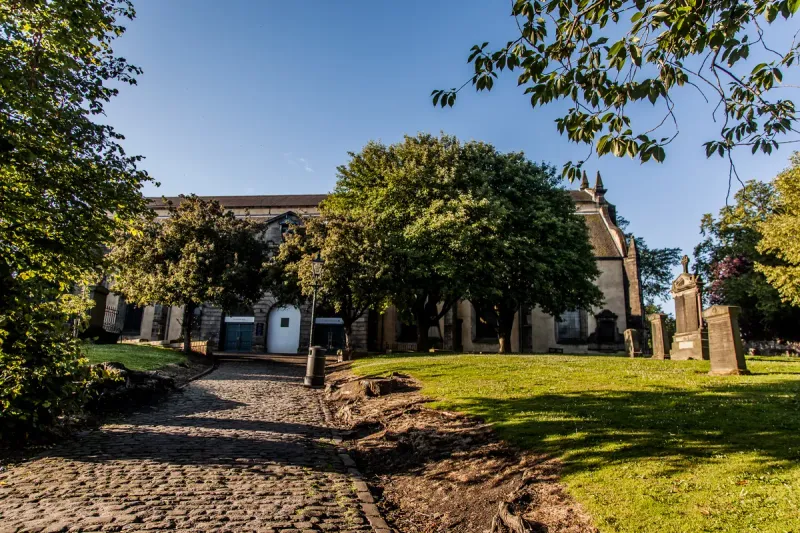
Bobby's own headstone sits just inside the main gate nearest the statue - a small pink granite marker, added only in 1981 by the Dog Aid Society of Scotland, reading 'Let his loyalty and devotion be a lesson to us all.' It's a comparatively recent addition; for over a century after Bobby's death, there was no marker there at all, and some accounts place his actual burial spot slightly differently, under a tree just outside the current gate. John Gray's own grave is a couple of minutes further in, on the eastern path roughly 30 metres north of the entrance - and per Wikipedia's own account, that headstone is a modern one too, replacing what was originally an unmarked grave.
The kirkyard is worth the extra twenty minutes even if you couldn't care less about the dog. Greyfriars Kirk itself, built between 1602 and 1620, is where the National Covenant was signed in 1638, a defining moment in Scottish religious and political history. At the back, the walled Covenanters' Prison enclosure held around 1,200 Presbyterian prisoners after the Battle of Bothwell Bridge in 1679, in famously brutal conditions - it was open to public view until around 1990, but is locked today after past vandalism; you'll see it through the railings on a free wander, or get inside on City of the Dead's after-dark ghost tour, which also covers the Mackenzie Poltergeist reputation attached to the same corner of the kirkyard. And if you're a Harry Potter fan, the grave of Thomas Riddell and a scatter of other surnames that echo in the books - a McGonagall among them - are a short walk from Bobby's own grave; our dedicated Harry Potter in Edinburgh guide has the full route and the honest caveat about how much of that connection Rowling has actually confirmed, and how much is the fandom's own detective work.
attraction · Old Town & Royal Mile
Greyfriars Kirkyard
4.7Google(2,133) 15-30 mins to find both graves and wander
Greyfriars Place, Edinburgh EH1 2QQ, UK
Price: FreeHours: Kirkyard open 24 hours, 365 days a year (per greyfriarskirk.com); the Kirk building and Kirk Museum keep their own shorter daytime hours - check ahead if you want to go inside the church itself
Access: Level access and toilet facilities in the Kirk itself, per Greyfriars Kirk; some Kirkyard paths are historic cobble or grass and can be uneven
Bobby's own grave and John Gray's grave, a short walk apart
The National Covenant was signed inside the Kirk in 1638
The locked Covenanters' Prison, where history and ghost-tour lore meet
Tip
Enter by the gate nearest the statue on Candlemaker Row. Bobby's headstone is a couple of minutes in, just off the main path; John Gray's grave is on the eastern path, about 30 metres north of the entrance.
Of course, the main reason I came was to see the graves linked to McGonagall and Thomas Riddell, and both were absolutely worth it. from a visitor review
3
Greyfriars Bobby's Bar
Bobby's Bar: the obvious last stop
Greyfriars Bobby's Bar sits directly across Candlemaker Row from the statue, in a building that started life as a candle-making workshop - the source of the street's name. It's a proper pub rather than a themed tourist trap: cask ales, a solid pub-food menu (a steak and ale pie gets repeat praise in reviews), and a genuinely warm atmosphere, with the caveat that seating inside is limited and can get tight when it's busy. It's part of the Nicholson's chain, open from 11am daily, later at weekends, and it's the natural place to sit down once you've done the statue and the kirkyard - close the loop with a pint rather than just the photo.
pub · Old Town & Royal Mile
Greyfriars Bobby's Bar
4.4Google(5,490) As long as your pint takes
30-34 Candlemaker Row, Edinburgh EH1 2QE, UK
Price: No entry fee - standard pub menu pricingHours: Mon-Thu & Sun 11am-midnight; Fri-Sat 11am-1am
Access: No published accessibility information, and the operator's site does not load. A few reviewers note seating inside is limited and can get tight at busy times
The obvious, well-earned pint stop right opposite the statue
Cask ales and proper pub food, including a well-reviewed steak and ale pie
Part of the same small route as the statue and kirkyard, so it fits naturally at the end
Tip
It's directly across from the statue, in a building that was originally a candle-making workshop - which is where Candlemaker Row gets its name.
A busy, well-regarded Nicholson's pub with a strong food and drink reputation; reviewers flag good cask ales, solid pub food, and friendly service, alongside the odd note about tight seating at peak times.
── the legend · what's documented, what's disputed
Is the story actually true?
Some of it, certainly. A small terrier did live around Greyfriars Kirkyard in the 1860s and became well known enough locally to be written up in The Scotsman, and a man named John Gray genuinely is buried in the kirkyard. Where it gets murkier is almost everything else in the tidy version most visitors hear: whether Gray was a night watchman for the Edinburgh City Police, as the popular telling has it, or a Pentland Hills shepherd nicknamed 'Auld Jock', as some earlier accounts (including Wikipedia's own entry on the kirkyard itself, describing the same grave) put it. Sources have genuinely disagreed on this since at least 1889.
The historian Jan Bondeson has gone further, cataloguing more than sixty similar 'graveyard dog' stories from 19th-century Europe and arguing that Bobby was likely a stray who attached himself to visitors rather than one man's devoted companion, that press coverage of the story brought real commercial benefit to the local area, and - most strikingly - that the original dog may have died around 1867 and been quietly replaced with a younger one, which would explain how a single terrier apparently kept vigil for fourteen years. None of this is settled history either way, and it doesn't erase what's genuinely moving about the story. It just means the plaque, understandably, tells the simple version rather than the historian's footnoted one.
── the statue
The statue, the fountain, and the nose you shouldn't touch
The bronze on Candlemaker Row was unveiled in 1873, a year after Bobby died, commissioned by the philanthropist Baroness Angela Burdett-Coutts and sculpted by William Brodie, mounted on a granite drinking fountain rather than a plain plinth. It's a genuinely small monument - part of its charm - and it's free to see any time, with no gates and no set hours.
The one honest ask: stop rubbing his nose. It's not part of the original story or an old local custom - it's a habit that's spread among visitors chasing luck, and it's visibly wearing the bronze down. This isn't a vague travel-forum rumour; multiple recent Google reviewers on the statue's own listing have called it out directly and unprompted, including one who wrote plainly that 'it has damaged the statue over time, and this little legend deserves to be preserved.' Get the photo standing next to him instead.
── the graves
Bobby's grave and John Gray's grave
Both graves are inside Greyfriars Kirkyard, a short walk from each other. Bobby's small pink granite headstone sits just inside the main gate nearest the statue - but it's a comparatively modern addition, erected in 1981 by the Dog Aid Society of Scotland, more than a century after his death. Some historical accounts put his actual burial spot slightly differently, under a tree just outside the current gate rather than exactly at the marker.
John Gray's grave is a couple of minutes further in, on the eastern path roughly 30 metres north of the entrance. Like Bobby's, the headstone there is a modern one - the grave was originally unmarked, which is itself part of why so much about Gray's actual life (his job, even the precise dates) is harder to pin down than the legend suggests.
── greyfriars kirk & kirkyard
More than just the dog
Greyfriars Kirk was built between 1602 and 1620, with congregational worship first held there on Christmas Day 1620, and it holds a genuinely significant place in Scottish history well before Bobby ever entered the picture: the National Covenant, a defining document of 17th-century Scottish Presbyterianism, was signed inside the church in 1638.
At the back of the kirkyard, the walled Covenanters' Prison held roughly 1,200 Presbyterian prisoners after the Battle of Bothwell Bridge in 1679, in conditions that killed a significant number of them over that winter. It was open to public view until around 1990, but the council keeps it locked today after past vandalism - you'll see it through the railings on a free daytime visit, or arrange access with Greyfriars Kirk's own guides during opening hours. Don't go out of your way trying to get inside on your own; there's no way past the locked gate, and the railings view is enough to get the shape of the place. The only way properly in is after dark on City of the Dead's paid Haunted Graveyard Tour, which also covers the Mackenzie Poltergeist reputation attached to the same corner of the kirkyard - our Edinburgh ghost tours guide covers that route and what it's actually like in full.
── harry potter
The graveyard J.K. Rowling walked past
Greyfriars Kirkyard has a second, entirely separate claim to fame: a cluster of gravestones bearing surnames that show up in the Harry Potter books, most famously Thomas Riddell, who died in 1806 and is buried a short walk from Bobby's own grave. Rowling wrote much of the first book at cafes overlooking this kirkyard, and the surname overlap is genuinely striking - Rowling has said a name like Riddell's may have lodged in her subconscious, but she has never confirmed the grave itself as a deliberate source, and most of the wider surname-spotting here is the fandom's own detective work rather than something she's stated outright.
We've kept this section short deliberately, because it deserves its own proper treatment rather than a rushed paragraph here: our Harry Potter in Edinburgh guide covers Thomas Riddell's exact grave location, the other surnames worth spotting, and how it fits into a wider Potter walking route through the Old Town.
── bobby's bar
Where to go afterwards
Greyfriars Bobby's Bar sits directly across Candlemaker Row from the statue, in a building that was originally a candle-making workshop - the actual origin of the street's name, which a lot of visitors assume is a Bobby-era coincidence and isn't. It's a proper Nicholson's pub rather than a themed tourist stop: cask ales, a solid pub-food menu, and a steak and ale pie that gets repeat praise in reviews. Open from 11am daily (until 1am on Friday and Saturday), it's the natural place to finish once you've done the statue and the kirkyard, though seating inside is limited, so it can feel tight when it's busy.
── the verdict
How long it takes, and is it worth it
Yes, easily, and it costs nothing beyond whatever you spend at the pub afterwards. Budget five to ten minutes for the statue alone, or thirty if you also want to find both graves and read a couple of the kirkyard's information boards properly. Everything here - the statue, the kirkyard, John Gray's grave, Bobby's grave - is free, all year round, with no booking required.
It's a small, honest thing to see: a modest bronze, a small headstone, and a story that's more complicated up close than the postcard version suggests. That's not a knock against visiting - if anything, knowing which parts are documented and which parts are folklore makes the ten minutes in front of the statue more interesting, not less. Pair it with a wider look at the Old Town either side, since it sits right at the southern edge of that walk.
Planning your trip? Save Greyfriars Bobby and the rest of your stops to your itinerary with Tourli, the app that turns travel guides into actionable day plans.
── frequently asked
Frequently asked questions.
Is Greyfriars Bobby a true story?+−
Partly, and historians genuinely disagree about how much. What's documented: a small terrier lived around Greyfriars Kirkyard in the 1860s, a man named John Gray is buried there, and the dog became a beloved local fixture written up in The Scotsman. What's disputed: whether Gray was a night watchman (the popularly told version) or a Pentland Hills shepherd nicknamed 'Auld Jock' (an earlier account, and the one Wikipedia's own Greyfriars Kirkyard entry uses for the same grave), whether Bobby's 14-year vigil is accurate or embellished, and whether it was even one dog the whole time. The historian Jan Bondeson has documented over 60 similar 'graveyard dog' stories across 19th-century Europe and argues Bobby may have been a stray fed by kindly visitors rather than devoted to one master, and speculates the original dog may have died around 1867 and been quietly replaced. None of that makes the statue or the grave any less worth seeing; it just means the plaque tells a tidier story than the historical record does.
Where is the Greyfriars Bobby statue, and is it free to visit?+−
It's a small bronze on top of a granite drinking fountain, standing at the corner of Candlemaker Row and George IV Bridge, right by the entrance to Greyfriars Kirkyard. It's a public street monument with no gates, no ticket and no set hours - you can see it any time, day or night. It sits about a 10-minute walk from the Royal Mile and 2 minutes from the National Museum of Scotland.
Should you rub Greyfriars Bobby's nose for luck?+−
No - please don't, even though plenty of people still do. There's no evidence it does anything for your luck, and it is visibly wearing down the bronze. Multiple recent visitors have left reviews on the statue's own Google listing flagging the damage directly, including one who wrote, 'It might be a "luck" thing, but it has damaged the statue over time, and this little legend deserves to be preserved.' Take the photo, skip the touch.
Where is Greyfriars Bobby actually buried?+−
Just inside the main gate of Greyfriars Kirkyard, a couple of minutes' walk from the statue. His small pink granite headstone was only added in 1981, by the Dog Aid Society of Scotland, and reads: 'Let his loyalty and devotion be a lesson to us all.' Some historical accounts place his actual burial spot slightly differently, under a tree just outside the gate rather than exactly at the marker - a small reminder that even the physical grave carries some uncertainty.
Can you go into the Covenanters' Prison at Greyfriars Kirkyard?+−
Not on your own. The walled prison enclosure at the back of the kirkyard was open to the public until around 1990 but is now kept locked by the council after past vandalism. You can see it through the railings on a free daytime wander, arrange access with Greyfriars Kirk's own guides during opening hours, or get inside after dark exclusively on City of the Dead's paid Haunted Graveyard Tour - see our full guide to Edinburgh's ghost tours for that route.
Tourli turns any guide into an actionable day plan — pinned to a map, walking directions and offline access included. One tap to save every place on this page.