Start at the west end by the memorial garden for the best free, uncropped view up to the Castle, then work east along the square's south side, where all five of this guide's pubs sit within about 100m of each other.
The Grassmarket, Edinburgh: A Complete Guide (2026)
The Grassmarket walked properly: the square's genuinely old pubs and their gallows-and-survivor names, Mary's Milk Bar and Petit Paris, the shops at the foot of Victoria Street, and the walk up West Bow to Victoria Street's actual flagship cheesemonger, plus the honest history behind all of it.
The Grassmarket The square, Victoria Street and West Bow, and what's genuinely different about each
The Grassmarket is the long, cobbled square directly under Edinburgh Castle's south face, at the bottom of the hill Victoria Street curves down from, and the Old Town's real drinking quarter once the Royal Mile's crowds thin out. It's a distinct sub-area within the Old Town rather than the whole district: our Old Town guide covers the wider neighbourhood, and this one goes deep on just the square itself, Victoria Street above it, and West Bow, the curving connector between the two. If you're building a wider day around it, our things to do in Edinburgh guide has the city-wide picture.
Grass by name and by function: Edinburgh's council licensed it as the city's main market in 1477, and for more than four centuries it did exactly what the name says, livestock and horse trading, with the meat market only moving out to Tollcross in 1911. It has a darker half of that history too. Public executions were carried out here until 1764, and over a hundred Covenanters were hanged in the square between 1661 and 1688, a period known as the Killing Time. A memorial funded by public subscription in 1937 marks the spot at the square's west end, with the outline of the old gibbet set into the paving in dark stone. One of the square's own survivors gave a pub its name: Margaret 'Maggie' Dickson was hanged here in August 1724 for concealing a pregnancy, revived in her coffin on the way to burial, and lived another four decades as 'half-hangit Maggie'.
That history is why the square is still ringed with genuinely old pubs rather than modern bars, several of them making their own oldest-pub claims. Below is how I'd walk it: the square itself, its pubs, food and shops first, then the loop up West Bow onto Victoria Street for one of the street's actual working shops, not just the photogenic curve of it. One honest note before you start: by day this is a relaxed square of pubs, food and small shops; on a Friday or Saturday night it's a livelier, occasionally rowdier stretch, part of the Old Town's stag- and hen-party circuit. Plan accordingly.

Grassmarket
The Grassmarket is the square everything else in this guide sits around: a long, level cobbled rectangle running directly under the Castle's south face, licensed as Edinburgh's main market in 1477 and used for livestock and horse trading for more than four centuries, right up until the meat market finally moved out to Tollcross in 1911. It's flat where the rest of the Old Town is steep, which alone makes it worth knowing about if hills aren't your thing.
It's also where the city carried out public executions until 1764, more than a hundred Covenanters among them between 1661 and 1688. That history is covered properly, with the memorial and Maggie Dickson's own story, right after this; here it's enough to say the square's pubs and shops sit on genuinely old ground, not a themed re-creation of it. Best for orientation: stand at the west end, get your bearings against the Castle, then work the loop this guide follows.
Covenanters' Memorial
The Covenanters' Memorial, at the Grassmarket's west end, marks the spot where more than a hundred Covenanters, Presbyterians who refused to accept the king's authority over the church, were hanged between 1661 and 1688, a period Scottish history calls the Killing Time. The memorial itself is relatively recent, funded by public subscription and unveiled in 1937, and it's a quiet, understated marker rather than a dramatic one: the outline of the old gibbet is worked into the paving in dark stone.
Public hangings continued here until 1764, when the site moved to the Old Tolbooth and Lawnmarket further up the hill; one of the last, in 1775, was for sheep-stealing, and James Boswell, the condemned man's own advocate, reportedly considered attempting to have him resuscitated afterwards. It's free, always accessible, and worth the two minutes it takes to actually read the inscription rather than walk past it. Best for anyone who wants the real history behind the pub names on this list, not just the pub crawl.
It's a small, easy-to-miss marker rather than a monument you can't help but see; look for the darker paving stones shaped like a gibbet near the west end of the square.
The Last Drop
The Last Drop, on the Grassmarket's south side, takes its name directly from the square's history: it's a gallows pun, sitting more or less where the condemned would have had their last drink before their last drop. It's a Nicholson's-group pub rather than a one-off, which means a predictable, solid menu and reliable opening hours alongside the history.
It holds a strong 4.4 rating across more than 5,600 Google reviews, genuinely high for a pub this central and this tourist-facing. It's open long hours daily, 11am to midnight most nights, 1am Friday and Saturday, so it's a safe, no-planning-required stop rather than one you need to time carefully. Best for a first pint in the square with the history built into the name; skip it if you want something less obviously aimed at passing trade.
The name is the joke: it's a straight gallows pun, sitting more or less where the condemned would have had their last drink before their last drop. Order at the bar rather than waiting for table service if it's busy.
The White Hart Inn
The White Hart Inn makes the boldest historical claim on this list: Edinburgh's oldest continuously operating pub, dating to the early 18th century, with Robert Burns recorded as a guest in 1791 and William and Dorothy Wordsworth in 1803. Less flatteringly, Burke and Hare, the city's infamous body-snatching murderers, are also said to have drunk here in the late 1820s, before their crimes caught up with them.
It's a proper working pub rather than a museum piece, open long hours daily like its neighbours on the square, and it holds a 4.5 rating across more than 3,200 Google reviews. It has no dedicated official website, which is worth flagging rather than papering over, so treat opening hours as generally reliable rather than guaranteed and check on the day if you're planning around it. Best for pairing a pint with the single strongest history claim on the Grassmarket.
Whether the oldest-pub claim is literally, provably true is beside the point; it's old enough and atmospheric enough that the debate doesn't matter once you're inside.
Maggie Dicksons
Maggie Dicksons, at 92 Grassmarket, is named for the square's most famous survivor: Margaret 'Maggie' Dickson, hanged here in August 1724 for concealing a pregnancy, a capital offence at the time, who then revived in her coffin on the way to burial and lived another roughly 40 years as 'half-hangit Maggie'. It's one of the most direct ties between this list's pubs and the square's actual history, not just a name borrowed for atmosphere.
It's open long hours daily, holds a 4.1 rating across more than 1,600 Google reviews, and keeps 92 hand-selected whiskies behind the bar alongside live music and sports on the screens. The venue's own site claims a blanket 11am-1am close every night, though Google's live listing shows Monday to Thursday closing at midnight, so treat a late weeknight visit as worth double-checking. Best for the story as much as the pint; it's a livelier, more sports-and-music room than the Last Drop or White Hart next door.
Ask about the 92 whiskies on the shelf if the story alone isn't reason enough to stop; it's a genuinely deep list for a pub this size.
Biddy Mulligans
Biddy Mulligans, at 94-96 Grassmarket, is the Irish pub on this list: live music most nights from local bands, big screens for rugby, GAA, hurling and football, and a genuinely different atmosphere from the whisky-and-history pubs either side of it. It holds a 4.2 rating across nearly 3,900 Google reviews.
The standout practical detail is the hours: it opens at 8am and runs straight through to 1am, seven days a week, unusual on this square and a genuine option for an early coffee or breakfast rather than only an evening pint. Best for sport on the screens and live music later on; skip it if you specifically want the quieter, history-first pubs instead.
It opens at 8am, which is genuinely useful if you want a full Irish breakfast before the Castle rather than after.
Beehive Inn
The Beehive Inn, at 18-20 Grassmarket, rounds out the square's cluster of historic pubs, open long hours daily and holding a 4.2 rating across almost 3,500 Google reviews. It's the one pub on this list with no working official website, so the description here stays with what's independently confirmed rather than repeating unverified claims about its food or beer garden.
What's confirmed: the address, the long opening hours (11am to midnight most nights, extending to 1am Friday and 10am to 1am Saturday), and a rating that holds up well against its neighbours. Best for filling out an evening on the square once the Last Drop or White Hart are busy; if a beer garden or food menu matters to your visit, check its current Google listing before you go rather than assuming.
It publishes no menu or food hours, so call ahead or check its Google listing on the day if food is the plan rather than just a drink.
Mary's Milk Bar
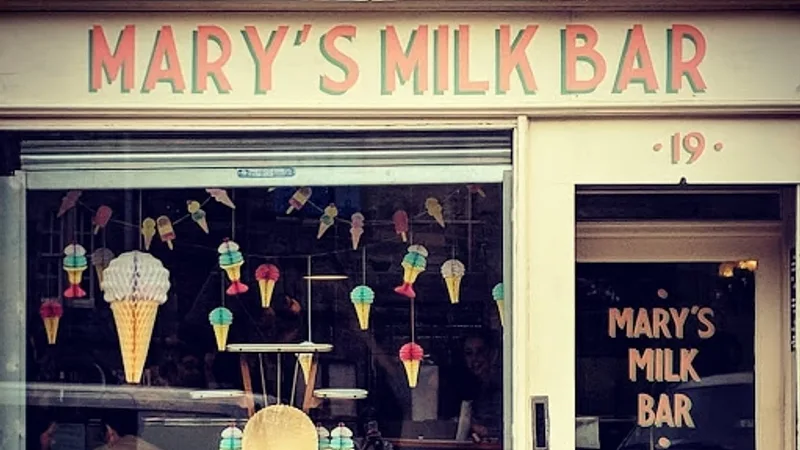
Mary's Milk Bar, at 19 Grassmarket, is the dessert stop on this list: a gelato and chocolate shop where the owner makes everything fresh each morning, with flavours that rotate daily and seasonally rather than staying fixed. It holds a genuinely excellent 4.7 rating across nearly 2,900 Google reviews, the highest of any food or drink venue in this guide.
The signature order is the Spaghetti Sundae, gelato pushed through a press into milk-ice-cream 'spaghetti' with cherries, breadcrumbs and white chocolate, served 11am to 6pm daily. It's closed Monday and Tuesday, and winter hours run 11am to 7:30pm Wednesday to Saturday and a shorter Sunday, so don't build a Monday plan around it. Best for the single best dessert stop on the whole square; check Instagram for the day's actual flavours before committing to a queue.

Check Instagram before you go, the gelato flavours rotate daily and the shop is closed Monday and Tuesday.
Petit Paris
Petit Paris, at 38-40 Grassmarket, is the proper sit-down dinner on this list: a French bistro doing classic dishes, tomato soup and mussels in blue cheese sauce among the starters, Scottish salmon and a grilled rib-eye on the mains, in a room that leans into its 'little corner of Paris' billing rather than doing a generic gastropub menu.
Go for the pre-theatre deal if the timing works: one main course and coffee for £14.90, or a full three courses with coffee for £20.90, available daily from noon to 7pm. À la carte, starters run £7.90-£11.90, mains £15.90-£26.90 and desserts £8.90-£10.90, with house wine from £5.90 a glass. It holds a 4.6 rating across more than 1,600 Google reviews, and bookings are required, with each table held for two hours. Best for a proper dinner without leaving the square; skip the pre-theatre window if you want a leisurely three-hour meal instead.
The pre-theatre menu (noon to 7pm daily) is the better deal by a distance: two courses and coffee for £20.90 against £15.90-£26.90 for mains alone à la carte.
Armstrongs Vintage
Armstrongs Vintage, at 81-83 Grassmarket right where the square meets the foot of Victoria Street, is the vintage clothing shop most Victoria Street write-ups are actually describing when they mention one 'at the foot of the street'. It holds a strong 4.6 rating across more than 700 Google reviews, and I'm keeping the description here honest about its limits: its own website carries no working detail on stock categories or founding history, so there are no unverified specifics repeated here.
What's confirmed directly: the address, and opening hours that run 10am to 5:30pm Monday to Thursday, 10am to 6pm Friday and Saturday, and a shorter noon to 6pm on Sunday. Best for a proper vintage-clothing browse on the way between the square and Victoria Street; if you want the specific backstory or stock detail, that's worth asking staff on the day rather than trusting a secondhand summary.
It's a genuine browse-for-an-hour shop rather than a five-minute stop; go in with time rather than a shopping list.
Bill Baber Knitwear
Bill Baber, at 66 Grassmarket, is a boutique Scottish knitwear maker that's been trading since 1977, and the thing that sets it apart from the generic tartan shops up on the Royal Mile is that the knitting happens on-site: natural fibres, linen, cotton, silk and merino wool, hand-knitted and finished in the workshop at the back of the shop, visible while you browse.
It holds the highest rating of any shop on this list, 4.8 across 62 Google reviews, a small sample but a genuinely strong score, and it's open 9am to 5:30pm Monday to Saturday, 11am to 4pm Sunday. The in-store range is wider than what's online, so it rewards an actual visit over browsing the website first. Best for a considered, genuinely made-in-Edinburgh purchase rather than a souvenir; it's priced accordingly, not a bargain rail.
The workshop at the back is genuinely working, not staged, so don't be surprised to see a garment you might buy still being knitted.
Dragonfly
Two minutes west of the square on West Port, in a converted fire station, and a considerable step up in drinks from the pubs on the Grassmarket itself. Dragonfly bills itself as Edinburgh's oldest cocktail bar and the room earns the billing: an unremarkable door opens into a double-height bar with chandeliers, a wall-length mirror and a mezzanine looking down on the whole thing. It's the right answer when you've done the historic pubs on the square, enjoyed them for what they are, and now want a drink somebody has thought about. Closed Mondays, open until 1am the rest of the week.
Closed on Mondays, which catches people out. The entrance is easy to walk past; it's the old fire station two minutes west of the square, so it works as the last stop of a Grassmarket evening rather than the first.
West Bow
West Bow is the short, curving street that connects the Grassmarket to the foot of Victoria Street, and it's worth walking slowly rather than treating as a corridor: it's where Major Thomas Weir, a 17th-century soldier known for his outward piety, lived until 1670, when he confessed to serious crimes, including incest and bestiality, and was executed by garrotting and burning.
His house stood empty for more than a hundred years afterwards on reports of hauntings, a walking stick topped with a carved head said to move through the streets on its own, and the top of West Bow was known as 'Major Weir's Land' for two centuries. The case has been proposed as a partial inspiration for Robert Louis Stevenson's Dr Jekyll and Mr Hyde. Best for the walk between the square and Victoria Street, and for knowing the story behind an otherwise unremarkable-looking corner.
Look up at the top of the street: this is the stretch once known as 'Major Weir's Land' for two centuries after his execution, avoided by locals long after the story should have faded.
I.J. Mellis (Victoria Street)
I.J. Mellis, at 30 Victoria Street, is the cheesemonger's actual flagship store, opened in 1993, and it's a different branch entirely from the shop covered in our Stockbridge guide: same counter of proper Scottish and continental cheese cut to order, but this is where the whole thing started.
It holds a strong rating across nearly 300 Google reviews and keeps consistent hours, 10am to 6pm most days, extending to 7pm Thursday and Friday. It sits on Victoria Street's upper, curved level, so it's worth the walk up from the Grassmarket via West Bow rather than a detour on its own. Best for actually buying something on Victoria Street rather than just photographing it; the street's shopfronts are colourful, but this is one of the few that's a genuine destination rather than a backdrop.
This is the original branch, not a franchise copy, worth knowing if you've been to the Stockbridge one and assumed that was the flagship.
Maison de Moggy
Maison de Moggy, Scotland's first cat cafe, is a short, flat five-minute walk from the Grassmarket down West Port, and it's worth being precise about the address here: it's on West Port, not Victoria Street, even though it gets folded into 'Grassmarket area' write-ups often enough that the exact location gets blurred. It holds a 4.5 rating across nearly 1,800 Google reviews.
Entry starts from £15 per person for a one-hour session, booking is required (the venue is explicit that it can't guarantee entry without one), and there's a minimum age of 10, with under-15s needing an accompanying adult. It's open 10am to 7pm daily for booked sessions. Best for a genuinely different hour away from pubs and shops if you're travelling with someone who'd rather spend it with cats; skip it if a booked, paid session isn't your idea of a spontaneous stop.
Book ahead online, walk-ins aren't guaranteed, and it's a booked hour session, not a casual coffee stop.
Market square to gallows: six centuries in one square
The Grassmarket's two identities, market and gallows, ran side by side for centuries rather than one replacing the other. Edinburgh's council licensed it as the city's main livestock and horse market in 1477, and it kept that function, formalised over time into a proper meat market, until the operation finally moved out to Tollcross in 1911. At the same time, from at least the 1660s, it was also the city's public execution site: more than a hundred Covenanters hanged here in the Killing Time of 1661-1688, and public hangings continuing until 1764, after which the site moved to the Old Tolbooth and Lawnmarket. The 1937 memorial at the square's west end, with the old gibbet's outline set into the paving, is the one physical marker of that half of the history.
Two of this square's pubs carry that history directly in their names: Maggie Dicksons, for the woman who survived her own 1724 hanging here, and The Last Drop, a straight pun on what stood in the square for over a century. The White Hart Inn's oldest-pub claim and its recorded guest list, Burns in 1791, the Wordsworths in 1803, add a different kind of history, literary rather than judicial. For the wider drinking scene beyond this square specifically, our best pubs and best bars guides cover Edinburgh more broadly.
Up through West Bow to Victoria Street
West Bow is the short, curving connector between the Grassmarket and Victoria Street, and it's worth walking slowly rather than treating as a corridor: it's where Major Thomas Weir, the 'Wizard of the West Bow', lived until his 1670 execution for confessed crimes including incest and bestiality, after which his house stood empty for over a century on reports of hauntings. The top of the street was known as 'Major Weir's Land' for two centuries afterwards, a reputation locals took seriously long after the story should have faded.
Victoria Street itself, the curved, two-tier, brightly painted run of shops above West Bow, gets covered as a photo stop in our Old Town guide, including its unofficial Diagon Alley association and the wizarding-merchandise shops leaning into it (our Harry Potter guide has the full case for that comparison). This guide's addition is I.J. Mellis's flagship cheese shop, the street's actual founding retail tenant from 1993, worth stopping at rather than just photographing the street it sits on. The Bow Bar, Oink and Cold Town House, the Old Town guide's three Victoria Street and Grassmarket picks, sit on this same stretch if you want the fuller food-and-drink picture alongside what's here.
How I'd spend an hour or an evening here
The plan in one line: work the square's pubs and shops first, since they're all within about 100m of each other, then climb West Bow onto Victoria Street for Mellis before continuing up into the rest of the Old Town. An hour covers the square's highlights on foot; give it half a day if you're adding a proper lunch at Petit Paris or a full stop at Maison de Moggy on West Port.
The honest caveat: by day this is a relaxed square of pubs, food and small independent shops, easy for families and slow browsing. By night, especially Friday and Saturday, it's part of the Old Town's stag- and hen-party circuit, livelier and occasionally rowdier. Neither version is the 'real' Grassmarket, they're just different hours; plan for whichever one you actually want.
Planning your trip? Save these Grassmarket spots into a day-by-day plan with Tourli, the app that turns travel guides into actionable itineraries.
Frequently asked questions.
What is the Grassmarket, and how is it different from the Old Town or the Royal Mile?
Why was the Grassmarket used for public executions?
What's the oldest pub in the Grassmarket?
How do you walk from the Grassmarket to Victoria Street?
Stop reading lists.
Start the trip.
Tourli turns any guide into an actionable day plan — pinned to a map, walking directions and offline access included. One tap to save every place on this page.