The 15 Most Instagrammable Spots in Edinburgh (2026)
15 of Edinburgh's most photogenic spots, researched and verified: the exact angle to stand at, the best light for the shot, and — where a popular claim turns out to be folklore — a plain caveat instead of a repeated myth.
Edinburgh's most Instagrammable spots 15 photogenic spots, with the exact angle and best light for each
Edinburgh photographs almost absurdly well, but most "instagrammable spots" lists just point a phone at something pretty and move on. This one is different: for each of the 15 spots below I've worked out the actual best angle to stand at and the best light for it, reasoned from the place's real geometry rather than guessed. And where a popular claim about a place turns out to be folklore rather than fact — Victoria Street's supposed Diagon Alley connection is the big one — I've said so plainly instead of repeating it as fact. I also went looking for Portobello's famous "beach huts" and couldn't find any evidence they exist; that entry covers what's actually there instead.
This is a deliberately different list from our best views in Edinburgh guide, which owns the panoramic viewpoints: Calton Hill, Arthur's Seat, the climb up inside the Scott Monument. Everything here is about a scene rather than a view — a curved street, a stepped close, a mural — somewhere the composition is the point, not how far you can see. If you want the wider picture of what to do in the city first, start with things to do in Edinburgh.
I've grouped these roughly by area: the Old Town's closes and curved streets first, since you can walk most of them in a single loop, then Stockbridge and Dean, then four spots further out that are each worth a dedicated trip. A few of these — Circus Lane, Dr Neil's Garden, the Colinton Tunnel mural — also show up in our hidden gems guide, which covers why they're worth finding in the first place; this one covers how to actually shoot them once you're there.

Victoria Street
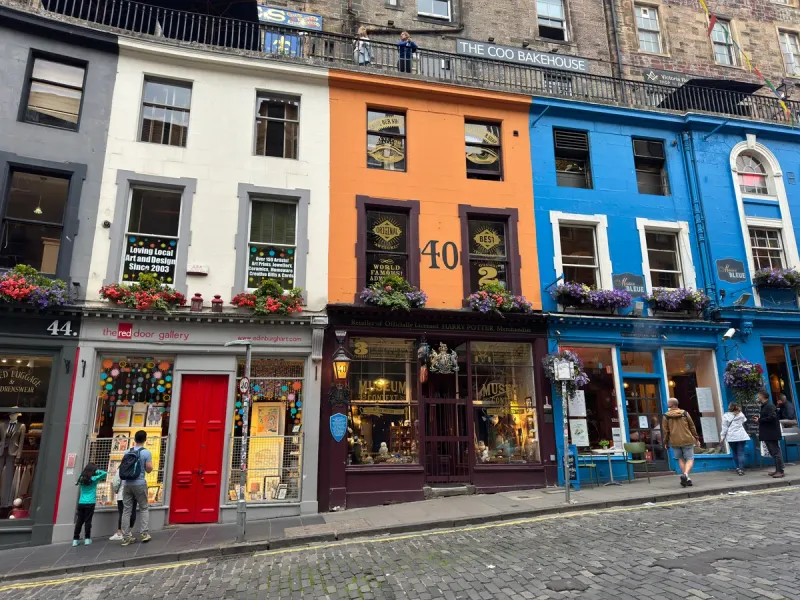
Victoria Street is Edinburgh's most photographed street for a reason: it curves sharply downhill from George IV Bridge to the Grassmarket, and the bend is genuinely the shot — a straight-on photo loses the thing that makes it distinctive. Built on two levels (a lower street of brightly painted shopfronts and an upper terraced walkway above them, reached by a short flight of steps), it gives you two completely different compositions from the same spot: stand partway down the curve at street level for the classic shot of the colourful frontages receding round the bend, or climb up to the upper terrace for an elevated angle looking down over the rooftops and shop awnings.
It's a narrow, curving street between tall buildings, so direct sun only reaches down it for a short window each day — an overcast morning gives far more even light across both sides of the curve than a sunny midday, which blows out one side and buries the other in shadow. Timing for crowds matters more than timing for light, though: this is one of the most tour-group-clogged streets in the Old Town from mid-morning onward, so go before 9am if you want the street to yourself. One honest correction: Victoria Street is very widely claimed online to have inspired Diagon Alley in the Harry Potter books. I went looking for a source that actually confirms this and couldn't find one — J.K. Rowling has never named it as an inspiration in anything I could verify, and Wikipedia's own Diagon Alley page names a different real-world inspiration entirely. It's a lovely street regardless; it just doesn't need the borrowed myth.

West Bow
West Bow is, honestly, the same street as Victoria Street under an older name — it's the historic name for the lower stretch, where the curve straightens out and opens onto the Grassmarket. Daniel Defoe described "the Bow" as a street "generally full of wholesale traders" back in the early 1700s, before the Victorian remodelling turned it into the shop-lined curve you see today. I'm including it as its own entry because the photo you get here is genuinely different: stand at the Grassmarket end, by the corner near Armstrong's Vintage, and shoot back up the street rather than down it. From this angle you catch the transition from the open square into the narrow historic lane, with the Castle rock often visible over the rooftops behind — a composition the mid-curve Victoria Street shot doesn't give you.
Because the street opens right onto the Grassmarket here, late-afternoon light can rake in more directly than it does further up the curve, where the buildings crowd in tighter. It's free, cobbled, and gently sloped with no steps, so it's the easiest of the Old Town entries on this list to reach if steps are a problem for you. Worth pairing with a stop in the Grassmarket itself; our Old Town guide covers the wider walk.
Cockburn Street
Cockburn Street looks like it should be medieval and isn't: it was cut through in 1856, replacing a set of steep, narrow closes with a single serpentine street engineered specifically to give a gentler, walkable gradient down to the newly built Waverley Station, and most of the buildings lining it were remodelled in Scots Baronial style between 1859 and 1864, largely by the architects Peddie and Kinnear. The buildings are mostly four storeys, and at one point the rear of the City Chambers looms twelve storeys above the street — a genuinely dramatic bit of scale if you catch it in frame. The engineered curve is the whole point of the shot: stand mid-street and shoot along the bend so the converging shopfronts and the curve both read, or go to the High Street end and shoot straight down for a version that shows the descent toward Waverley.
It runs on a diagonal from the High Street ridge down to the valley, so morning light rakes down it more evenly than midday, when the four-storey buildings throw hard shadows across the narrower stretches. It's also the most step-free entry on this list — paved and gently sloped throughout, no steps anywhere — which makes it the easiest Old Town street here for anyone who needs that. The independent, alternative-leaning shopfronts along here change their window displays often, so don't be surprised if the exact frame you saw online looks slightly different by the time you visit.
Advocate's Close
Advocate's Close has the single best framed view on the Royal Mile, and it's easy to walk straight past the entrance without noticing it. The close drops away steeply from the High Street, and because of demolitions along its lower stretch in the 1920s, the sightline now lines up almost perfectly with the Scott Monument and the New Town skyline below. Stand about a third of the way down from the High Street end — not all the way at the bottom, where you lose the framing effect — and shoot straight down the steps, letting the close's stone walls act as a natural frame around the spire in the distance. A 2012 archaeological dig here uncovered the remains of a 16th-century tenement and even rarer 12th/13th-century deposits, so you're standing on genuinely old ground, not a reconstruction.
This is a hard exposure to get right in direct sun: dark stone walls on both sides, a bright view at the far end. Overcast days or the flat light just after sunrise give you the most even result; harsh midday sun blows out the view while the close itself stays in shadow. It's free and open 24 hours, but steep and heavily stepped — not wheelchair or pushchair accessible — and it's a real thoroughfare with residential and business entrances, so keep it brief and let people through.
Fleshmarket Close
Fleshmarket Close takes its name from the Scots word for a butcher's market that once stood nearby, and it's most famous now for lending its name to Ian Rankin's 2004 Inspector Rebus novel Fleshmarket Close (published in the US as Fleshmarket Alley, on the theory American readers wouldn't know the word "close"). The novel was later adapted into a 2006 TV episode starring Ken Stott — Whether it was actually filmed here isn't documented anywhere reliable, so take that detail as unverified rather than fact. What makes it distinctive photographically is that it crosses Cockburn Street partway down, so you get two different shots from one spot: look up the steps toward the High Street, or down toward Market Street and Waverley, with the crossing itself as a third option.
Same light logic as Advocate's Close: it's steep and stepped with bright openings at both ends, so overcast or early-morning light handles the contrast far better than midday sun. It's free and always accessible, but genuinely used as a commuter shortcut at rush hour — narrow steps mean lingering for a shot, or setting up a tripod, can properly block people trying to get through. Be quick and considerate.
The Vennel
The Vennel gives you the single best street-level shot of Edinburgh Castle in the city, and it's an easy one to miss unless you already know to duck off the Grassmarket and climb the steps. Stand about two-thirds of the way up, where the stairwell narrows between the tenements, and the Castle sits framed almost dead-centre above the rooftops — the same angle that shows up on more postcards than anywhere in the city bar Princes Street Gardens. The steps themselves run alongside a genuine surviving stretch of the old Flodden and Telfer town wall, so there's real 16th-century stonework in the same frame if you want it.
I'd shoot this in the hour after sunrise, when low light catches the Castle's west face and the steps are usually still empty; by mid-morning it's a queue of people all trying to get the same shot. Overcast days work well too — even light on the sandstone, no harsh shadow cutting across the steps. It's steps only, no ramp, so it's not an option if you need step-free access, and it's a genuine bottleneck if two photographers try to use it at once — take turns.
Greyfriars Kirkyard
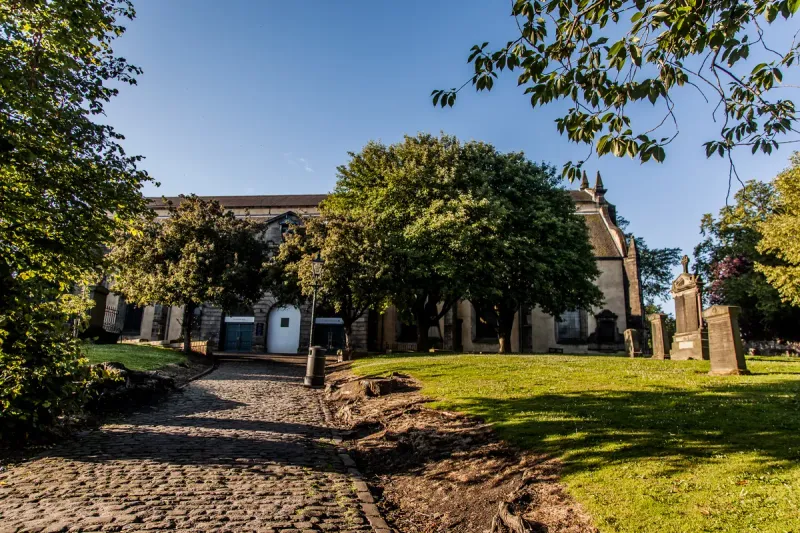
Greyfriars Kirkyard is dense with tall, blackened 17th- and 18th-century tombs in the Celtic Baroque style, crowded together on sloping ground next to the kirk, and that density is what makes it photogenic rather than any single monument. Shoot low, framing a cluster of headstones against Edinburgh Castle's silhouette in the background where the angle allows it, or go tight down one of the narrow tomb-lined paths for a straightforwardly gothic, claustrophobic composition. It's also the home of the Greyfriars Bobby story, the loyal Skye Terrier said to have guarded his owner's grave here for years — genuinely documented local history, unlike the popular claim that some of the kirkyard's surnames (a "Thomas Riddell" headstone, most famously) directly inspired J.K. Rowling's character names. I checked the kirk's own official page and it makes no mention of Rowling or Harry Potter at all, so treat that connection as repeated tourist lore, not confirmed fact.
The dense stonework and heavy shadow mean overcast days or late-afternoon low light suit the mood far better than flat midday sun, which just bleaches the texture out of the stone. It's open 24 hours, 365 days a year, free, with a wheelchair-accessible entrance, though the internal paths are grass and gravel and slope with the ground. It's still an active kirkyard and a place people visit to grieve, not a film set — keep your voice down and don't climb on the monuments.

Circus Lane
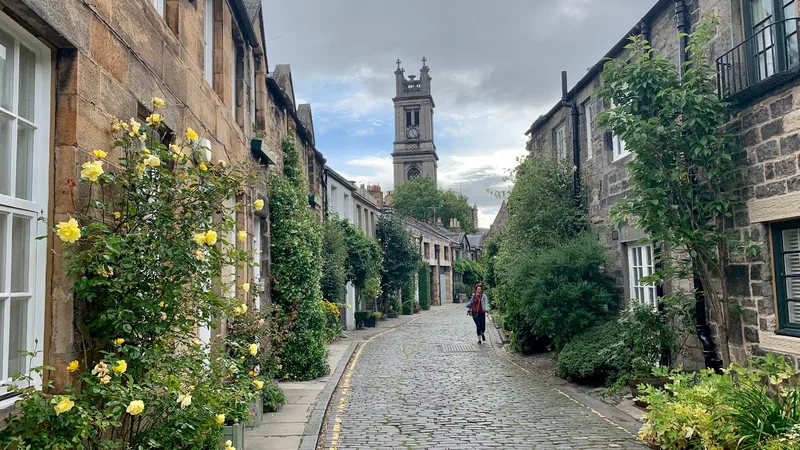
Circus Lane is Stockbridge's cobbled mews, a row of converted Georgian stable buildings hung with ivy, and you've almost certainly seen it on someone else's feed already — it's one of the most reproduced shots of Edinburgh online. The classic composition runs straight down the cobbles from the Circus Place end, using the ivy-covered gable walls on both sides as leading lines toward the lane's gentle curve; stand centre-lane, not pressed against a wall, to keep the symmetry. The lane runs roughly east-west, so a low morning sun catches the stonework without the flat overhead shadows you get by early afternoon.
The one thing every version of this list should say and most don't: people actually live here. It's a residential mews, not an attraction, so keep it to a few frames, don't block doorways for the shot, and treat it the way you'd want a stranger to treat your own street.

Stockbridge Colonies
The Stockbridge Colonies are twelve parallel terraced streets built between 1861 and 1911 by the Edinburgh Co-operative Building Company, a scheme set up to house working people, with each street named after one of the company's founders or trustees, including the geologist and writer Hugh Miller. What makes them photogenic is the repetition: identical stone gables and chimney stacks marching away from you down a narrow street, a rhythm you don't get from Edinburgh's more familiar Georgian terraces. Shoot straight down the centre of one of the streets to let that repetition carry the frame, rather than trying to capture the whole scheme at once.
Low morning or evening sun raking across the facades picks out the depth of the stonework far better than flat midday light, which washes the repeating lines out. These are private homes on ordinary residential streets, not a museum or a set piece, so this is a look-quietly-and-move-on stop: a few frames from the street, nothing that lingers outside anyone's window.
Dean Village
Our best views guide already covers Dean Village's general charm and history in depth, so here's the one thing that guide doesn't: the specific shot everyone's actually chasing. It's Well Court, the red-brick 1880s tenement block built for newspaper magnate John Findlay, with its distinctive clock tower — and the shot that puts both the building and its reflection in frame is from along the Water of Leith near Bell's Brae or the footbridge just below it, looking across the water toward the courtyard. I'd call this an informed read of the geometry rather than a single officially sanctioned angle; there's more than one spot along that stretch of bank that works.
Because the shot depends on a reflection, conditions matter more than the clock: a still morning with no wind gives you a clean mirror in the water, while a blustery afternoon breaks the reflection up into ripples. It's a free, always-open public street, but a genuinely residential conservation area and one of the more crowded photo stops on this list by mid-morning — arrive early if you want it quiet.

Scott Monument
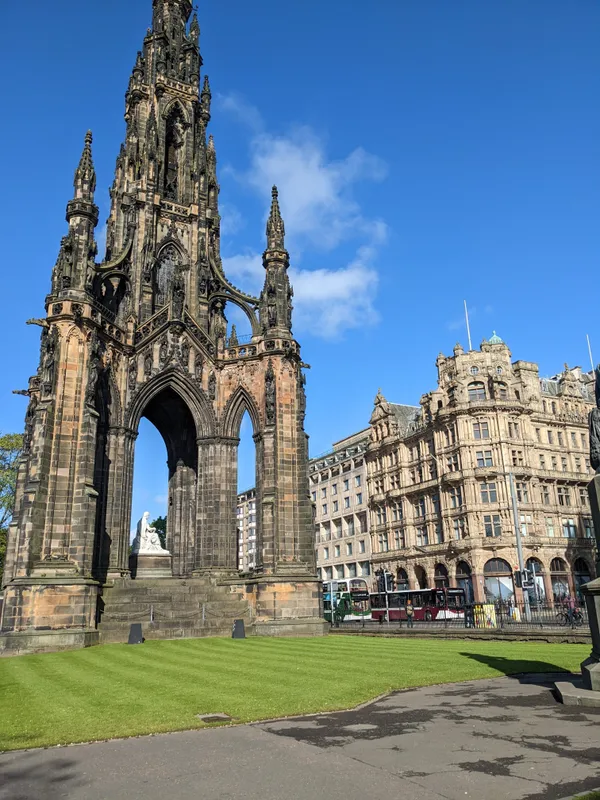
This is a different entry from the Scott Monument in our best views guide, which is about the view from inside the climb. This one is about the monument itself as the subject: a 61-metre Gothic spire in Princes Street Gardens, built as a memorial to Sir Walter Scott, with a 30-ton Carrara marble statue of Scott at its base carved by Sir John Steell over six years. Shoot from ground level in East Princes Street Gardens looking straight up the spire to exaggerate its height and let the tiered, pinnacled stonework fill the frame — go slightly off-axis rather than dead-centre, which avoids the flat, symmetrical, slightly clichéd postcard version everyone else takes.
The monument's principal face looks north over the gardens toward the Old Town, which means it sits mostly in shadow around midday; early morning or late-afternoon side light picks out the carved detail on the pinnacles far better. Viewing and photographing it from the gardens is free — you only pay if you actually want to climb it, which is a separate experience covered in our best views guide.

Dr Neil's Garden
Dr Neil's Garden is a different kind of photogenic to everything else on this list: quiet, green, and built around water rather than stone. It sits on the shore of Duddingston Loch next to one of Scotland's oldest churches, and the best composition is from the lochside path, looking back through the walled garden toward Thomson's Tower, with the water filling the lower part of the frame and, on a still day, holding a reflection. Go in late spring or summer when the planting's in full bloom for the most colour.
Time it for early morning or the last couple of hours before dusk — midday sun here is flat and the garden loses most of its colour in photos. It's free, with donations welcomed, open daily 10am to dusk, and because it sits south of Holyrood Park, well off the standard Old Town route, you'll likely have it largely to yourself even in summer.
Portobello Beach
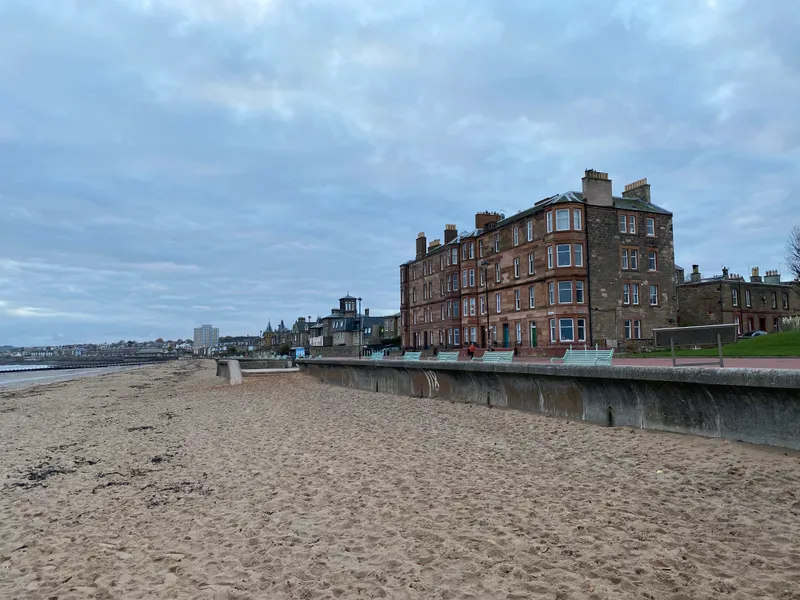
A word of honesty first: this list originally had Portobello down for its colourful "beach huts", and I couldn't find any evidence they exist. I checked Wikipedia's full article on Portobello and a search of Wikimedia Commons's photo archive for the area and came up with nothing — my best guess is that's a mix-up with Portobello Road in London, which is famous for colourful houses. What Portobello Beach actually has is a wide stretch of sand facing the Firth of Forth toward Fife, a Victorian promenade lined with cafés, and a genuinely distinctive local fixture: a wild swimmers' club that's gathered here through the year since 2010, whatever the weather, in a scatter of bright robes and tow floats along the shoreline.
The beach faces roughly north across the water, so sunrise plays out toward or over the Forth while sunset falls inland, behind the town, rather than over the sea — worth knowing if you're planning around golden hour. If you're photographing the swimmers, ask first rather than shooting strangers close-up; from a distance, the colour of a dozen robes against grey water and the wide sand is the real shot. This is genuinely a different angle to our best views guide's Portobello entry, which covers the promenade view — this one's about the beach's colour and the community on it.

Colinton Tunnel
The Colinton Tunnel is Scotland's largest historical mural, 140 metres of a disused railway tunnel painted floor-to-ceiling with scenes from Robert Louis Stevenson's poem "From a Railway Carriage", and it's less about one frame than about the tunnel as a whole. The strongest shots run straight down the tunnel's centre line, using the painted archway and the tunnel's natural curve to frame whoever's walking through it — a wide-angle lens helps if you've got one, and a person in the shot gives you a real sense of scale against the artwork.
It's permanently lit, so this is one of the few spots on this list that works regardless of weather or time of day, though the painted colours read truest with a phone light or torch held close rather than relying on the tunnel's fixed lighting alone from a distance. It's free and sits on the Water of Leith walking route — worth building a whole afternoon around if you're already doing the Colinton stretch.
The Leith Mural
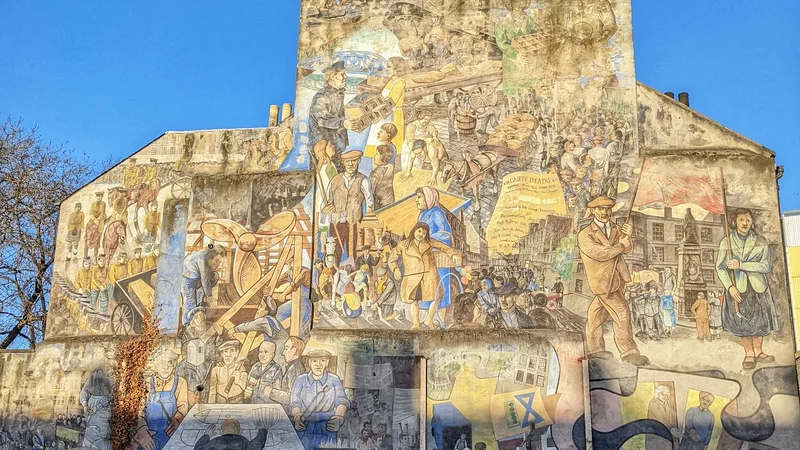
The Leith Mural, on the corner of Ferry Road and North Junction Street, is a large-scale, multi-panel piece painted in 1986 by a team of artists led by Tim Chalk, depicting Leith's maritime and dockworking history across a full gable wall. It's the kind of mural that rewards two different shots: a wide establishing frame of the whole wall to take in the scale and the narrative sweep, and tighter detail shots of individual panels for the texture and colour up close.
One honest caveat: the most recent independently dated photo I could confirm was from 2020, and Ferry Road went through major tram-line construction between 2019 and 2023 that ran right past this corner, so I can't personally guarantee it's still exactly as described. Google's own listing for it currently shows the location as operational, which is a reasonable signal it's still standing, but I'd treat this one as worth a quick check before you make a special trip out to Leith for it specifically.

How I'd string these together
Old Town loop (half a day): Start at the Vennel for the Castle-framed shot in the quiet early morning, then work through Advocate's Close and Fleshmarket Close on your way along the High Street, detour to Greyfriars Kirkyard, and finish the loop down Cockburn Street to Victoria Street and West Bow via the Grassmarket. All seven are within a 15-20 minute walk of each other.
Stockbridge and Dean (an hour or two): Circus Lane and the Stockbridge Colonies are a short walk apart, and Dean Village is about 15 minutes further on foot along the Water of Leith. Pair this with our Stockbridge guide for places to eat in between.
New Town add-on: The Scott Monument sits right in Princes Street Gardens, an easy detour if you're already walking between the Old Town and Stockbridge.
Further out, each worth a dedicated trip: Dr Neil's Garden (Duddingston), Portobello Beach, the Colinton Tunnel mural, and the Leith Mural are all in different directions from the centre and not realistically walkable together — pick one or two based on what's already on your route, or spend a full day working through all four if photography is the main point of your trip.
Planning your trip to Edinburgh? Save these places to your itinerary with Tourli, the app that turns travel guides into actionable day plans.
Frequently asked questions.
What is the most Instagrammable street in Edinburgh?
Did Victoria Street inspire Diagon Alley in Harry Potter?
What's the best time of day to photograph Edinburgh's Old Town closes?
Is Fleshmarket Close named after Ian Rankin's novel, or the other way round?
Stop reading lists.
Start the trip.
Tourli turns any guide into an actionable day plan — pinned to a map, walking directions and offline access included. One tap to save every place on this page.