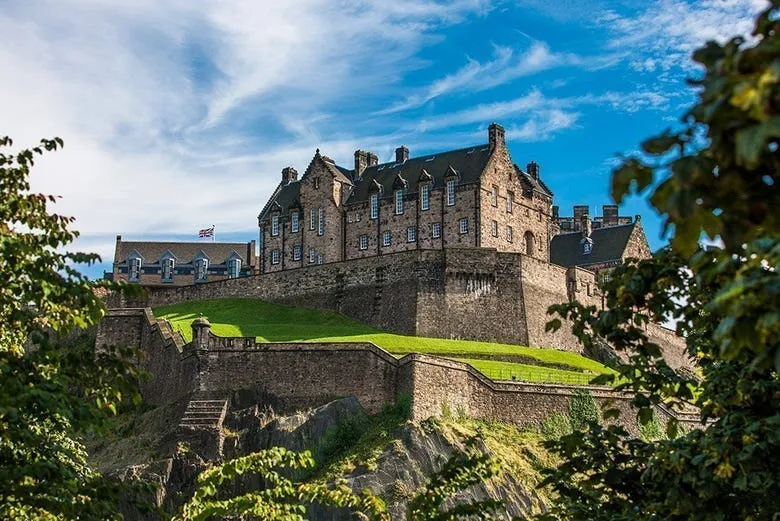
── tickets · 2026 prices
Admission: what it actually costs
Adult (16-64): £23.50 online, £26.00 at the gate. Concession (65+ or unemployed, with proof; this doesn't cover students): £19.00 online, £21.00 at the gate. Child (7-15): £14.00 online, £15.50 at the gate; under-16s must be with an adult. Family tickets scale from £48.50 online (1 adult, 2 children) up to £80.00 online (2 adults, 3 children), with the walk-up rate roughly 10% higher across the board.
If you're staying more than a week or plan to come back, a 7-day Flexi ticket (online only) gives one entry any day in a rolling week for £38.00 adult, £30.50 concession, £22.50 child, with no need to lock in a timeslot when you book. Free entry covers Historic Scotland members, Explorer Pass holders, carers accompanying a disabled visitor (two per transaction), and serving British Armed Forces members with a MOD90 card. A Young Scot card gets you in for £1. An audio guide, on your own phone or a hired device, is £4.00 (20% off for members and Explorer Pass holders) and comes in 13 languages plus large-print and dyslexia-friendly versions.
Book online. It's not just cheaper, it's the only reliable way in during summer: the official line is that tickets often sell out days in advance, and once they're gone online there is nothing left to buy at the gate. I'd treat the castle the same way you'd treat a popular restaurant: decide your date, book that morning, don't leave it to the day.
── opening hours · 2026
Hours, and the August exception
Summer (1 April-30 September): opens 9:30am, last entry 5pm, closes 6pm. Winter (1 October-23 December and 2 January-31 March): opens 9:30am, last entry 4pm, closes 5pm. Christmas week runs its own schedule: 24 December closes early (last entry 2:30pm, gates shut 4pm), 25 and 26 December the castle is fully closed, and 27-31 December it's back to standard winter hours. New Year's Day it opens later, at 11am, with the usual 4pm last entry.
The one exception worth flagging separately: during the Royal Edinburgh Military Tattoo, the castle closes early (last entry 3:30pm, gates shut 4:30pm) on 15, 22, 28 and 29 August 2026, so the Esplanade can be turned over for the evening show. If you're building an August trip around both the castle by day and the Tattoo by night, check that date list before you pick your visit day. For everything about the show itself, booking, seating, accessibility, see our Edinburgh Military Tattoo guide rather than guessing from the castle's own site.
How long to spend: the official guidance is a minimum of 2 hours to see the main attractions, and that's about right if you keep moving. I'd budget closer to 3 if you actually want to read the Honours of Scotland exhibition properly, walk the Great Hall, and give the National War Museum more than a glance. It's easy to burn an hour just queuing for the Crown Room on a busy day, so build slack in rather than cutting it fine.
── inside the castle
What's actually worth seeing
The castle is less a single building than a walled hilltop with a dozen distinct things to see, and it's worth knowing which ones earn a stop before you're inside and running out of time.
The Honours of Scotland, in the Crown Room on the first floor of the Royal Palace, are the crown, sceptre and sword of state: the oldest crown jewels anywhere in Britain. The crown itself was made in 1540 for James V and first worn at Mary of Guise's coronation; the set was hidden from Cromwell's army in the 1650s, locked away after the 1707 Act of Union, and only rediscovered by Sir Walter Scott in 1818. This is the single most-recommended room in the whole castle, and it's the one I'd point you to first if you're short on time.
A correction worth making plainly: the Stone of Destiny is not here. It left Edinburgh Castle for good when the new Perth Museum opened on 30 March 2024, where it's now a permanent exhibit. It only travels again for a future coronation, the way it briefly went to Westminster Abbey for Charles III's in 2023 before coming back. Older guides (and a fair few current ones) still describe it as part of the Honours of Scotland display here. It isn't, and hasn't been for two years.
St Margaret's Chapel is the castle's oldest surviving building, built around 1130 by King David I and named for his mother. It's a genuinely small, plain stone room, and for centuries nobody even remembered what it was: it spent years as a gunpowder store before an antiquary rediscovered its original purpose in 1845. It's still a working chapel, hosting weddings and christenings, with fresh flowers kept by the St Margaret's Chapel Guild.
The One O'Clock Gun fires every day at 1pm except Sundays, Good Friday and Christmas Day, a tradition dating to 1861 so ships in the Firth of Forth could set their maritime clocks by it. It's a genuinely loud 105mm field gun (the original was a 64-pounder), fired from Mills Mount Battery near the Redcoat Café. It's known to startle people on Princes Street below, so time your visit to catch it if you can, or brace for it if you can't.
Mons Meg, sitting outside St Margaret's Chapel, is a six-tonne 15th-century siege gun gifted to James II in 1457, cutting-edge military technology in its day, capable of firing a 150kg gunstone nearly two miles. Its barrel finally burst in 1681 during a ceremonial salute, and it spent 75 years exiled in the Tower of London before a military escort brought it home from Leith Docks in 1829.
The Great Hall, in Crown Square, was completed in 1511 for James IV, who barely got to enjoy it before dying at Flodden two years later. It later served as army barracks under Cromwell and then a military hospital until 1886. Restored to its medieval appearance, it now displays weapons, armour and pole arms, including the Lochaber axe, under one of the finest surviving timber roofs in Britain.
The Prisons of War, in the vaults below Crown Square, held pirates and prisoners of war from the 1700s and 1800s: French privateers from 1758, then hundreds of Napoleonic Wars and American War of Independence captives from France, America, Spain, the Netherlands, Ireland, Italy, Denmark and Poland. The youngest was six years old, captured at Trafalgar. Look for the early Stars-and-Stripes carving scratched into one of the doors, a reminder that a good number of the American prisoners here were sailors fighting for independence.
The National War Museum, in Hospital Square down past the Redcoat Café, covers Scottish military history through letters home, Highland broadswords, chemical warfare suits and Robert Gibb's painting 'The Thin Red Line'. One honest flag: it's currently partially closed for essential building repairs, so don't plan your visit around seeing the full collection until that work wraps up. Check the castle's own site for the current status before you go.
── the esplanade · military tattoo
The Esplanade, by day and by August night
The Esplanade, the flat forecourt in front of the gates, is the castle's parade ground and its best free view: on a clear day you can see across the Firth of Forth. It doubles, every August, as the purpose-built arena for the Royal Edinburgh Military Tattoo, rebuilt into temporary raked stands for the run of the show and dismantled afterwards. That's also why the castle's own daytime hours shorten on the specific August dates listed above, rather than for the whole run: the changeover needs the extra time.
If you're coming specifically for the Tattoo, treat it as a separate booking from your castle ticket: it has its own prices, seating bands and accessibility setup, all covered properly in our Edinburgh Military Tattoo guide.
── accessibility
Getting around: the honest version
The castle is upfront about where accessibility ends, and it's worth reading before you go rather than discovering it on the day. The esplanade itself is easy: 110 metres of smooth tarmac on a gentle 5-degree slope. What comes next is the real obstacle: a 350-metre cobbled route up to Crown Square that hits 15 degrees at its steepest point, averaging 5 degrees overall, on a genuinely uneven surface.
A mobility vehicle to Crown Square is available on request from staff at the entrance, seating up to three passengers plus one wheelchair user (chair limits: 103cm high, 73.5cm wide, 100cm long, 150kg). One quirk worth knowing: the service pauses for an hour, 12:15pm to 1:15pm, while the One O'Clock Gun fires. Manual wheelchairs are also available, first-come, first-served.
Once you're up at Crown Square, some areas still aren't step-free: the Battlement Walk, the 70-stone-step route out of the castle, and the Prisons of War vaults, which need several short flights of stairs to reach. Adapted toilets sit at Crown Square; the entrance-level accessible toilets are closed for refurbishment through the end of August 2026, with temporary accessible units on the esplanade in the meantime. It's worth checking they've reopened if you're visiting soon after that date. A small number of accessible parking spaces are available on the esplanade for ticket holders with mobility needs; reserve ahead at ecparking@hes.scot or ask on arrival.
── the verdict
Is Edinburgh Castle worth it?
Yes, and I'd say that even knowing it's the most expensive single ticket in the city. £23.50 buys you 900 years of Scottish history compressed into one hilltop: the oldest crown jewels in Britain, the country's oldest surviving building, a working 15th-century siege gun, and a view over the whole city that's free the moment you clear the gate. The 4.6-star average across more than 108,000 reviews isn't the reason to go, but it's a reasonable signal that most people leave feeling it earned the price.
The one honest caveat is crowding, not cost. On a peak summer afternoon without a booked slot, you can lose the better part of an hour just queuing for the Crown Room, and the official site's own warning about tickets selling out isn't marketing, it's a real constraint in July and August. Book online, pick the earliest slot your trip allows, and go straight to the Honours of Scotland before the day-trip coach groups arrive.
Practically: the nearest station is Edinburgh Waverley, an uphill walk from the exits with the castle visible the whole way up; there's no parking at the castle itself, so if you're driving, plan on Castle Terrace NCP nearby. Pair the visit with a walk down the Royal Mile afterwards: it's all downhill from the gates to the Palace of Holyroodhouse, which is the direction you want to walk it in.
More Edinburgh guides
If you're weighing up whether to add more castles to the trip, our castles near Edinburgh guide ranks nine others within day-trip range, exact prices and closures included. For the wider medieval district the castle sits above, see our Old Town guide, and for the full spread of things to do in the city, start with things to do in Edinburgh. If you're squeezing the castle into a single day, our one day in Edinburgh itinerary opens with it at the 9:30am opening, before the coach tours build.
Planning your trip? Save the castle and everything around it into a day-by-day plan with Tourli, the app that turns travel guides into actionable itineraries.