Bells Brae
Bells Brae, Edinburgh EH4 3BJ, UK
Tip
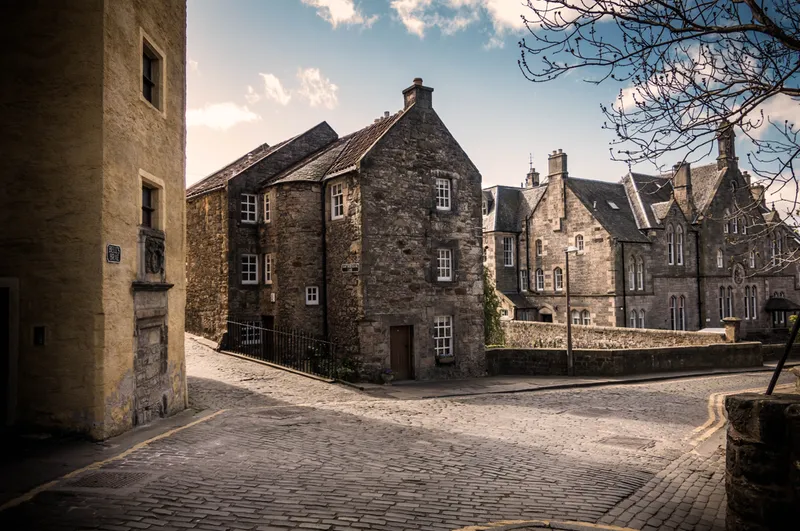
This is the way in on foot from the West End: a short, steep drop from street level into the village. It's cobbled and has no pavement in places, so mind traffic on the way down.
How I'd spend half an hour to an hour in Dean Village, Edinburgh's former milling hamlet on the Water of Leith: Well Court and the footbridge photo spot, the walk past Hawthornbank Lane and Dean Bridge, a coffee stop, and honest notes on what it actually is (a small, lived-in residential hamlet) versus the half-day some guides pretend it is.

Dean Village is the one that catches people off guard. You're ten minutes from Princes Street, still hearing city traffic, and then you drop down Bell's Brae and the whole skyline disappears: stone mill buildings crowding a river gorge, a Victorian tenement with a clock tower reflected in the water, nothing taller than three storeys anywhere. It was a working grain-milling village for more than 800 years, at its peak home to eleven mills grinding flour for the city above, and it still looks the part. It's also become one of Edinburgh's most photographed spots, which is worth knowing before you go: this is a genuinely lived-in residential street, not a heritage attraction built for visitors.
This guide covers the village itself: Bell's Brae, the icon of the place (Well Court), the footbridge everyone photographs from, and the walk out toward Dean Cemetery and the Gallery of Modern Art. It's one of the entries in our most instagrammable spots in Edinburgh, and if you want to see how it fits into a wider day, it's also on the list of things to do in Edinburgh.
Be honest with yourself about scale here. This is a 30 to 60 minute stop, not a half-day plan: a short, dense loop of a few streets, not a district you wander for hours. If you want more, the Water of Leith Walkway keeps going, past St Bernard's Well and on to Stockbridge in around half an hour. I've routed this guide in the order I'd actually walk it, arriving from the West End and heading out toward Stockbridge at the end.
Bells Brae is how I'd arrive on foot from the West End, and it's worth knowing what it is before you get there: this steep, cobbled street was the original road down into Dean Village, in use long before Dean Bridge opened overhead to bypass it in the 1830s. It's a proper hill, not a gentle slope, and there's no pavement for a stretch, so keep an eye out for cars sharing the same narrow road.
You'll get your first glimpse of the village from partway down: stone roofs below, the river running through the middle of it. It's a good moment to slow down rather than a place to linger, since it's still a live residential street with normal traffic using it.
This is the way in on foot from the West End: a short, steep drop from street level into the village. It's cobbled and has no pavement in places, so mind traffic on the way down.
Dean Bridge is the reason Dean Village stopped being on the main road in the first place. Thomas Telford designed it, and construction finished in 1831; it opened to pedestrians (for a penny toll) in early 1832, but horse and cart traffic wasn't allowed across until May 1834. It was built so that traffic from the New Town's western extension could reach the land to the north without dropping down Bell's Brae and back up the other side. It's a serious piece of engineering for its time: four arches, 447 feet long, 106 feet above the riverbed. If you're coming from the New Town side, this bridge is the historical link between the two.
You don't need to walk across it. The better view is from underneath, in the village, looking up at the arches with the stone mill buildings in the foreground. It's still a working road bridge today, so there's traffic overhead, which is a strange contrast with how quiet the village feels directly below it.
Look up at it rather than plan to cross it: at 106 feet above the river, the view from underneath, framed by the village, is the one worth having. You'll pass right under it as you descend Bell's Brae.
Well Court is the building that makes Dean Village instantly recognisable: a red sandstone tenement block from the 1880s, with a distinctive clock tower over a quiet courtyard, right on the riverbank. It was built as social housing for local workers, commissioned by John Ritchie Findlay, owner of The Scotsman newspaper, and designed by the architect Sydney Mitchell. Original tenants paid £7 to £12 a year in rent and had to keep to conditions on behaviour and church attendance, which tells you something about how paternalistic Victorian philanthropy could be, however well-intentioned.
It's still private housing today, and I couldn't find anything confirming the courtyard is open to walk into, so I'd treat it as someone's front garden rather than a public square: admire the clock tower and the building's reflection from Damside or the riverside path instead. It's one of the most photographed buildings in Edinburgh for a reason, but that's exactly why the residents deserve a bit of consideration.
It's private flats, not a museum, so there's no door to walk through. View the clock tower and courtyard from Damside or the riverside path rather than wandering in.
The footbridge below Bell's Brae is where the actual money shot happens: Well Court and its clock tower reflected in the still water, shot from the riverbank near the unnamed footbridge a couple of minutes downstream. It's the single most-photographed angle in the village, and once you're standing there, it's obvious why. There's more than one spot along that stretch of bank that works, so don't feel like you need to find one exact tile on the pavement.
I don't have a source for a reliable golden-hour time here, so I won't invent one. What I will say: this spot draws a queue of photographers on a nice weekend afternoon, so if you want it quiet, go earlier in the day or on a weekday rather than assuming any particular hour will be empty.
The footbridge itself doesn't have an official name on any source I can find, so don't go looking for it on a map by name. It's the unmarked footbridge below Bell's Brae, a couple of minutes' walk from Well Court along the riverbank.
Hawthornbank Lane is the riverside lane that carries you along the water past a row of old cottages, which the Water of Leith Conservation Trust's own trail notes date to 1895. It's a public lane, not a private close, so you're free to walk its length, and it's the quieter, less-photographed half of the village if the footbridge crowd puts you off.
This is genuinely residential too: real front doors, real windows, people's actual homes a few feet from the path. Keep your voice down and your camera pointed at the river and the buildings rather than into anyone's front room.
A public riverside lane, not a private close, so it's fine to walk its length. It's the row of old cottages the Water of Leith Conservation Trust's own trail notes date to 1895.
Dean Village Coffee House is where I'd stop, right by the entrance to the village on Belford Road. It's a proper independent cafe, not a tourist-trap kiosk: fresh scones, cheese toasties and a short, sensible coffee menu, using coffee from Dear Green in Glasgow and milk from Mossgiel Farm in Ayrshire. Flat whites are £3.70, and a morning roll starts at £3.75 if you want something more than a pastry.
It's walk-in only, no bookings, open every day from 8:30am to 3:30pm. Worth knowing: it went by a slightly different name in an earlier version of this site's coverage of Dean Village, so if you're searching, its current name is Dean Village Coffee House, not 'The Dean Coffee Shop.'
It's currently listed under its old informal name, 'The Dean Coffee Shop,' in one older Tourli guide, so don't go looking for that name on Google. The scone with jam and cream is the order; it isn't itemised on the online menu, but it's what regulars come back for.
Dean Cemetery is the detour I'd add if you have an extra 20 minutes, one street back from the river. It opened in 1846 on the site of the demolished Dean House, and it's the resting place of a genuinely remarkable set of Edinburgh names: photography pioneer David Octavius Hill, traveller and writer Isabella Bird, steam-hammer inventor James Nasmyth, railway engineer Sir Thomas Bouch, and Elsie Inglis, the pioneering doctor who ran WWI field hospitals when the War Office turned her away. There are also 39 Commonwealth war graves here, tended by the CWGC.
It's free, open every day (9am to 5pm in summer, 9am to dusk in winter), and it's the kind of place that rewards a slow, quiet walk rather than a checklist. The paths are uneven Victorian-era gravel in places, so it's not an easy wheelchair or pushchair visit throughout, and I couldn't find a published policy on dogs, so I wouldn't assume either way.
The paths are uneven Victorian-era gravel and stone, so it's not a stroller- or wheelchair-easy visit in every corner. No official policy on dogs is published, so I wouldn't assume either way.
National Galleries Scotland: Modern One & Modern Two sit about 10 minutes further down Belford Road, and I'd treat them as an optional add-on rather than part of the core Dean Village loop; they're genuinely their own destination. Both buildings are free to enter for their permanent collections (Picasso, Matisse, Hockney, and a strong Scottish Colourists showing), open daily 10am to 5pm. The one paid ticket right now is Gwen John: Strange Beauties at Modern Two, running until 4 January 2027, £3.50 to £14.
Don't skip the grounds even if you skip the galleries. Landform Ueda, Charles Jencks' sweeping grass-mound-and-pool sculpture on Modern One's front lawn, is free to walk around any time and won the Gulbenkian Museum of the Year prize in 2004. It's covered in more depth in our best museums in Edinburgh guide.
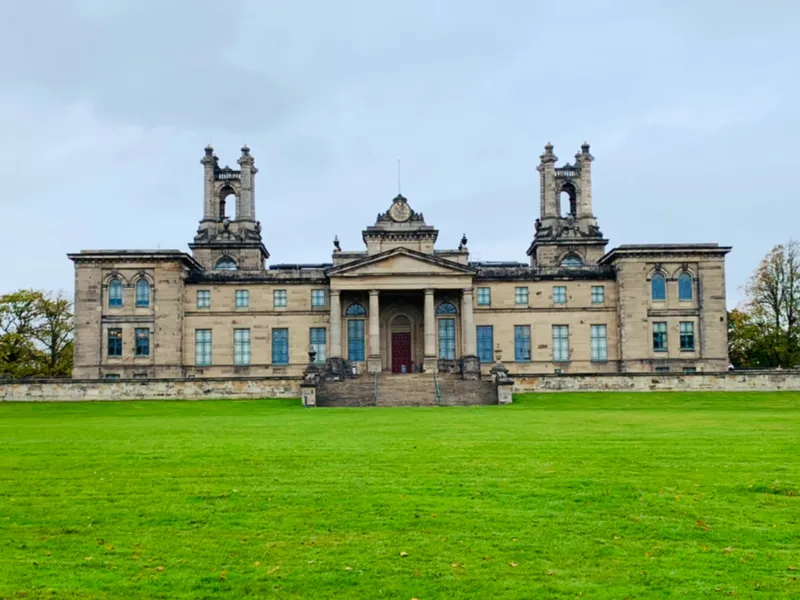
Treat it as an optional extension, not part of the core loop: it's roughly a 10-minute walk further down Belford Road from Dean Village, not right in it.
St Bernard's Well is the natural place to end, if you're walking on rather than heading back the way you came. It's about 25 to 30 minutes downstream along the Water of Leith Walkway, flat and paved the whole way, and this Roman-temple-style pavilion from 1788 marks the point where Dean Village's stretch of river gives way to Stockbridge.
The domed interior is closed most of the year, open only on Sundays in August and Edinburgh's Doors Open Day in September, so treat it as a two-minute photo stop on the path rather than a ticketed visit. From here it's a few more minutes into Stockbridge proper, for lunch, the shops on St Stephen Street, or the Sunday market if your timing lines up.
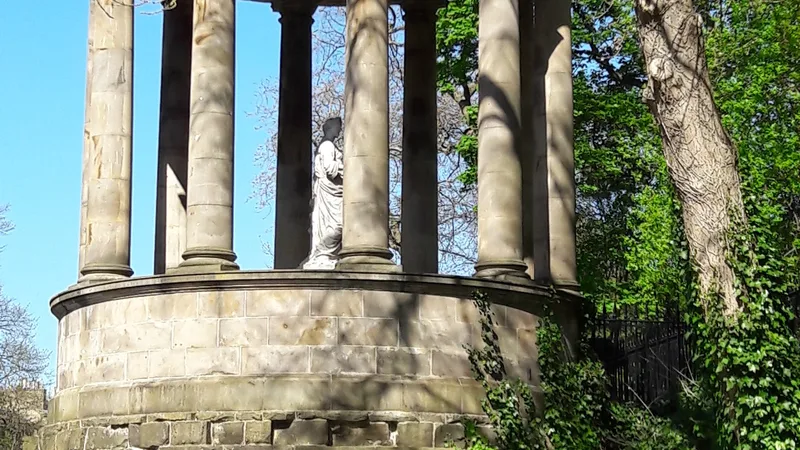
The Roman-temple-style interior is closed to the public most of the year: you're viewing it from the path, not going inside, except on Sundays in August and Edinburgh's Doors Open Day in September.
Visitors describe St Bernard's Well as one of the prettiest, most photogenic stops on the Water of Leith walkway; the consistent note is that it's a viewing-only stop for most of the year, not a walk-in attraction.
Dean Village was a working grain-milling settlement for more than 800 years, first recorded in King David I's founding charter for Holyrood Abbey around 1145, and it had as many as eleven working mills at its peak, all turned by the Water of Leith. The Incorporation of Baxters, Edinburgh's bakers' guild, was closely tied to the village and built their own meeting hall, the Baxters' Tolbooth, here around 1675; it was later altered in 1900 by the architect Robert Lorimer into the Cathedral Mission for St Mary's Episcopal Cathedral. Look for the carved stone plaques of baked bread and pies on some of the older buildings, a small, literal record of the trade that built the place.
The mills closed through the 19th century as bigger, more modern operations opened at Leith, and Dean Bridge's opening in the 1830s pulled the main road traffic away from the village entirely, which is largely why it survived: nobody had a reason to redevelop it. It stayed a quiet backwater until restoration work through the 1970s and the Water of Leith Walkway's opening in 1983 turned it into the well-loved, well-photographed spot it is today.
The honest version: this is a small, dense loop, not a half-day. Arrive via Bell's Brae from the West End (about 15 minutes from Princes Street), take in Well Court and the footbridge photo spot, walk the length of Hawthornbank Lane, and look up at Dean Bridge on your way past. That core loop is 30 to 45 minutes at a comfortable pace, with a coffee stop at Dean Village Coffee House built in. Add 20 to 30 minutes for Dean Cemetery, or a further hour if you're continuing on to the free Gallery of Modern Art buildings down Belford Road.
What I'd skip: don't plan a whole afternoon around Dean Village alone, and don't expect to walk into Well Court's courtyard. It rewards being folded into a bigger loop rather than visited in isolation. Pair it with the West End on the way in, or keep walking north to Stockbridge along the water on your way out.
A genuine ask, not a manufactured one: this is a residential street, not a heritage park. I couldn't find any reported dispute specific to Dean Village, but a few streets over in Stockbridge, Circus Lane residents have publicly asked photographers to be more considerate about noise and privacy, and the same logic applies here. Keep your voice down, don't photograph into windows or private gardens, and treat the footbridge queue the way you'd want a stranger to treat the street outside your own front door.
Planning your trip? Save these Dean Village spots into a day-by-day plan with Tourli, the app that turns travel guides into actionable itineraries.
From central Edinburgh, it's roughly a 15-minute walk from the west end of Princes Street: along Queensferry Street onto Belford Road, then down Bell's Brae into the village. It's an easy add-on if you're already exploring the West End. There's no dedicated visitor parking in the village itself; the streets are mostly residents'-permit-only, so don't plan to drive in and park.
There's no public toilet in Dean Village itself. The nearest options are the Gallery of Modern Art down Belford Road, or the cafes in Stockbridge if you're walking that way. And the terrain is genuinely uneven in places: cobbles on Bell's Brae, steep sections, narrow pavements, so it's not the easiest visit if mobility or a pushchair is a concern.
Stop reading lists.
Start the trip.
Tourli turns any guide into an actionable day plan — pinned to a map, walking directions and offline access included. One tap to save every place on this page.