── tickets · 2026 prices
What it actually costs
2026 admission is £24.95 for an adult, £21.95 for a student (with ID) or a senior aged 65+, and £17.95 for a child aged 5 to 15. Under-5s are free.
There's no family ticket. The operator prices every ticket individually rather than bundling by household shape, which is a deliberate choice, not an oversight, so a group of two adults and three kids pays the same per-person rate as any other combination. If your dates are flexible, booking an 8:00 to 8:45am online-only slot takes a further £4 off the standard adult price, and has the added benefit of getting you the rooftop before the tour groups arrive.
Booking online is recommended for guaranteed entry, especially in peak summer and around the Fringe, but same-day walk-up tickets are sold at the door when there's capacity. There's no on-site cafe, just snacks in the gift shop, though nearby partner restaurants offer ticket-holder discounts.
── the visit · floor by floor
What's actually on each floor
You enter at street level, where the gift shop and a couple of warm-up exhibits, an AutoWed marriage machine and a giant kaleidoscope, sit before the real climb starts. From there it's five floors of illusions, over 100 interactive exhibits in total, stacked up the tower with the rooftop at the top.
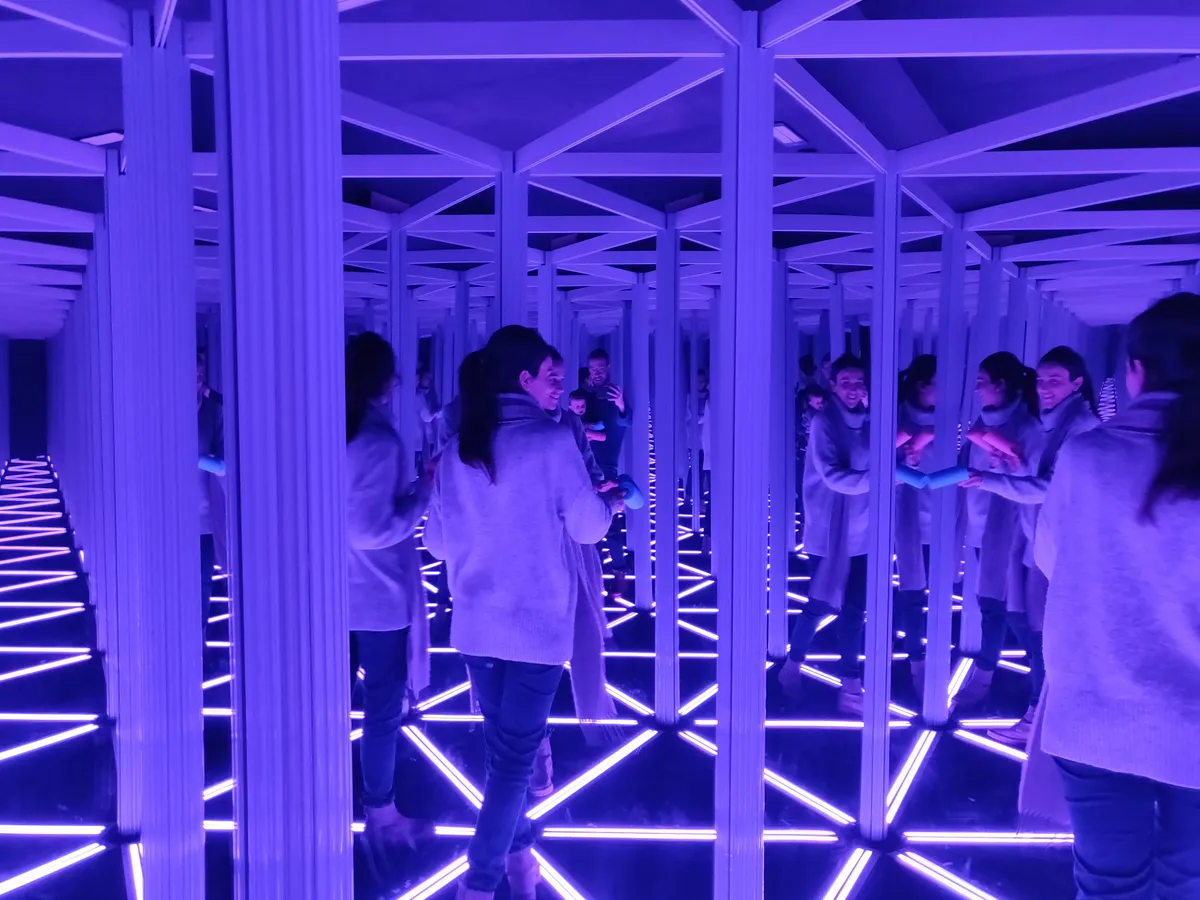
Floor 2, Bewilderworld, is where most people's phones come out: the Mirror Maze and the Vortex Tunnel, a spinning, lit chamber crossed on a metal bridge that genuinely messes with your sense of balance. Floor 3, Eye Spy Edinburgh, leans into cameras and reflections, Victorian-style bendy mirrors, a sparkling infinity corridor, and thermal-camera and live-viewcam displays of the street outside. Floor 4, Light Fantastic, is the one I'd slow down for: an Ames Room that shrinks and stretches people standing in the same spot, and a 4,947-pin Pinwall that takes a 3D impression of your hand or face, plus a quiet space if the crowds get overwhelming. Floor 5, Magic Gallery, closes out the illusions with plasma tubes and a giant plasma ball in the Electric Room, an instant shadow-capture wall, and classic distorting mirrors.
None of it needs explaining by a guide: every exhibit is genuinely hands-on, which is what makes it work for a mixed group of ages moving at different speeds.
── the rooftop · live camera obscura show
The show the whole place is named for
The top floor is a 173-year-old Victorian rooftop chamber built specifically to house the camera obscura, an optical device that uses mirrors, lenses and nothing but daylight to project a live, moving image of the city onto a table inside a darkened room. During the day, a guide runs a continuous demonstration, panning the image around Edinburgh's landmarks and narrating a bit of the city's history as they go. There's no fixed timetable; it's run as a rolling presentation as groups reach the top.
After dark, or when the weather is too overcast for the mirrors to catch enough light, the live projection switches to pre-recorded footage filmed from the same tower in daylight, so the show still runs; it's just not live in that moment. Photography is allowed everywhere in the attraction except inside the camera obscura chamber itself, which is the one place they ask you to just watch.
Step outside onto the rooftop terrace and the reason people put up with the stairs becomes obvious: 360-degree views over the Old Town, the Castle from an angle most visitors never get, and out to the Firth of Forth on a clear day, with free telescopes and binoculars set up around the terrace. It genuinely earns its spot in our best views reasoning, even though the illusion floors are the bigger draw for most visitors.
── who it suits
Kids, the Vortex Tunnel, and who this is for
This is a genuinely good family attraction, and it's built that way: every exhibit is interactive rather than look-but-don't-touch, under-5s are free, and there's enough variety across five floors that a 7-year-old and a 70-year-old can both find something to linger on. It's one of the more reliably fun wet-weather picks in the Old Town for exactly that reason.
The one exhibit worth a genuine heads-up is the Vortex Tunnel on floor 2: a metal walkway through a spinning, illuminated tunnel that can trigger real vertigo or motion sickness, in adults as much as kids. It's easy to bypass if anyone in your group would rather not, and nobody's forced through it. Anyone with a pacemaker is advised to keep about a metre back from the Electric Room's plasma exhibits on floor 5, which is a narrower and less commonly flagged caution worth knowing before you go up.
── accessibility
The honest version: it's all stairs
There's no way to soften this one: Camera Obscura is not wheelchair accessible beyond the ground-floor foyer, and the operator states plainly why. It's a listed 19th-century building, so a lift genuinely can't be installed, which means reaching the rooftop involves roughly 100 steps up a single staircase with one handrail, carrying two-way foot traffic. A wheelchair can be left at the entrance, but there's no route through the exhibition floors themselves.
What's genuinely on offer, rather than a token gesture, is real: walking-stick stools for rest breaks if you reserve one ahead, staff who will slow the pace or arrange a later camera obscura show for anyone who needs more time on the stairs, a quiet space on floor 4, free-loan sensory backpacks, monthly adapted 'Sensory Sundays' sessions, and a virtual tour plus sensory maps published online for anyone planning ahead. Assistance dogs are welcome throughout.
On the discount side: visitors who are Deaf, hard of hearing, blind or partially sighted get 10% off admission, and one carer is admitted free per paying visitor, with ID documentation required at the door. None of that changes the fundamental fact that this is a stairs-only building; it's worth knowing that plainly before you commit to a ticket, not discovering it at the foot of the first staircase.
── the verdict
Is Camera Obscura worth it?
Yes, with the caveat that's worth naming rather than burying: it's genuinely pricey for its footprint. £24.95 for a converted townhouse tower is a fair criticism, and it's the recurring complaint across independent reviews of the place. What tips it back into worth-it territory for me is that you're not just paying for a mirror maze, you're paying for the oldest continuously running visitor attraction in Edinburgh, a live optical demonstration that's genuinely rare to see anywhere else, and a rooftop view that rivals paid viewpoints charging separately for the privilege.
Budget the full 1 hour 45 minutes, book ahead if you're set on a specific time, and take the early-bird discount if your schedule allows it. It sits two minutes from the Castle esplanade at the very top of the Royal Mile, so it pairs naturally with a Castle morning or an Old Town wander, and it's a genuinely reliable rainy-day fallback if the forecast turns while you're already up on Castlehill.
More Edinburgh guides
For the street this attraction sits on, see our Royal Mile guide, and for the district around it, our Old Town guide. Travelling with children? Edinburgh with kids covers the rest of the family-friendly attractions this one sits alongside. Weather turned? Our rainy-day guide rounds up the other indoor options nearby. And for the full spread of what else is worth doing in the city, start with things to do in Edinburgh.
Planning your trip? Save this and everything around it into a day-by-day plan with Tourli, the app that turns travel guides into actionable itineraries.