Best Late Night Food in Tokyo (2026) - After Midnight Eats

Tokyo doesn't really close. When the last train leaves around midnight, the city just shifts gears. Ramen counters fill up with salarymen, yakitori smoke drifts through narrow alleys, and convenience stores quietly serve some of the best cheap food you'll eat on your entire trip. This guide covers the best places to eat after dark.

Places
10
Avg Rating
4.3
City
Tokyo

Late Night Food in Tokyo

There’s a moment, usually around 12:30 AM on your first night in Tokyo, when you realise the city has been holding out on you. The restaurants that guidebooks recommend have closed. The last train just left. And yet the streets are busier than they were at dinner. Salarymen are filing into ramen shops. Smoke is rising from yakitori grills tucked under train tracks. A convenience store is doing brisk business in egg sandwiches and onigiri that, against all reason, taste better than some sit-down meals you’ve had back home.

Tokyo’s late-night food scene isn’t a consolation prize for missing dinner. It’s a whole separate layer of the city’s eating culture, and for many visitors it becomes the most memorable part of the trip. The food is cheap, the atmosphere is unfiltered, and you’re eating alongside locals who are doing exactly what you’re doing: fuelling up after a long night out.

This guide covers the full range. 24-hour ramen booths where you eat alone in a private stall. Smoky yakitori alleys that haven’t changed since the 1950s. Gyudon beef bowl chains where a filling meal costs less than a coffee at home. And yes, the convenience stores, because ignoring them would be leaving out some of the best cheap food in the entire country. If you’re looking for a proper sit-down dinner, head to our best restaurants in Tokyo guide instead. This one is for the hours after midnight.

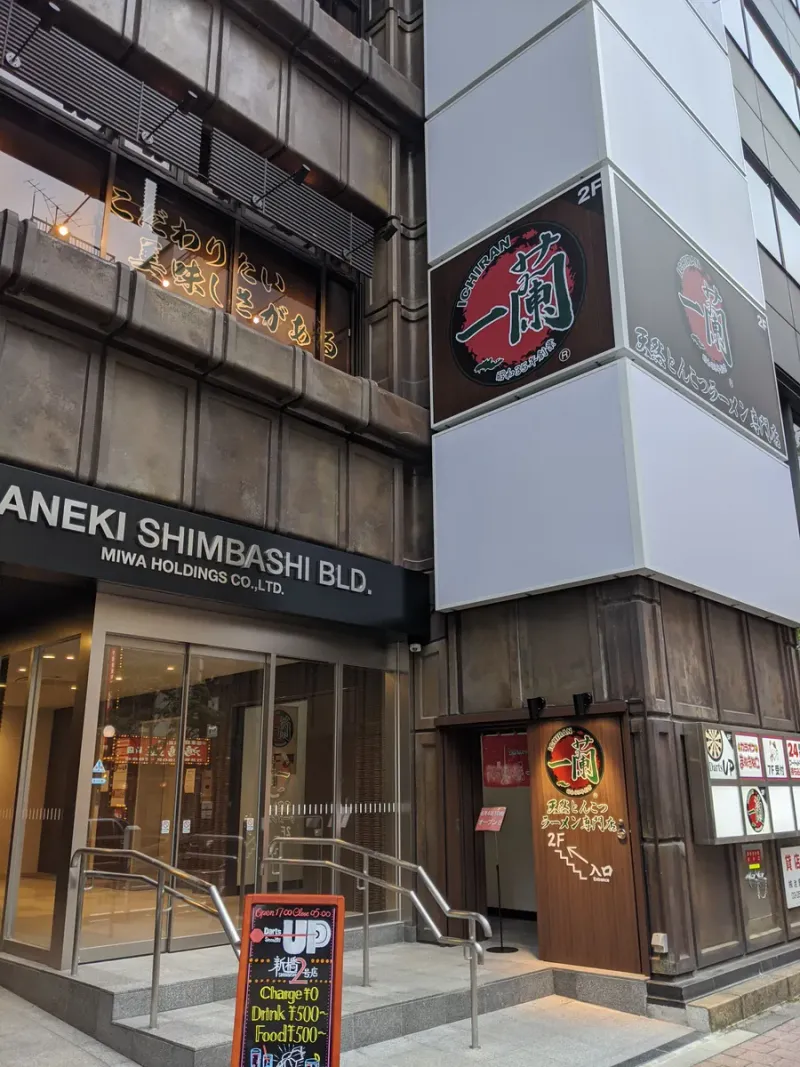
1. Ichiran Shimbashi (24-Hour Ramen)

If you’ve been out drinking in Tokyo and need something warm and salty at 3 AM, Ichiran is the answer that never lets you down. This Shimbashi location is open around the clock, every single day. You buy a ticket from the vending machine, fill out a preference card to customise your broth richness, noodle firmness, garlic level, and spice, then slide into one of the individual partitioned booths. A bamboo curtain separates you from the kitchen. Your ramen appears through a small window. It’s designed for solo dining and it works perfectly at the kind of hour when you don’t want to make conversation with anyone.

The tonkotsu broth is rich and porky without being heavy. The thin Hakata-style noodles have a good snap to them. And the system of ordering extras like additional chashu slices, a soft-boiled ajitama egg, or a second serving of noodles (kae-dama) means you can build exactly the bowl you want. Two bowls with extras will run you about ¥2,000, which at 3 AM feels like the best money you’ve ever spent.

Ichiran Shimbashi
1

Ichiran Shimbashi

restaurant Shimbashi $$
4.2 Google 2-5-6 Shinbashi, Minato City, Tokyo
  • Open 24 hours for ramen any time of night
  • Iconic solo-booth experience with complete privacy
  • Customizable tonkotsu ramen with preference cards
Tip

Use the preference card to set broth richness, spice, and garlic. Order extra chashu and the ajitama egg.

"Reviewers consistently praise the high-quality, customizable tonkotsu ramen. The unique individual partitioned stalls offer privacy."

2. Omoide Yokocho (Memory Lane)

Just west of Shinjuku Station, tucked behind the Odakyu department store, there’s a narrow alley crammed with about 60 tiny restaurants that looks like it hasn’t been updated since the postwar era. That’s because it hasn’t. Omoide Yokocho, sometimes called Piss Alley by English speakers (the locals prefer Memory Lane), is a tangle of yakitori stalls, offal grills, and counter-only bars where the smoke is thick, the seats are tight, and the beer is ice cold.

Most stalls seat six to ten people at a counter. You sit elbow to elbow with strangers, point at whatever’s being grilled, and order. The specialty here is horumon (grilled offal) and yakitori, and the charcoal flavour you get from these tiny grills is something a modern kitchen can’t replicate. Many stalls stay open until midnight or later, which makes this a perfect first stop on a late-night food crawl before moving on to the ramen shops and gyudon joints that run until dawn. Carry cash. Almost nobody here takes cards.

2

Omoide Yokocho

neighborhood Shinjuku $
4.5 Google 1 Chome Nishishinjuku, Shinjuku City, Tokyo
  • Atmospheric alley of 60+ tiny yakitori and offal grill stalls
  • Many stalls open until midnight or later
  • Unchanged post-war atmosphere steps from Shinjuku Station
Tip

Most stalls are cash-only. Grab a seat at the counter, point at what looks good, and order a beer.

"A narrow alley packed with tiny restaurants serving yakitori, grilled offal, and beer. The smoky, cramped atmosphere is part of the charm."

3. BeBu-Ya (Late-Night Yakiniku)

Sometimes what you want at 11 PM isn’t a quick bowl of noodles but a proper sit-down meal where you grill your own meat and take your time. BeBu-Ya in Shibuya is open late enough to catch the post-bar crowd, and the deal is almost absurdly good: all-you-can-eat A4 wagyu yakiniku for ¥5,000. That’s about $33 for 90 minutes of grilling genuinely marbled beef at your own table. You order through a QR code on your phone and plates arrive within minutes.

The A4 wagyu is rich enough that most people hit their limit around plate four or five, which is when you switch to the pork belly, seafood, and side dishes. Three tiers run from ¥5,000 to ¥8,200 for the premium cuts. It’s the kind of place you stumble out of at midnight, pleasantly overfed and wondering how it only cost ¥5,000. Book ahead on weekends.

BeBu-Ya
3

BeBu-Ya

restaurant Shibuya $$
4.8 Google Shibuya, Tokyo
  • All-you-can-eat A4 wagyu yakiniku from ¥5,000
  • Open late into the evening in Shibuya
  • 90-minute sessions with QR code ordering
Tip

Book ahead, especially weekends. The A4 wagyu course at ¥5,000 is the sweet spot for value.

"Reviewers consistently praise BeBu-Ya for its exceptional all-you-can-eat Japanese BBQ with high quality wagyu beef at surprisingly affordable prices."

4. GYOPAO Gyoza Roppongi

Roppongi is one of Tokyo’s late-night epicentres, and when you’re done with the bars and clubs, GYOPAO is where you want to end up. This gyoza specialist serves some of the best dumplings in the city, with crispy, golden pan-fried gyoza that shatter when you bite into them and a spicy mapo gyoza that brings genuine heat. The menu goes well beyond the standard pork filling, with creative variations that give you a reason to order three or four plates.

The atmosphere is lively and casual, which is exactly what you want at 1 AM with a group of friends. It sits right in the Roppongi nightlife zone, so you don’t have to go far. Order the signature pan-fried set, add the mapo version for contrast, and pair it with a cold beer. Simple, satisfying, and exactly right for the hour.

GYOPAO Gyoza Roppongi
4

GYOPAO Gyoza Roppongi

restaurant Roppongi
4.8 Google Roppongi, Minato City, Tokyo
  • Some of the best dumplings in Tokyo
  • Open late in Roppongi's nightlife district
  • Creative gyoza variations beyond the classic
Tip

Order the signature pan-fried gyoza and the spicy mapo gyoza for contrast.

"GYOPAO Gyoza Roppongi serves some of the best dumplings in Tokyo. Reviewers highlight the perfectly crispy pan-fried gyoza and lively atmosphere."

5. Sukiya (24-Hour Gyudon)

Here’s the thing about gyudon chains in Tokyo: they’re not exciting and they’re not trying to be. What they are is open at 4 AM, everywhere, and serving a steaming bowl of thinly sliced beef simmered in sweet soy broth over rice for about ¥400. That’s roughly $2.70. Sukiya is the biggest of the three major chains (the others being Yoshinoya and Matsuya), and the one you’re most likely to stumble across at any given intersection.

The standard gyudon is the move, but the cheese gyudon has a cult following, and adding a raw egg on top of any bowl for ¥70 makes it richer and silkier. There’s miso soup on the side for another ¥100. The whole meal takes about ten minutes. Nobody is trying to impress anyone. The fluorescent lighting is harsh, the table is plastic, and the food is comforting in the way only a ¥400 bowl of rice and beef can be when you’re exhausted and hungry at an hour that doesn’t exist back home.

5

Sukiya

restaurant Citywide $
3.8 Google Multiple locations across Tokyo
  • Open 24 hours at most locations
  • Gyudon beef bowls from just ¥400
  • On practically every major street in Tokyo
Tip

The cheese gyudon is a sleeper hit. Add a raw egg on top of any bowl for ¥70.

"Japan's largest gyudon chain serves reliable, cheap beef rice bowls around the clock. Not gourmet, but consistently satisfying at 3 AM."

6. Sushi Zanmai Higashi Shinjuku (24-Hour Sushi)

If the idea of eating sushi at 2 AM sounds questionable, you haven’t been to Japan. Sushi Zanmai is a chain that originated from Tsukiji Market and operates multiple 24-hour locations across Tokyo. The Higashi Shinjuku branch, a three-minute walk from Higashi-Shinjuku Station, is the one you want after a night out in the area. Even deep into the early hours, the place is busy with locals who clearly know what they’re doing.

The fish is fresh, the prices are reasonable (especially for central Tokyo), and the menu runs over 160 items including sashimi, rolls, donburi, and set meals. The maguro (tuna) is the standout. You order via QR code, which makes the whole process painless even if you don’t speak Japanese. It’s not a high-end omakase experience, but that’s not what you’re after at this hour. What you’re after is decent sushi at a reasonable price when everything else is closed, and Sushi Zanmai delivers on that every time.

6

Sushi Zanmai Higashi Shinjuku

restaurant Shinjuku $$
3.9 Google 1-1-15 Okubo, Shinjuku-ku, Tokyo
  • 24-hour sushi in central Shinjuku
  • Over 160 sushi items at reasonable prices
  • Fresh fish sourced from Tsukiji origins
Tip

Go for the set meals for best value. The maguro (tuna) is the standout.

"A reliable 24-hour sushi chain that delivers surprisingly fresh fish at affordable prices. Popular with locals finishing a night out."

7. Fuunji (Late-Night Tsukemen)

Just south of Shinjuku Station, Fuunji serves what many ramen obsessives consider the best tsukemen (dipping noodles) in Tokyo. The concept is simple: thick, chewy noodles served cold alongside a small bowl of intensely concentrated broth made from dried fish and pork bones. You dip the noodles in, slurp them up, and repeat. When the noodles are gone, you ask the kitchen to thin the remaining broth with hot water and drink it as a soup.

Fuunji’s broth is thick enough to coat every strand and loaded with umami that hits you in waves. There’s always a queue, even late at night, which should tell you something. The medium size is enough for most people. This is the kind of place that turns people into tsukemen converts. If you’ve only ever had regular ramen, this will recalibrate your understanding of what noodle soup can be.

7

Fuunji

restaurant Shinjuku $
4.3 Google 2-14-3 Yoyogi, Shibuya City, Tokyo
  • Famous tsukemen dipping noodles near Shinjuku South Exit
  • Rich, thick fish and pork broth that coats every noodle
  • Open late and always has a queue for good reason
Tip

Get the tsukemen (dipping noodles), not the regular ramen. Medium size is plenty.

"One of Tokyo's most acclaimed tsukemen shops. The thick, rich dipping broth is packed with umami from dried fish and pork bones."

8. Japanese Convenience Stores (7-Eleven, Lawson, FamilyMart)

This isn’t a joke recommendation. Japanese convenience stores, or konbini, serve food that would embarrass fast-casual restaurants in most other countries. At any hour of any day, you can walk into a 7-Eleven, Lawson, or FamilyMart and find freshly made onigiri (rice balls) with fillings like salmon, tuna mayo, or pickled plum. Egg sandwiches on impossibly fluffy milk bread. Hot nikuman steamed buns in winter. Fried chicken (Lawson’s karaage-kun is a late-night legend). Bento boxes with katsu curry or grilled salmon that cost under ¥600.

The trick is knowing what to grab. The onigiri are always reliable. The egg sandwiches at 7-Eleven are weirdly perfect. Lawson’s fried chicken pieces come in original, cheese, and seasonal flavours. FamilyMart’s fried chicken sandwich (Famichiki) has a devoted following. In winter, the oden (simmered fish cake and vegetable stew) at the counter is warming and cheap. This is the food that will sustain you between midnight and dawn, and you will miss it when you get home.

8

7-Eleven (any Tokyo location)

shop Citywide $
4.0 Google Multiple locations across Tokyo
  • Open 24/7 on literally every block
  • Onigiri, bento, and hot snacks that are genuinely delicious
  • ATMs that accept foreign cards
Tip

The egg sandwiches, onigiri, and nikuman (steamed buns) are the standouts. Lawson's karaage-kun fried chicken is also excellent.

"Japanese convenience stores are a category of their own. The food quality is miles ahead of Western equivalents."

9. Don Quijote Kabukicho (Food Floor)

Don Quijote is primarily a discount variety store, but the Kabukicho location doubles as a surprisingly good late-night food stop. It’s open 24 hours, sitting right in the neon heart of Shinjuku’s entertainment district, and the basement grocery floor has bento boxes, onigiri, Japanese snacks, ice cream, and cheap alcohol. Near the entrance, you’ll often find hot food counters selling takoyaki (octopus balls), yakitori skewers, and fried chicken.

It’s not a restaurant. It’s more like a chaotic treasure hunt where the treasure is a ¥500 bento box at 2 AM. Grab food from the basement, pick up some Strong Zero chuhai from the drinks section, and take it all to a nearby park bench or back to your hotel. The vibe is somewhere between a convenience store and a night market, and the people-watching alone is worth the visit. If you’re staying in Shinjuku, you’ll probably end up here at some point whether you planned to or not.

9

Don Quijote Shinjuku Kabukicho

shop Kabukicho $
4.2 Google 1-16-5 Kabukicho, Shinjuku City, Tokyo
  • Open 24 hours in the heart of Kabukicho
  • Basement food floor with bento, snacks, and drinks
  • Hot food counters with takoyaki and fried chicken
Tip

The basement grocery floor has bento, onigiri, and ice cream. The takoyaki and yakitori near the entrance are solid.

"The iconic discount store doubles as a late-night food stop. The basement grocery floor has surprisingly good bento boxes and cheap alcohol."

10. Kabukicho Tower Food Hall

The Tokyu Kabukicho Tower, which opened in 2023, brought a modern food hall to the heart of Shinjuku’s wildest neighbourhood. The ground and second floors have multiple late-night food vendors covering ramen, Korean fried chicken, yakitori, and more. It’s the kind of place that works when your group can’t agree on what to eat, because everyone can order from a different stall and sit together.

The quality varies by vendor, but the convenience factor is hard to beat. It’s clean, well-lit, and open late enough to catch the after-midnight crowd. If Omoide Yokocho feels too cramped or too smoky, and you want something with a bit more elbow room, this is the modern alternative. It won’t give you the same atmospheric thrill as eating on a plastic stool in a postwar alley, but sometimes what you want at 1 AM is air conditioning and a table that doesn’t wobble.

10

Kabukicho Tower Food Hall

restaurant Kabukicho $$
4.1 Google 1-29-1 Kabukicho, Shinjuku City, Tokyo
  • Multiple late-night food vendors under one roof
  • Located in Shinjuku's entertainment epicentre
  • Options from ramen to Korean to yakitori
Tip

The ground and second floors have the food options. Good for groups who can't agree on one cuisine.

"The dining floors of the Tokyu Kabukicho Tower offer a variety of late-night food options in a modern, clean setting."

Tips for Eating Late at Night in Tokyo

The last trains run around midnight, so if you’re planning a late-night food crawl, decide in advance whether you’ll taxi back or stay out until the first trains resume around 5 AM. Many visitors find that the gap between last train and first train is one of the best windows for eating, because the city takes on a completely different energy.

Cash is still important for late-night spots. Yakitori stalls, ramen ticket machines, and smaller izakaya often don’t accept cards. Carry at least ¥3,000-5,000 in small bills.

For a deeper look at Tokyo’s best ramen options during regular hours, or if you want to pair your late-night eating with some bar-hopping, check out our best nightlife in Tokyo guide. And if you’re hungry again in the morning, our best restaurants in Tokyo guide covers the full range from casual to splurge.

Planning your late-night adventures in Tokyo? Save these spots to your itinerary with Tourli, the app that turns travel guides into actionable day plans.

Frequently Asked Questions

What time do restaurants close in Tokyo?
Most sit-down restaurants close between 10 PM and midnight. However, ramen shops, izakaya, and gyudon chains often stay open until 2-5 AM or later. Ichiran ramen is open 24 hours at multiple locations. Convenience stores like 7-Eleven, Lawson, and FamilyMart are open 24/7 and serve surprisingly good hot food around the clock.
Where is the best area for late night food in Tokyo?
Shinjuku is the top pick, especially Kabukicho and the alleys around Omoide Yokocho. Shibuya, Roppongi, and Shimbashi also have strong late-night scenes. Golden Gai's tiny bars often serve small plates past 3 AM, and the gyudon chains scattered across every neighbourhood are reliable 24-hour options.
Is it safe to eat out late at night in Tokyo?
Yes. Tokyo is one of the safest major cities in the world, and eating alone at 2 AM is completely normal. Solo diners are the majority at late-night ramen counters and gyudon chains. Trains stop around midnight, but taxis, ride-shares, and night buses can get you back to your hotel.
How much does late night food cost in Tokyo?
Late-night eating in Tokyo is very affordable. A bowl of ramen at Ichiran costs around ¥1,000-1,500 ($7-10 USD). A gyudon beef bowl at Sukiya or Matsuya runs ¥400-600 ($3-4). Convenience store onigiri and bento boxes are ¥150-600 ($1-4). Even izakaya dishes with drinks rarely exceed ¥3,000-4,000 ($20-27) per person.

More Tokyo Guides

3-Day Tokyo Itinerary (2026)

Itinerary

Three days, three pairs of neighbourhoods. This itinerary groups Tokyo by geography so you spend less time underground and more time eating, photographing, and getting properly lost.

14 places 3 days

5-Day Tokyo Itinerary (2026)

Itinerary

Five days, five neighbourhoods. This itinerary groups Tokyo by geography so you spend less time on trains and more time eating, exploring, and getting lost in the right way.

25 places 5 days

Things to Do in Asakusa, Tokyo (2026 Neighbourhood Guide)

Guide

Asakusa is Tokyo at its most traditional. While most of the city rebuilt itself into glass and steel after the war, this neighbourhood held onto its wooden shopfronts, its temple rituals, and its open-air drinking culture. Senso-ji has been standing here since the seventh century. Nakamise has been selling rice crackers and souvenirs since the Edo period. And Hoppy Street has been serving cheap beer alternatives to salarymen since the 1940s. It's the part of Tokyo that still feels like old Tokyo, and it's one of the few neighbourhoods where you can spend an entire day without running out of things to see, eat, and do.

13 places

Best Breakfast in Tokyo (2026) - From 6AM Sushi to Kissaten Toast

Vibe

Tokyo is one of the few cities where eating sushi at 6 AM is completely normal. Breakfast here spans everything from a three-piece sashimi set at a Tsukiji fish stall to a ¥500 kissaten morning set with toast so thick it could double as a pillow. This guide covers 11 ways to start your day, from the traditional to the trendy.

11 places

11 Best Brunch Spots in Tokyo (2026)

Vibe

Tokyo takes breakfast seriously, just not in the way you might expect. The city runs on kissaten morning sets, fluffy souffle pancakes that take 20 minutes to cook, and hotel buffets that could double as Michelin-level tasting menus. This guide covers all of it.

11 places

15 Best Cafes in Tokyo (2026)

Guide

Tokyo has over 550 cafes in our database alone, ranging from century-old kissaten to cafes where a capybara sits in your lap. These 15 cover matcha specialists, third-wave roasters, themed experiences, and traditional tea shops.

15 places

Save these places to your Tokyo trip

Tourli turns travel guides into actionable day plans. Save places, get walking directions, and share your itinerary — all in one app.