Skip to content
Updated November 2026

Hatsumode in Tokyo: Best Shrines for New Year (2027)

Hatsumode, the first shrine or temple visit of the year, in Tokyo for New Year 2027: Meiji Jingu for the spectacle, Senso-ji for the 108 midnight bell strokes, Zojo-ji to ring a bell yourself, and three quieter shrines. Plus the trains on 31 December and what's open 1 to 3 January.

6
places
4.5
avg Google rating
Tokyo
Japan
── hatsumode · tokyo

Hatsumode in Tokyo Where to go for the first shrine visit of 2027

Hatsumode is Japan's first shrine or temple visit of the year, and in Tokyo it's the biggest crowd event of the calendar. Between the night of 31 December and 3 January, millions of people queue at the city's shrines to give thanks for the old year, pray for the new one, buy fresh charms and draw a fortune. You can join in as a visitor: there's no ticket, no dress code and no expectation that you're religious. You just need to know where to go, when the crowds peak, and how to get home after midnight.

My short version: for the full spectacle, go to Meiji Jingu on the afternoon of 1 or 2 January, or just after midnight if you want the countdown crowd. For the sound of the New Year, be at Senso-ji in Asakusa at midnight, where the temple bell is struck 108 times. And if you want to ring a bell yourself, Zojo-ji sells tickets from 1 December, but for 31 December 2026 it has moved its bell earlier (9:45pm to about 11pm). Then check the trains: JR's Yamanote line runs late-night trains on the night of 31 December 2026, but the subway didn't run all night for New Year 2025-26.

For the year-round versions of these places, see the best temples and shrines in Tokyo and our Asakusa guide; for everything else to do, the best things to do in Tokyo. Where a shrine hasn't published its 2026-27 schedule yet, the page says so.

Meiji Jingu

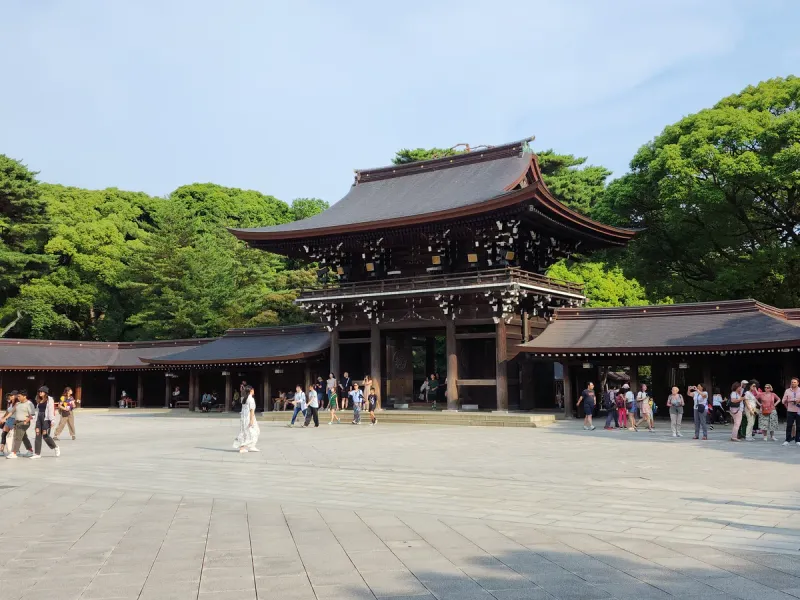
Meiji Jingu is Tokyo's default hatsumode. The shrine says its New Year crowds fill the approach every year, and Tokyo's official tourism site puts the visitors between New Year's Eve and 3 January in the millions. It's dedicated to Emperor Meiji and Empress Shoken, and the walk in through the forest from Harajuku, under the giant wooden torii, is the whole point: it's the one place where the scale of Tokyo's New Year really lands. Normally the gates open at sunrise and shut at sunset (6:40am to 4pm in December, 6:40am to 4:20pm in January). Last New Year it stayed open through the night of the 31st, so you could arrive before midnight and pray in the first minutes of the year; the shrine hasn't published its 2026-27 schedule yet.

Two things set it apart. Its fortune, Omigokoro, has no good or bad luck at all: instead of a grade, you get one of 30 short poems by Emperor Meiji or Empress Shoken with an explanation, and an English version has been offered since 1968. And it only takes back its own old charms, at the returns box to the right of the south water basin. The honest drawback: at peak times the crowd is herded in waves and the prayer itself lasts seconds. Harajuku station on the JR Yamanote line is a minute away, and the Yamanote is the line that runs all night.

Meiji Jingu
shrine · Harajuku
Meiji Jingu
4.7 Google (54,374) 1-3 hours at New Year
1-1 Yoyogikamizonocho, Shibuya, Tokyo 151-8557, Japan
Price: Free Hours: Gates open at sunrise and close at sunset: 6:40am-4pm in December, 6:40am-4:20pm in January. Last New Year it stayed open through the night of 31 December; the 2026-27 New Year schedule isn't published yet.
Tip

Nearest stations: Harajuku (JR Yamanote line, one minute's walk), Meiji-jingumae (Tokyo Metro Chiyoda and Fukutoshin lines) or Sangubashi (Odakyu line). After midnight on the 31st, only the JR route is a sure thing.

Senso-ji

Senso-ji is where I'd see the year in. From early evening on the 31st the precinct gradually fills, and at midnight the bell on Benten-yama, the small hill in the south-east corner of the grounds, is struck to announce the New Year. The temple describes the cheer and applause that goes up at that moment; then three uncounted strokes are rung, followed by the 108 strokes of joya no kane, which take about 40 minutes. The ringers are members of the temple's own bell association, so you're there to listen. From midnight the main hall also starts its special New Year prayers, held every 30 minutes or hourly until near closing, through 7 January.

Draw an omikuji here and you may not like it: Senso-ji's fortunes are the old Kannon hundred-lot set, and the temple admits they're known for a lot of bad results. It says that's just the original system, and a bad one turns good if you live patiently and honestly; if you get one, tie it at the place set aside for it in the grounds. Nakamise, the shopping street up to the temple, is hung with New Year decorations. The catch is getting home: Asakusa's subway and Tobu lines didn't run all night last year. For the area around the temple, see our Asakusa guide.

temple · Asakusa
Senso-ji
4.6 Google (101,082) 1-2 hours at New Year
2-3-1 Asakusa, Taito City, Tokyo 111-0032, Japan
Price: Free Hours: Main hall normally 6:30am-5pm from October to March. New Year's Eve bell at midnight on Benten-yama; special New Year prayers in the main hall from 1 to 7 January.
Tip

Nearest station: Asakusa (Tokyo Metro Ginza line, Toei Asakusa line, Tobu line, Tsukuba Express). There's no JR station nearby, and the Metro, Toei and Tobu lines didn't run all night last New Year's Eve, so plan a taxi or a long walk if you stay past the last train.

Kanda Myojin

Kanda Myojin, just up the hill from Akihabara, is the shrine Tokyo's businesses pray at. Its annual calendar lists a New Year's Eve rite on the 31st, the New Year's Day rite and hatsumode on 1 January, and then, from the first working day of January, the rush of company visits, when office workers come in groups to pray for the year's business. It hasn't published its 2027 New Year schedule yet. Its signature charm is the katsu mamori, a victory charm: the shrine tells the story of Tokugawa Ieyasu praying here before the battle of Sekigahara and winning, after which the Tokugawa family were devoted to the shrine.

Its fortune advice is relaxed: you don't have to tie your omikuji at the shrine, it says, and a good one, or a bad one you want to keep as a warning, can go home with you. It's smaller and quicker than Meiji Jingu, and it's a short walk from JR Ochanomizu, on the Chuo-Sobu local line that ran through the night last New Year. The shrine hasn't published New Year opening hours on its site.

shrine · Akihabara & Ochanomizu
Kanda Myojin
4.4 Google (26,552) 45-90 mins
2-16-2 Sotokanda, Chiyoda City, Tokyo 101-0021, Japan
Price: Free Hours: The shrine's annual calendar lists a New Year's Eve rite (joya-sai) on 31 December, the New Year's Day rite and hatsumode on 1 January, and first-working-day business visits from early January. Its 2027 New Year opening hours aren't published yet.
Tip

Nearest stations: Ochanomizu (JR Chuo-Sobu line, which ran through the night last New Year) and Akihabara (JR). Suehirocho and Shin-ochanomizu are the nearest subway stops.

Zojo-ji

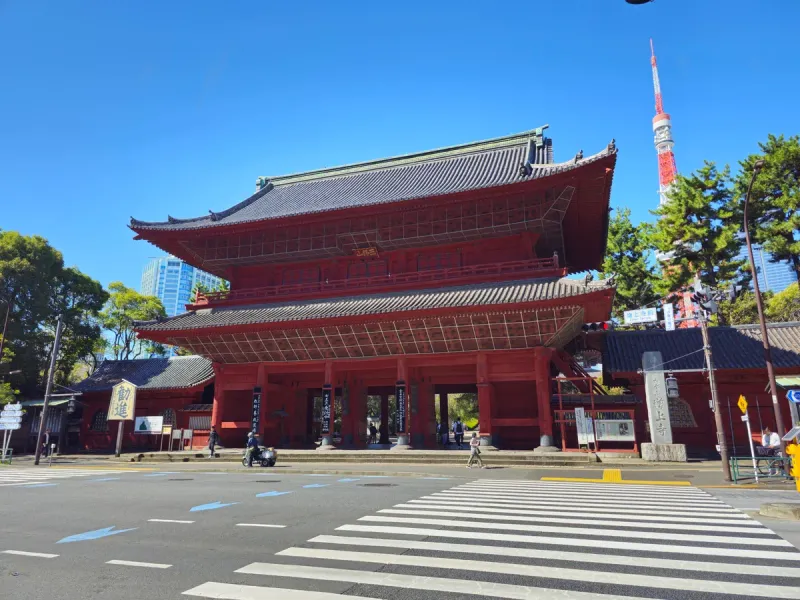
Zojo-ji, the great Pure Land temple under Tokyo Tower, is the place to ring a bell yourself, and it has changed its timing for 2026. Citing the crowds in recent years, the temple has moved its New Year's Eve bell from midnight to earlier in the evening: the bell service starts at 9:30pm on 31 December, and the bell is struck from 9:45pm until about 11pm. The head priest strikes the first stroke, then visitors ring the rest in groups of four. Bell-ringing tickets cost ¥2,000 including a souvenir, and the public allocation goes on sale at 9am on 1 December at the temple office on the second floor of the temple hall building, in limited numbers. One ticket lets one person take part, and if you're not a group of four you'll be put with others.

The rest of the night still runs to midnight. At 8pm on the 31st the temple burns the old charms and tablets people have brought back (it suggests dropping yours off beforehand), and at midnight the New Year service begins in the main hall. Prayers for the year start in the small hours of 1 January and then run every half hour from 9:30am to 4pm on the 1st to the 3rd. The temple's Ankokuden hall keeps the black Amida statue that Tokugawa Ieyasu is said to have carried into battle, which is why people come here to pray for luck in winning. Tokyo Tower lit up behind the main gate makes it the most photogenic hatsumode in the city.

Zojo-ji
temple · Shiba & Tokyo Tower
Zojo-ji
4.5 Google (12,978) 1-2 hours on New Year's Eve
4-7-35 Shibakoen, Minato City, Tokyo 105-0011, Japan
Price: Free to enter; bell-ringing ticket ¥2,000 (with a souvenir) Hours: 31 December 2026: burning of old charms 8pm; bell service 9:30pm; bell struck from 9:45pm to about 11pm; New Year service in the main hall from midnight. Bell tickets on sale from 9am on 1 December at the temple office (second floor of the temple hall building), limited numbers.
Tip

Nearest stations: Daimon (Toei Oedo and Asakusa lines), Onarimon or Shibakoen (Toei Mita line), or Hamamatsucho (JR Yamanote line, which runs through the night on 31 December).

Hie Jinja

Hie Jinja in Akasaka is my pick if you want a real shrine without the Meiji Jingu crush. It sits on a hill among the government buildings of Nagatacho, and it's far quieter than the big two. Its normal hours are 6am to 5pm for the grounds and 8am to 4pm for charms; the 2027 New Year hours aren't published yet. The drawback for a midnight visit is transport: its stations, Tameike-sanno and Akasaka, are Tokyo Metro only, and the Metro didn't run all night last year. Go on the morning of the 1st or on the 2nd.

shrine · Akasaka
Hie Jinja
4.4 Google (13,018) 45-60 mins
2-10-5 Nagatacho, Chiyoda City, Tokyo 100-0014, Japan
Price: Free Hours: Normal hours: gates 6am-5pm, charm counter 8am-4pm, prayers 9am-4pm. New Year hours for 2027 aren't published yet.
Tip

Nearest stations: Tameike-sanno and Akasaka (Tokyo Metro). Both are subway-only, and the subway didn't run all night last New Year's Eve.

Yushima Tenjin (Yushima Tenmangu)

Yushima Tenjin is the shrine of Sugawara no Michizane, the god of learning, and in January it fills with students praying to pass the entrance exams that start that month. The gakugyo mamori, the shrine's charm for study, is the one to buy. You can book a prayer for exam success on the day, without a reservation, from 9am to 4:30pm, from ¥5,000. Normal grounds hours are 6am to 8pm; New Year hours for 2027 aren't published yet. It's a short walk from Yushima station on the Tokyo Metro Chiyoda line and close to Ueno, so it pairs well with a morning in Ueno Park.

shrine · Yushima & Ueno
Yushima Tenjin (Yushima Tenmangu)
4.3 Google (11,934) 30-60 mins
3-30-1 Yushima, Bunkyo City, Tokyo 113-0034, Japan
Price: Free; exam-success prayers from ¥5,000 Hours: Normal hours: grounds 6am-8pm; prayers (no booking) 9am-4:30pm daily; main charm counter 9am-7:30pm. New Year hours for 2027 aren't published yet.
Tip

Nearest station: Yushima (Tokyo Metro Chiyoda line). Ueno-hirokoji and Ueno-okachimachi are a short walk.

── new year's eve · tokyo

What happens on the night of 31 December

New Year's Eve in Tokyo is quiet at home and busy at the shrines. Many families eat toshikoshi soba, buckwheat noodles for a long life, and watch the year out on television; the crowds that go out head for a shrine or temple to be there at midnight. That's called ninen-mairi, a visit that spans two years.

At Buddhist temples, the night is about the bell. Joya no kane, the year-end bell, is a Buddhist temple custom rather than a Shinto one; at Senso-ji it's 108 counted strokes, which are said to clear away the 108 worldly desires of Buddhist teaching (Senso-ji gives this and other explanations for the number). At Senso-ji the bell is rung from midnight by the temple's own bell association. At Zojo-ji you can ring it yourself with a ticket, but in 2026 its bell runs from 9:45pm to about 11pm, not at midnight. Shinto shrines don't ring joya no kane; they hold a year-end rite on the 31st (Kanda Myojin's is the joya-sai) and the first rite of the year on the morning of the 1st.

If you want to see the first sunrise of the year, hatsuhinode, the sun rises at 6:50am in Tokyo on 1 January 2027 (National Astronomical Observatory of Japan). For the wider winter, including illuminations, Christmas and the countdowns, see Tokyo in winter.

── getting there · new year's eve

Which trains run all night on 31 December

JR East (announced): JR East announced on 22 October 2026 that it will run extra trains after the last regular service on the night of 31 December 2026 into 1 January 2027 on six Tokyo-area lines. The Yamanote line runs both ways from about 1am to 4:50am, roughly every 10 to 30 minutes. The Keihin-Tohoku and Negishi line runs between Sakuragicho and Omiya from about 1am to 4am (every 10 to 80 minutes), and the Chuo-Sobu local line between Mitaka and Chiba from about 12:10am to 4:40am (every 10 to 125 minutes). The Chuo rapid line (Mitaka to Takao), Yokosuka line (Yokohama to Zushi) and Sobu and Narita lines (Chiba to Narita, not stopping at Higashi-Chiba) get only a handful of trains each way. Check exact times in JR East's own timetable or app before you rely on them.

Tokyo Metro and Toei subway (not announced yet): neither had published its 2026-27 New Year timetable as of 3 November 2026. Last New Year neither ran all night: Tokyo Metro said it would not run all-night trains, push back its last trains or bring forward its first trains, and ran a Saturday-and-holiday timetable from 30 December to 3 January; Toei likewise ran no all-night service. Assume the same until they announce otherwise.

What that means for your shrine: Meiji Jingu (Harajuku, JR Yamanote), Zojo-ji (Hamamatsucho, JR Yamanote) and Kanda Myojin (Ochanomizu and Akihabara, JR) are on lines that run through the night. Senso-ji (Asakusa) and Hie Jinja (Akasaka) have no nearby JR station: last year Asakusa's Tokyo Metro, Toei and Tobu lines didn't run overnight, and Akasaka is Metro-only. After the last train you're looking at a taxi, a long walk, or waiting for the first trains. Expect long taxi queues after midnight. Getting around Tokyo the rest of the time is easy with a Suica or Pasmo IC card.

── etiquette

How to pray at a shrine and a temple

At a shrine (a jinja or jingu, the ones with a torii gate): bow slightly before you pass under the torii and walk to the side of the path, not the middle. At the water basin, rinse your left hand, then your right, then pour a little water into your cupped left hand to rinse your mouth, and never drink from the ladle (some, like Kanda Myojin's, now pour from a running tap instead). At the hall, put a coin in the offering box, then do Meiji Jingu's sequence: two bows, two claps, pray with your hands together, one deep bow.

At a temple (a tera or ji, with incense and often a pagoda): there's no clapping. Put in your coin, put your hands together, bow and pray quietly. At Senso-ji you'll see people wafting smoke from the big incense burner over themselves before they go in.

At New Year specifically: the queue is the experience, so move with it and follow the staff, who manage the crowd in waves at the big shrines. Throwing your coin from a few rows back is normal when you can't reach the box. A 5-yen coin is a popular offering because 'go-en' sounds like the word for a good connection, but any amount is fine. Have coins ready before you reach the front. Don't stop to take photos in the middle of a moving queue.

── omamori, omikuji, hamaya

What to buy, and what to bring back

Omamori are charms in small cloth pouches, each for something specific: health, safe travel, study, love, business or traffic safety. Keep it on you (in a bag or wallet) and don't open it. Kanda Myojin's victory charm and Yushima Tenjin's study charm are the two most famous in central Tokyo.

Omikuji are paper fortunes, drawn from a box or shaken out as a numbered stick. The usual grades run from great luck (daikichi) down to bad luck (kyo), and if you get a bad one, you tie it to the frame provided so the bad luck stays at the shrine. Senso-ji is known for its high share of bad fortunes; Meiji Jingu's have no luck grades at all, just a poem; and Kanda Myojin says you can take any fortune home.

Hamaya are decorative arrows, the name means 'evil-breaking arrow', sold at many shrines over the New Year period to protect a home for the year. They're light and come in a sleeve, so they travel in a suitcase.

Bring back last year's charms. Charms are meant to last a year, and shrines and temples collect old ones to burn. Kanda Myojin says it's best to return them to the shrine you got them from (it takes paper and wooden items, not dolls or daruma); Meiji Jingu only accepts its own; Zojo-ji burns returned charms at 8pm on New Year's Eve and suggests dropping them off before the 31st.

── crowds and timing

When to go, and what the queues are like

None of these shrines publishes queue times, so treat this as general guidance rather than official figures. The crowds peak in two places: the hour or two either side of midnight on 31 December, and late morning to late afternoon on 1, 2 and 3 January. Meiji Jingu is by far the busiest. The calmest windows are early morning, and after dark on the 2nd and 3rd at shrines that stay open.

You don't have to go on the 1st. Visiting in the first week of January is still hatsumode: Senso-ji's special New Year prayers and charms, for example, run to 7 January. From about 4 January the crowds thin at the tourist shrines, though Kanda Myojin gets busy with office groups on the first working days.

Practical kit for the night of the 31st: warm layers (the average January low is 1.2°C, 34°F; see Tokyo in winter for the weather), cash in coins for the offering and charms, a charged phone, and a plan for getting home.

── 1-3 january

What's open and closed from 1 to 3 January

Open: the big hatsumode shrines and temples, at their busiest of the year and often with special New Year hours, so check each one's published schedule. Most convenience stores stay open, though individual branches can shorten their hours, and hotel restaurants are a safe bet for meals. Trains run on holiday timetables (last year Tokyo Metro ran its Saturday-and-holiday timetable from 30 December to 3 January).

Mixed: the first days of January are Japan's main family holiday, and many small independent restaurants, bars and shops close for a few days around New Year; chains and places in the big stations and malls are more likely to be open. Some big sights reopen early: the Tokyo National Museum in Ueno closes from 26 to 31 December 2026, then opens on 1 January 2027 from noon to 8pm. Others close on New Year's Day: Tokyo Midtown in Roppongi closed on 1 January last year. Check each place's own site for its New Year dates, which most post in December.

Closed: banks are closed from 31 December to 3 January. Most offices and many government services shut for the same days.

Also on 2 January: the Emperor's New Year greeting at the Imperial Palace, when the imperial family appears on the palace balcony several times through the day and anyone can go in. Last year it ran from 9:30am to 2:10pm on 2 January; the Imperial Household Agency hasn't published the 2027 details yet.

Planning your trip to Tokyo? Save these places to your itinerary with Tourli, the app that turns travel guides into actionable day plans.

── frequently asked

Frequently asked questions.

What is hatsumode?
Hatsumode is the first visit of the year to a Shinto shrine or Buddhist temple, to thank the gods for the old year and pray for the new one. Many Tokyo residents go just after midnight on 1 January, but most go some time between 1 and 3 January, and it's still normal to go in the first week of January. You don't need to be religious or Japanese to take part: you queue, make an offering, pray, and usually buy a new charm or draw a fortune.
Which shrine is best for hatsumode in Tokyo?
For the classic, biggest experience, Meiji Jingu in Harajuku: it draws Tokyo's biggest New Year crowds, and it was open through the night of 31 December last year. For the midnight bell and a temple atmosphere, Senso-ji in Asakusa. For something calmer, Hie Jinja in Akasaka or Kanda Myojin near Akihabara. If you're studying for an exam, Yushima Tenjin, the shrine to the god of learning.
Do trains run all night on New Year's Eve in Tokyo?
Some do. JR East announced on 22 October 2026 that it will run late-night trains after the last regular service on 31 December 2026 on six lines, including the Yamanote line (roughly every 10 to 30 minutes from about 1am to 4:50am) and the Chuo-Sobu local line. Tokyo Metro and the Toei subway haven't announced their 2026-27 plans yet; last New Year neither ran all night, so Asakusa and Akasaka were not reachable by subway after the last train.
How long is the queue at Meiji Jingu at New Year?
Meiji Jingu doesn't publish queue times. As general guidance, the longest waits are in the hour or two around midnight on 31 December and from late morning to late afternoon on 1 to 3 January. If you want a shorter wait, go in the early morning or after dark on 2 or 3 January, or any time from 4 January.
What should I buy at a shrine at New Year?
The usual New Year purchases are an omamori (a small charm in a cloth pouch, for health, study, safe travel or luck), a hamaya (a decorative arrow that wards off evil, sold at many shrines over New Year), and an omikuji (a paper fortune). Bring back last year's charms: most shrines and temples have a place to return them for burning, though Meiji Jingu only takes its own.
Can you ring the temple bell on New Year's Eve in Tokyo?
At Zojo-ji, yes, with a ticket. For 2026 it has moved its New Year's Eve bell earlier: the service starts at 9:30pm on 31 December and the bell is struck from 9:45pm until about 11pm. Bell-ringing tickets cost ¥2,000 (with a souvenir) and go on sale at the temple office from 9am on 1 December, and four people strike the bell together. At Senso-ji the 108 strokes at midnight are rung by members of the temple's own bell association, so visitors listen rather than ring.
── save these to your tokyo trip

Stop reading lists.
Start the trip.

Tourli turns any guide into an actionable day plan — pinned to a map, walking directions and offline access included. One tap to save every place on this page.

── travel inspiration, weekly

One short email, every Sunday.

New guides, off-the-radar places and the occasional discount. No spam, unsubscribe anytime.