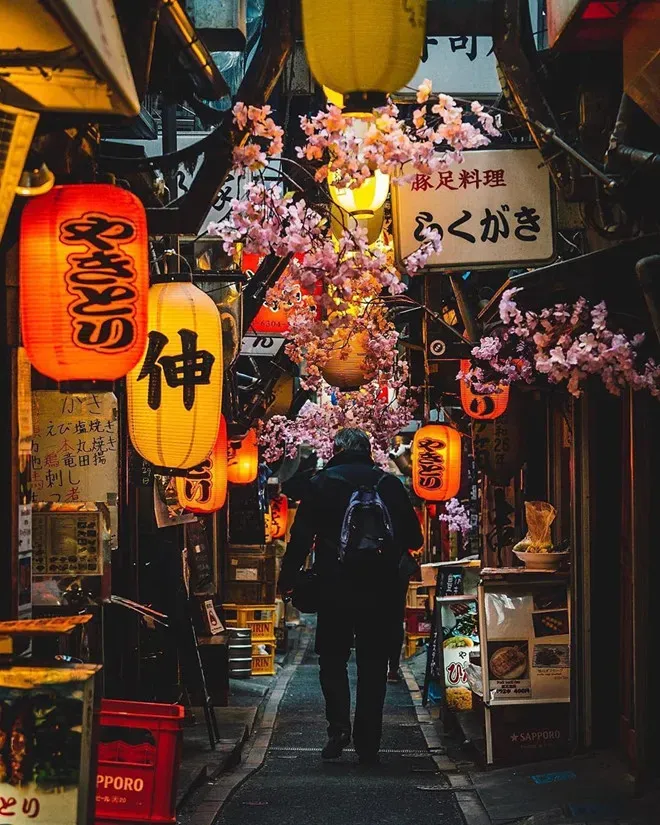
Many shops are cash only, some have their own ordering rules, and the shops on Nakadori share one toilet.
Shinjuku's two post-war drinking alleys: Omoide Yokocho's 60-odd grills by the tracks and Golden Gai's 280 tiny bars by Hanazono Shrine. When they open, cover charges, photo rules, cash and smoking, 11 bars and grills, and an evening route from one to the other.
Shinjuku has two old drinking quarters that grew out of the black markets around the station after the war, and they are quite different nights out. Omoide Yokocho, on the west side by the tracks, is about 60 tiny grills and bars serving charcoal-grilled skewers and beer, open from the afternoon. Golden Gai, a short walk east by Hanazono Shrine, is about 280 bars, most of them a counter and a handful of stools, opening around 8pm and running until the small hours.
The short version: eat at Omoide Yokocho first, then walk to Golden Gai after 8pm. Bring cash. Don't smoke or drink in the lanes. Check the charge before you sit down, keep your group small, and keep your camera away unless someone says yes. For the rest of the neighbourhood, from Shinjuku Gyoen to Kabukicho, see our Shinjuku guide, and for the whole city, things to do in Tokyo.
Omoide Yokocho
Omoide Yokocho ('Memory Lane') is a knot of narrow lanes beside the JR tracks just north-west of Shinjuku Station. Its shopkeepers' association, the Shinjuku Nishiguchi Shopping District Promotion Association, traces it to an open-air black market that sprang up on the burned-out land after the war. Today about 60 places to eat and drink, mostly motsuyaki (grilled offal) and yakitori grills, plus ticket shops and the like, about 80 in all, are packed onto roughly 2,000 square metres. The association's president writes that many of its buildings are the barracks put up after the war, and a fire on 24 November 1999 burned about a third of the alley; that date is now Omoide Yokocho Day.
Getting there: about 2 minutes on foot from Shinjuku Station's west side, says GO TOKYO, the city's official tourism site; the association also lists Seibu-Shinjuku and Toei Oedo Line Shinjuku-nishiguchi stations. Torien, one of its restaurants, warns that while the big rebuilding works around the west exit continue, walking round from the east exit can be quicker. When: shops set their own hours; the places below open between 11:30 and 17:00, and most close around midnight. Cost: free to walk through.
The house rules. Kenji Murakami, the association's president and the second-generation owner of Sushi Tatsu, wrote a guide for first-timers in 2021, and it is still the clearest account of how the alley works. Bring cash: about 60% of the shops took cash only. Some shops have their own rules: a table charge, one drink and one food item per person on arrival, or a 90-minute limit, so check before you go in. The shops on Nakadori don't have their own toilets and share one communal block, rebuilt in 2021 with a ladies' toilet; go before you're desperate. And don't smoke in the lanes: smoking is only allowed inside shops that permit it, because of that 1999 fire.
Omoide Yokocho Day 2026. The association marks 24 November each year. For 2026 it sells a commemorative T-shirt on Friday 20 to Sunday 22 November, from a booth outside Tajimaya Coffee and at some shops, and each buyer gets a voucher for a free drink. One more thing: you'll see an older English nickname for the alley online. It comes from a Japanese name that the association asks the media never to use.

Many shops are cash only, some have their own ordering rules, and the shops on Nakadori share one toilet.
Dai-ichi Horaiya is where Omoide Yokocho's motsuyaki began: it says it was the first shop in the alley to sell grilled offal, in 1947, and the tare (basting sauce) has been topped up for over 70 years. Skewers are grilled over charcoal; the menu runs from tongue, heart and liver to the unfamiliar cuts, and it also serves offal as sashimi.
Order: the chef's choice of five skewers (¥880), or pick your own at ¥176 each (prices from the menu on its site, dated November 2024). Open: weekdays and holidays 3:30pm to midnight, Friday and Saturday 4:30pm to 1am. It closes on irregular days, which it marks on the calendar on its website. Pay: cash only, says the association listing. The catch: only 20 seats, per the association listing.
The first shop in the alley to sell motsuyaki, in 1947. Cash only, 20 seats.
Kikuya, open since 1956, is a motsuyaki house on two floors with a few seats outside, 61 in all. It's known for skewers in its own topped-up sauce or special salt, handmade croquettes and menchi katsu, and a house chuhai (shochu highball) it calls the original.
Order: skewers come in pairs (it asks for at least two per order), salt or sauce. The association listing from October 2024 gives ¥132 a skewer, ¥495 for the stew and ¥528 for two croquettes. Open: Monday to Friday 3pm to 11:30pm, weekends and holidays 3pm to 11pm. Book: by phone (03-3342-5928); it recommends booking at weekends. Pay: cash or PayPay, per the association listing. The catch: smoking is allowed at every seat.
Order skewers two at a time, minimum. Smoking is allowed at every seat.
Kabuto has served nothing but eel since just after the war: every part of the fish, from the head and fins to the liver and tail, skewered and grilled over binchotan charcoal. The association's president picked it out in 2021 as a shop with its own rules: there's essentially one item on the menu, everything, and the skewers arrive one after another without you ordering. He also wrote that it allowed three alcoholic drinks per customer, so that people queueing don't wait too long.
Order: there's nothing to choose; the 2021 listing gave ¥350 for a kabayaki skewer and ¥400 for the fins. Open: 1pm to 8pm, closed Sundays and national holidays (the association listing is dated March 2021, and Kabuto has no website, so check before a special trip). Pay: cash only. The catch: 11 seats, early closing, and it isn't for anyone who doesn't eat eel.
There's no ordering: the eel skewers come in turn. The association president wrote in 2021 that it allowed three alcoholic drinks per customer. Cash only, 11 seats.
Torien is the alley's biggest restaurant and, it says, its oldest, trading since the black-market days: three floors, a terrace outside, and a long menu of yakitori, sashimi and izakaya dishes. It takes bookings, groups and children.
Order: the signature shamoji tsukune, a chicken meatball pressed onto a wooden rice paddle, with a choice of four toppings (¥825), and the motsu stew (¥660). Courses with all-you-can-drink start at ¥3,500. Open: every day, 11:30am to 11:45pm; closed only on New Year's Day. Book: by phone (03-3342-2011, busiest after 6pm) or through Tabelog or Hot Pepper. The catch: it's a large restaurant rather than a tiny counter. Heated tobacco is allowed on the lower floors; the third floor is non-smoking.
The alley's biggest restaurant, on three floors, and it takes bookings. Heated tobacco only inside; the third floor is non-smoking. Children welcome.
Yasubee, founded in 1950, calls itself the largest independent restaurant in the alley: 83 seats over two floors, with tatami rooms upstairs, fish bought fresh every day and sake from all over Japan. It's the sit-down izakaya option, with private rooms for groups.
Order: the seasonal sashimi platter (¥1,705 per person) and the tamagoyaki (¥605), prices from the association listing of June 2024. Open: until 11:20pm Monday to Saturday (food last order 10:40pm) and until 10pm on Sunday; the association listing gives 4pm as opening time. Closed over New Year and on irregular days it posts on its site. Pay: cards and e-money accepted. The catch: smoking is allowed at every seat, and on Fridays and nights before holidays it asks for about two hours per table.
Cards and e-money accepted. Smoking at all seats. On Fridays and nights before holidays it asks groups to keep to about two hours.
Sushi Tatsu is the only sushi bar in Omoide Yokocho, run by its second-generation owner, Kenji Murakami, who wrote the association's 2021 guide for first-timers as its president. The association listing says it makes its own thick tamagoyaki, and that the nigiri come already seasoned, so skip the soy sauce except on the rolls.
Order: the omakase (¥4,400), or nigiri (¥3,300). Open: 5pm to 11:45pm, closed Sundays and holidays. Book: reservations get priority, phone 03-3342-0740. Pay: cash only. Details are from the association listing of June 2024; the shop has no website. The catch: closed on Sundays, and cash only.
Reservations get priority: phone 03-3342-0740. Cash only.
Albatross, opened in 1997, describes itself as the only bar in Omoide Yokocho: a red room lit by candles and chandeliers, with an art gallery upstairs. It serves cocktails and stays open later than the grills.
Open: every day, Sunday to Thursday 5pm to 2am, Friday and Saturday until 5am (its Japanese text gives a 4pm Friday and Saturday start, its English text 5pm). Charge: the association listing (March 2021) gives a ¥300 charge and drinks from ¥500; the bar's own site doesn't publish prices, so treat that as a guide. The catch: the only prices on record are five years old.
A chandelier-lit gallery bar, open since 1997; the upstairs room is an art gallery.
Golden Gai
Golden Gai is a block of low wooden row houses, about 2,000 tsubo (around 6,600 square metres), holding more than 280 small bars along seven lanes: G1 and G2 streets, Akarui Hanazono 1st, 3rd, 5th and 8th streets, and Maneki-dori. It has two shopkeepers' associations because it began as two groups of post-war stalls, moved here when the area around the station was cleared from the end of the 1940s: one from the Wada-gumi black market in front of the station, the other from the stalls around Shinjuku 2-chome. The lanes are private land, not public streets. Its bars were famous in the 1960s and 70s as hangouts for writers, film-makers and actors, survived the land speculators of the 1980s bubble, and have filled with younger owners and overseas visitors since the 2000s.
Getting there: about 5 minutes on foot from the east exit of Shinjuku Station, says GO TOKYO, and about 3 minutes from Shinjuku-sanchome Station (Marunouchi, Fukutoshin and Toei Shinjuku lines), as the Ramen Nagi branch inside it gives the walk. It sits just west of Hanazono Shrine, with the Shiki no Michi promenade, an old tram line, along its western edge. When: most bars open around 8pm, says GO TOKYO; the Sanko association gives business hours as roughly 7pm to 5am. A few places run earlier, and the Ramen Nagi branch on the second floor at 1-1-10 opens 24 hours (see our best ramen in Tokyo guide). Not every bar is open to you: GO TOKYO notes that some are members-only.
The house rules. The Shinjuku Golden Gai Shopping District Promotion Association publishes six rules: no smoking in the street (it's a district of wooden row houses); no drinking while walking, and no taking glasses out of the bars; photos and video need permission; don't hang around or sit in the lanes making noise; use the nearby public toilet rather than the back alleys; and don't damage or graffiti signs and shopfronts.
How to drink here, by the association's own advice. Come in small numbers: the bars are tiny, many customers drink alone, and some bars turn groups away. Check the price system before you go in: almost every bar adds an otoshi (a small dish) or a seat charge on top of drinks, usually ¥500 to ¥1,500. More bars have dropped the charge for overseas visitors, but some have no menu at all, and some are members-only and turn first-timers away. Respect the owner behind the counter and the regulars. Don't overstay: when a bar fills up, giving your seat to a newcomer is good form, and Golden Gai is meant for bar-hopping, so ask the owner where to go next. The bars below publish their own details, and the bar picks in our best bars in Tokyo guide include two more Golden Gai bars.

No smoking or drinking in the lanes, photos only with permission, small groups only, and check the charge before you sit.
Albatross G, on 5th Street, is the Golden Gai sister of the Omoide Yokocho bar, and its owners say it gets overwhelming support from overseas customers: the most direct sign of any bar here that visitors are wanted. They describe it as a grown-up's secret hideout.
Open: every day, 7pm to 5am. Charge: not published on its website, so ask. The catch: with no published charge, you'll need to ask at the door.
Sister bar of the Albatross in Omoide Yokocho. Its own site says it is hugely popular with overseas guests.
Natsu no Tobira ('The Door into Summer'), also on 5th Street, is a ground-floor bar. Its website lists the charge and its hours, and says first-timers are welcome.
Charge: ¥800. Open: 8pm to about 2am; closed Monday and Tuesday. The catch: no drinks list is published online.
Its own site says first-timers are welcome. Ground floor.
Bar Tomorrow, on Akarui Hanazono 1st Street, calls itself a bar that connects Tokyo's people and culture, like a small club room for people who enjoy drinking alone but don't like being lonely. Upstairs is a tiny gallery lounge with art on the walls.
Charge: ¥500, drinks from ¥700. Open: Sunday to Thursday 7pm to midnight, Friday and Saturday 7pm to 2am. The catch: it closes at midnight from Sunday to Thursday.
Pitches itself at people who like drinking alone but not being lonely. A tiny gallery lounge upstairs.
3rd ROOM, on the fourth floor of the Palace Building in 8th Street, breaks the Golden Gai mould: a café by day, with natural light, and a bar at night, with pasta, curry and desserts. It says it takes everyone from solo drinkers to groups.
Open: Monday to Thursday 5pm to 2am, Friday and Saturday 5pm to 4am, Sunday 3pm to 11pm; irregular days off. Spend: draft beer ¥700 a glass. The operator's own page for the bar lists a ¥600 table charge, which its current site doesn't mention, so ask. The catch: it's on the fourth floor rather than at street level.
A café-bar on the fourth floor that says it takes everyone from solo drinkers to groups.
Start at Omoide Yokocho between 5pm and 7pm, when most of the places above are open (Kabuto and Sushi Tatsu close on Sundays and holidays). Have a few skewers at Dai-ichi Horaiya or Kikuya, or book Torien if you're a group, then a drink at Albatross.
From the north end of the alley, walk under the railway bridge (the Ogado) and east along Yasukuni-dori, past Kabukicho, to Golden Gai, the block just west of Hanazono Shrine: under a kilometre. Aim to arrive after 8pm, when most bars are open.
In Golden Gai, pick two or three bars rather than settling into one: Bar Tomorrow (¥500 charge) or Natsu no Tobira (¥800) to start, Albatross G, which is open until 5am, to finish. With a group, go to 3rd ROOM, which says it takes them. For food after midnight, see late-night food in Tokyo.
Planning your trip? Save these bars and grills into a day-by-day plan with Tourli, the app that turns travel guides into actionable itineraries.
Cash: bring yen. Omoide Yokocho's association asks first-timers to bring cash rather than cards, and many of the bars here don't publish which payments they take. Yasubee takes cards; Kikuya takes PayPay.
Smoking: both areas ban smoking in the lanes, and Shinjuku City bans smoking on the street across the whole ward, outside designated smoking areas. Inside, it depends on the bar: Kikuya and Yasubee allow smoking at every seat; Torien allows heated tobacco only and has a non-smoking third floor. If smoke bothers you, ask before you sit down.
Photos: Golden Gai's lanes are private land. There, photos and video need permission, and its filming terms say even a close-up of the streetscape or a sign counts; for students and individuals, photo shoots start at ¥10,000 an hour and video at ¥20,000 before 6pm, more after. Omoide Yokocho's terms say street photography needs an application at least 10 days ahead and costs ¥30,000 (plus tax) per 30 minutes; tripods and flash are banned, and unauthorised filming is charged on the spot. Inside a bar or restaurant, ask the staff first, and ask people before you photograph them.
Groups: Golden Gai's association asks you to avoid big groups and check before going in, though it notes a few bars can seat 10 to 20. 3rd ROOM says it takes groups, as do Torien and Yasubee in Omoide Yokocho.
Toilets: in Omoide Yokocho, the shops on Nakadori share one communal block. In Golden Gai, the association points you to the nearby public toilet.
More nights out: the best izakaya in Tokyo has Shibuya's Nonbei Yokocho and other alleys, the best yakitori in Tokyo has the city's top grills, and Tokyo nightlife covers clubs, karaoke and live music.
Stop reading lists.
Start the trip.
Tourli turns any guide into an actionable day plan — pinned to a map, walking directions and offline access included. One tap to save every place on this page.