
Things to Do in Ginza, Tokyo (2026 Neighbourhood Guide)
Ginza is where Tokyo puts on its best suit. It is the city's oldest and most prestigious shopping district, home to more sushi counters per block than anywhere else on earth, and the place where a department store basement food hall can be just as exciting as a Michelin-starred restaurant upstairs. But it is also, five minutes on foot from the brand-name boulevards, the gloriously chaotic Tsukiji Outer Market, where you eat grilled scallops standing up at 8 AM. This guide covers all of it.
Things to Do in Ginza: A Neighbourhood Guide
Ginza is the part of Tokyo that feels like it was designed by someone with very strong opinions about presentation. Every storefront is immaculate. The department store food halls could pass for art galleries. The sushi counters have been perfecting the same twelve-piece omakase for longer than most cities have had restaurants. And then, about a five-minute walk east, the whole mood shifts to Tsukiji Outer Market, where you’re eating grilled king crab legs at 8 AM while standing in an alley next to a man selling dried bonito the size of your forearm.
That contrast is what makes Ginza one of the most interesting neighbourhoods in Tokyo. It is not just the luxury shopping destination that its reputation suggests. Yes, you can spend a small fortune on Chuo-dori. But you can also watch a single act of kabuki for ¥1,000, drink world-class coffee for ¥500, eat standing sushi for ¥200 a piece, and visit a free contemporary art gallery inside the Hermes building. Ginza rewards people who look past the obvious.
This guide covers the whole Ginza and Tsukiji area, from the sushi counters and ramen shops to the rooftop gardens, art spaces, and department store basements. If you are planning meals across the city, our best restaurants in Tokyo guide covers every neighbourhood, and our best sushi in Tokyo guide goes deep on the omakase scene.
Tsukiji: Start Your Morning Here
The wholesale tuna auction moved to Toyosu in 2018, and you’ll still hear people say Tsukiji is “finished.” They are wrong. The Outer Market stayed exactly where it was, and it is still one of the best food experiences in the city. Over 400 stalls and shops line the narrow lanes, selling everything from fresh uni and tamagoyaki to grilled scallops, wagyu skewers, and matcha soft serve. The key is to arrive early. By 7 or 8 AM the stalls are fully operational and the crowds haven’t peaked yet. By noon, the best stuff has sold out and the energy is winding down.
The strategy is simple: show up hungry, bring cash, and graze. Buy a few pieces of sashimi here, a grilled oyster there, a tamagoyaki on a stick from the next stall over. Don’t try to plan a route. Just wander the lanes and follow whatever smells best.
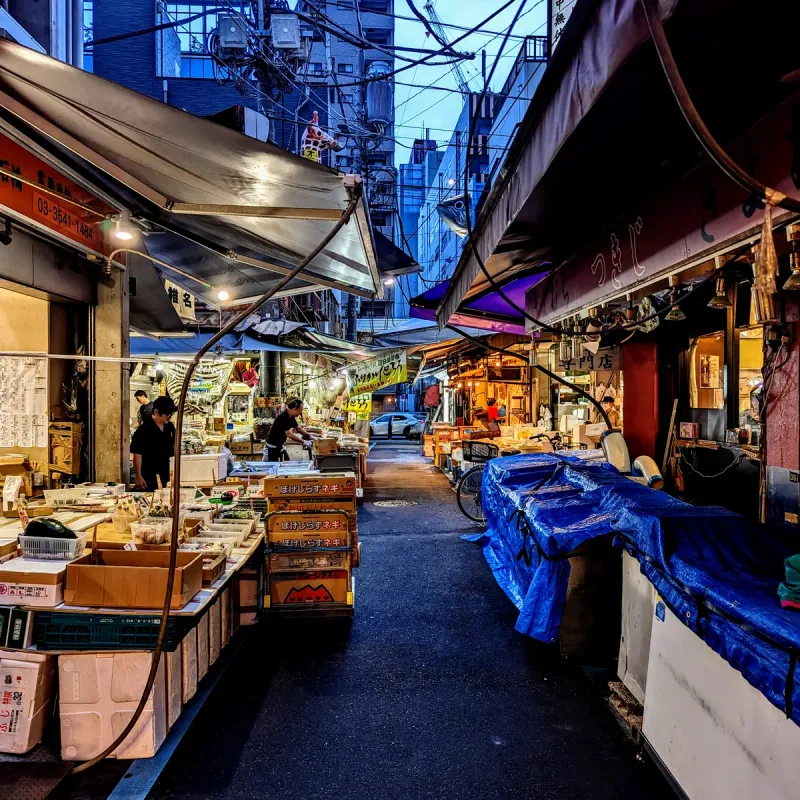
Tsukiji Outer Market
- Over 400 shops and street food stalls
- Fresh seafood, tamagoyaki, and grilled skewers
- One of Tokyo's best morning food experiences
Arrive before 9 AM for the freshest food and smallest crowds. Most stalls close by early afternoon.
"Tsukiji Outer Market remains a top food destination in Tokyo despite the inner market's move to Toyosu. Visitors praise the huge variety of fresh seafood, street food, and the lively atmosphere, especially in the morning hours."
Once you’ve grazed your way through the stalls, Tsukiji Ihachi honten is worth a proper sit-down. They serve A5 wagyu steak that you cook yourself on a hot stone at the table. The lunch sets are the move here, offering that same high-grade beef at a price that would be impossible in central Ginza. Watching the fat render and hearing it sizzle on the stone is half the experience. The other half is the first bite, which is genuinely one of the best things you can eat in this city for under ¥3,000.
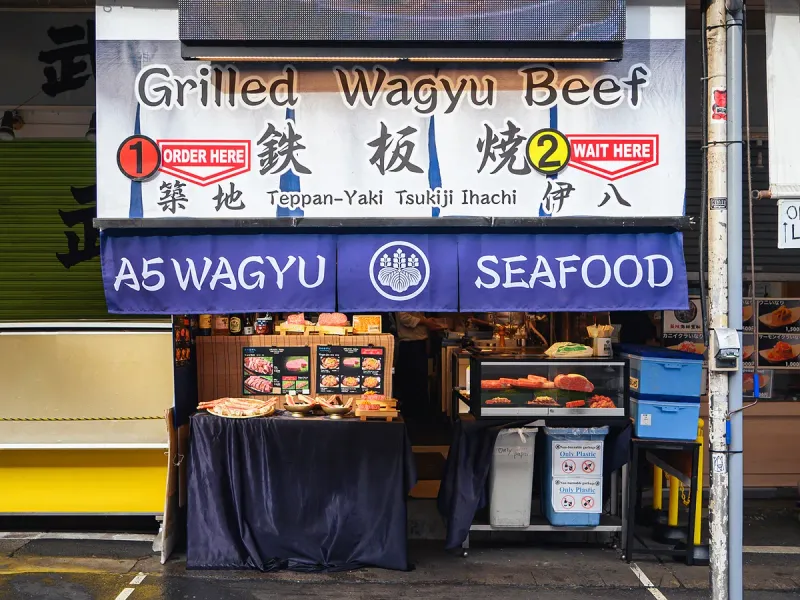
Tsukiji Ihachi honten
- A5 wagyu steak grilled on a hot stone at your table
- Located steps from Tsukiji Outer Market
- Excellent value lunch sets
Go for the A5 wagyu steak set at lunch for the best value.
"Tsukiji Ihachi honten offers a unique and delightful dining experience with its A5 wagyu steak, grilled on a hot stone at your table. The quality of beef and the theatrical presentation consistently impress visitors."
For sushi near Tsukiji, skip the overpriced tourist spots on the main drag and head to Standing Sushi Bar instead. It’s exactly what it sounds like: you stand at a counter, order individual pieces of nigiri, and eat them as the chef makes them. Pieces run ¥200 to ¥400 each, the fish is impeccably fresh, and you can have a genuinely excellent sushi experience for ¥2,000 or less. The tuna and uni are the standouts. A perfect 5.0 on Google, which tells you everything about what regulars think. For more affordable options across the city, see our cheap eats in Tokyo guide.
Standing Sushi Bar
- Perfect 5.0 Google rating
- Affordable standing sushi near Tsukiji
- Individual nigiri pieces from ¥200-400
Order piece by piece and stop when you're full. The tuna and uni are standouts.
"A no-frills standing sushi bar near Tsukiji where fresh fish is served piece by piece at excellent prices. Reviewers love the quality-to-price ratio and the casual, quick-service format."
Ginza’s Sushi Scene
Ginza is, without exaggeration, the sushi capital of Tokyo. And since Tokyo is the sushi capital of the world, that makes Ginza the single highest concentration of top-tier sushi counters anywhere. The original Sukiyabashi Jiro is here. So are dozens of other omakase counters where chefs who trained for a decade serve twelve to twenty courses of Edomae-style sushi, where the fish is treated, cured, or aged rather than served raw.
If you can get a reservation (and plan ahead, because many of these counters book out weeks in advance), Ginza Kousui is a remarkable experience. A perfect 5.0 on Google, intimate enough that you can talk with the chef, and the fish quality is extraordinary. This is the kind of place where each piece arrives one at a time, and the rice is still warm when it reaches you. Reservations are possible through their website and Instagram, and the counter seats are the way to experience it.
Ginza Kousui
- Intimate omakase experience with exceptional fish quality
- Perfect 5.0 Google rating
- Chef interaction at the counter
Reserve through their website or Instagram. The counter seats are the best experience.
"Ginza Kousui offers an amazing omakase experience in an intimate setting. Guests rave about the freshness of each piece and the attentive service."
For a Michelin-starred experience, Sushi Arai is one of Ginza’s finest. Chef Arai’s technique is precise in a way that’s almost hypnotic to watch. The rice seasoning is dialled in perfectly, the fish is sourced seasonally, and the whole meal unfolds at a pace that lets you appreciate each piece. This is a splurge, and reservations typically need to go through a hotel concierge or a Japanese-language booking service, but if you’re going to have one blowout sushi meal in Tokyo, Ginza is the neighbourhood to do it. Our best sushi in Tokyo guide covers the full range from standing bars to high-end counters.
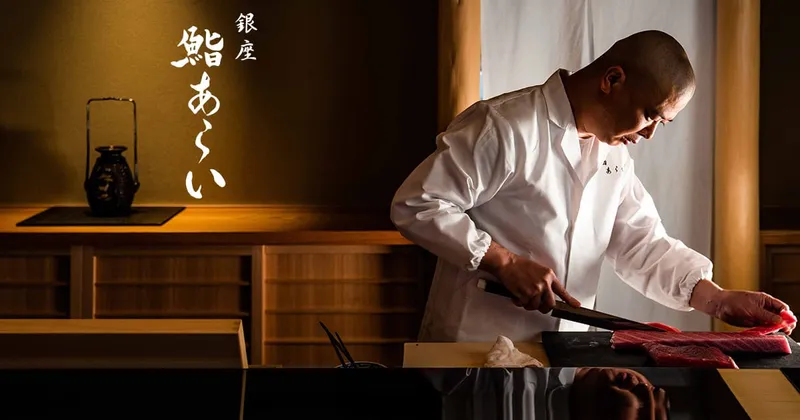
Sushi Arai
- Michelin-starred Edomae sushi
- Chef Arai's precise technique and seasonal sourcing
- One of Ginza's top sushi counters
Book well in advance through a hotel concierge or Japanese reservation service. Lunch is slightly easier to secure.
"Sushi Arai is a Michelin-starred sushi restaurant in Ginza where Chef Arai serves impeccable Edomae-style sushi. Reviewers praise the quality of the fish, the precision of the rice seasoning, and the calm, focused atmosphere."
Ramen and Coffee Breaks
Not everything in Ginza requires a reservation or a second mortgage. Ginza Kagari is one of the best ramen shops in Tokyo, full stop. Their tori paitan (chicken broth) is thick, creamy, almost porridge-like in consistency, and deeply savoury in a way that hits different from the usual tonkotsu or shoyu bowls. There are only 8 seats around a U-shaped counter, and the queue starts forming before the 11 AM opening. Arrive early, bring cash, and get the chicken paitan shoyu. The truffle-flavored version is also excellent if you want something richer. A bowl costs around ¥1,100, which makes this some of the best value eating in the neighbourhood.
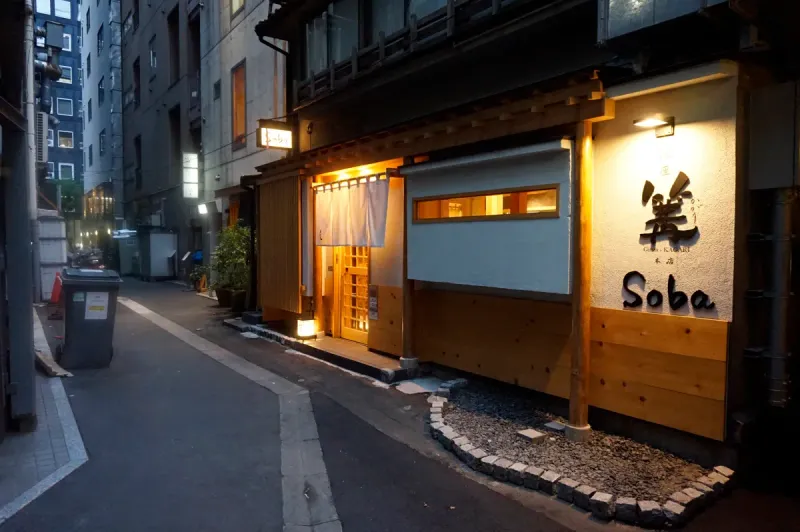
Ginza Kagari
- Famous creamy tori paitan chicken broth
- Michelin-recommended ramen
- Truffle-flavored chicken ramen option
Arrive before 11 AM opening to beat the queue. Cash only. Try the chicken paitan shoyu.
"A small ramen spot known for its rich and creamy chicken broth that keeps customers coming back despite long queues. Only 8 seats around a U-shaped counter."
For caffeine, Brewman Tokyo GINZA does specialty coffee properly. Pour-over single origins, carefully roasted beans, and a calm atmosphere that provides a welcome contrast to the pace of the shopping streets outside. It is a good first stop if you’re starting your Ginza day after Tsukiji, or a useful reset in the afternoon when your legs start complaining.
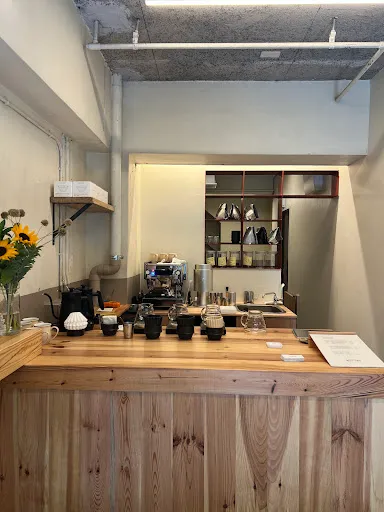
Brewman Tokyo GINZA
- Specialty coffee with expertly roasted beans
- Near-perfect 4.9 Google rating
- Calm atmosphere for a caffeine reset
Try the pour-over single origins. A good morning stop before exploring Ginza.
"Brewman Tokyo GINZA is a specialty coffee shop where carefully sourced beans and precise brewing produce exceptional cups."
Culture, Art, and Theatre
Ginza has a cultural side that’s easy to overlook if you’re focused on the food and shopping. Kabuki-za, the massive traditional theatre on Harumi-dori, has been staging kabuki performances since 1889 (the current building, its fifth incarnation, reopened in 2013). A full kabuki performance runs three to four hours, which is a commitment, but the theatre also sells single-act tickets from a separate entrance on the fourth floor. These cost ¥1,000 to ¥2,500, let you watch one act, and come with the option of renting an English subtitle guide. The costumes are spectacular, the rotating stage is genuinely impressive, and even without understanding every word, the drama translates. It is one of the most distinctly Japanese experiences you can have in Tokyo.
Kabuki-za Theatre
- Japan's most famous kabuki theatre since 1889
- Affordable single-act tickets from ¥1,000
- Impressive traditional architecture and rotating stage
Single-act tickets (hitomaku-mi) from the 4th floor entrance are the budget-friendly way in. English subtitle guides available.
"Kabuki-za is a landmark theatre in Ginza offering both full kabuki performances and affordable single-act tickets. Even non-Japanese speakers appreciate the elaborate costumes and dramatic stagecraft."
For contemporary art, Maison Hermes Le Forum is a genuine surprise. Yes, it’s in the Hermes building. Yes, that Hermes. But the gallery on the upper floors hosts serious contemporary art exhibitions by international artists, and admission is free. The building itself, designed by Renzo Piano entirely from glass blocks, is worth seeing from the outside after dark when it glows like a lantern. Inside, the exhibitions rotate regularly and the curation is thoughtful. It is one of the best free cultural experiences in Ginza, and most tourists walk right past it.
Maison Hermes Le Forum
- Free contemporary art gallery
- Housed in Renzo Piano's stunning glass-block building
- Rotating exhibitions by international artists
Free entry. Check the current exhibition online before visiting. The Renzo Piano glass building itself is worth seeing.
"Le Forum in the Maison Hermes building hosts thoughtful contemporary art exhibitions in a beautiful Renzo Piano-designed space. Visitors appreciate the quality of the curation and the fact that entry is free."
Shopping, Depachika, and Chuo-dori
The main shopping boulevard, Chuo-dori, runs north-south through the heart of Ginza and becomes pedestrian-only on weekends and holidays (noon to 6 PM in summer, noon to 5 PM in winter). When the cars disappear, the wide boulevard fills with people strolling between the flagship stores. It is the best time to visit. The major brands are all here, Chanel, Louis Vuitton, Cartier, Mikimoto, but the architecture of the buildings is often more interesting than what’s inside them. Ginza Six, the largest commercial complex in the district, is worth visiting even if you buy nothing. The Tsutaya bookshop on the sixth floor specialises in art publications and is beautifully curated. And the rooftop garden is free, quiet, and offers views over the Ginza rooftops that very few visitors know about.
Ginza Six Rooftop Garden
- Free rooftop garden with city views
- Peaceful retreat above the Ginza shopping district
- Part of the Ginza Six complex with excellent food and bookshop below
Free entry via the elevators in Ginza Six. Nice at sunset. Combine with a visit to the Tsutaya bookshop and depachika downstairs.
"The rooftop garden at Ginza Six offers a surprisingly peaceful green space above one of Ginza's biggest shopping complexes. Visitors enjoy the city views and the fact that it's free."
But the real star of Ginza’s department stores is underground. The depachika, the basement food halls, are a category of experience that doesn’t really exist anywhere else. Mitsukoshi Ginza has one of the best. The basement floors are packed with hundreds of vendors selling wagashi (Japanese confectionery), elaborate bento boxes, pastries, charcuterie, prepared foods, and seasonal specialties, all presented with the kind of visual precision that makes you feel guilty about eating any of it. Free samples are common. You could easily spend an hour down here without buying anything, though you almost certainly will. The wagashi section alone, with its seasonal designs that change monthly, is worth the trip.
Mitsukoshi Ginza Depachika
- Tokyo's finest depachika (department store food hall)
- Hundreds of vendors selling wagashi, bento, pastries, and prepared foods
- Free samples and beautifully packaged food gifts
Head straight to the basement floors. Free samples are common. The wagashi and bento sections are the highlights.
"The basement food hall of Mitsukoshi Ginza is a destination in itself, with an enormous selection of Japanese sweets, bento boxes, pastries, and prepared foods."
If you want a more considered Japanese confectionery experience than the depachika scrum, HIGASHIYA GINZA is a refined tea salon where wagashi is treated as art. The seasonal sets, paired with matcha, are beautiful and delicious. The space itself is minimalist and calm, designed to slow you down. After a few hours of Ginza’s sensory intensity, sitting in HIGASHIYA with a cup of tea and a perfectly formed sweet feels like the exact right thing to do.
HIGASHIYA GINZA
- Beautifully designed Japanese tea salon
- Traditional wagashi confectionery with modern presentation
- A peaceful escape from Ginza's shopping streets
Try the seasonal wagashi set paired with matcha. The afternoon tea is worth the splurge.
"HIGASHIYA GINZA is a refined Japanese tea salon offering beautifully crafted wagashi and premium teas in an elegant, minimalist space."
The world’s largest UNIQLO is also in Ginza, and before you skip this as “just a clothing store,” know that the Ginza flagship is twelve floors of something closer to an experience centre. Exclusive designs, art installations, a floor of collaborative T-shirts you can’t find elsewhere, and a make-your-own-T-shirt station. It is significantly more interesting than any other UNIQLO you’ve been to.
UNIQLO Ginza
- World's largest UNIQLO flagship with 12 floors
- Exclusive Ginza-only designs and collaborations
- More experience than store, with art installations throughout
The UT floor with exclusive T-shirt designs and the make-your-own-T-shirt station are the draws.
"The Ginza UNIQLO flagship is far more than a clothing store. Twelve floors include exclusive collections, art installations, and interactive experiences."
Planning Your Ginza Day
A good Ginza day starts early at Tsukiji Outer Market for street food and standing sushi. By mid-morning, walk west into Ginza proper for coffee at Brewman, then ramen at Kagari (arrive before the 11 AM opening to beat the queue). Spend the early afternoon on Chuo-dori, especially on weekends when it’s car-free. Hit the Mitsukoshi depachika, browse Ginza Six and take the elevator to the rooftop garden, and pop into Maison Hermes for free art. Late afternoon, catch a single act of kabuki at Kabuki-za. End the day with an omakase dinner at Ginza Kousui or Sushi Arai if you’ve planned ahead with reservations, or grab wagashi and tea at HIGASHIYA if you want something lighter.
If you’re exploring other Tokyo neighbourhoods, our Shibuya guide and Shinjuku guide cover the west side of the city, and our best restaurants in Tokyo guide pulls together the top spots across every area.
Planning your trip to Tokyo? Save these places to your itinerary with Tourli, the app that turns travel guides into actionable day plans.
Frequently Asked Questions
When does Chuo-dori become pedestrian-only in Ginza?
Is Tsukiji Outer Market still worth visiting after the inner market moved to Toyosu?
How expensive is Ginza compared to other Tokyo neighbourhoods?
Can I see a kabuki performance without understanding Japanese?
More Tokyo Guides
3-Day Tokyo Itinerary (2026)
ItineraryThree days, three pairs of neighbourhoods. This itinerary groups Tokyo by geography so you spend less time underground and more time eating, photographing, and getting properly lost.
5-Day Tokyo Itinerary (2026)
ItineraryFive days, five neighbourhoods. This itinerary groups Tokyo by geography so you spend less time on trains and more time eating, exploring, and getting lost in the right way.
Things to Do in Asakusa, Tokyo (2026 Neighbourhood Guide)
GuideAsakusa is Tokyo at its most traditional. While most of the city rebuilt itself into glass and steel after the war, this neighbourhood held onto its wooden shopfronts, its temple rituals, and its open-air drinking culture. Senso-ji has been standing here since the seventh century. Nakamise has been selling rice crackers and souvenirs since the Edo period. And Hoppy Street has been serving cheap beer alternatives to salarymen since the 1940s. It's the part of Tokyo that still feels like old Tokyo, and it's one of the few neighbourhoods where you can spend an entire day without running out of things to see, eat, and do.
Best Breakfast in Tokyo (2026) - From 6AM Sushi to Kissaten Toast
VibeTokyo is one of the few cities where eating sushi at 6 AM is completely normal. Breakfast here spans everything from a three-piece sashimi set at a Tsukiji fish stall to a ¥500 kissaten morning set with toast so thick it could double as a pillow. This guide covers 11 ways to start your day, from the traditional to the trendy.
11 Best Brunch Spots in Tokyo (2026)
VibeTokyo takes breakfast seriously, just not in the way you might expect. The city runs on kissaten morning sets, fluffy souffle pancakes that take 20 minutes to cook, and hotel buffets that could double as Michelin-level tasting menus. This guide covers all of it.
15 Best Cafes in Tokyo (2026)
GuideTokyo has over 550 cafes in our database alone, ranging from century-old kissaten to cafes where a capybara sits in your lap. These 15 cover matcha specialists, third-wave roasters, themed experiences, and traditional tea shops.
Save these places to your Tokyo trip
Tourli turns travel guides into actionable day plans. Save places, get walking directions, and share your itinerary — all in one app.