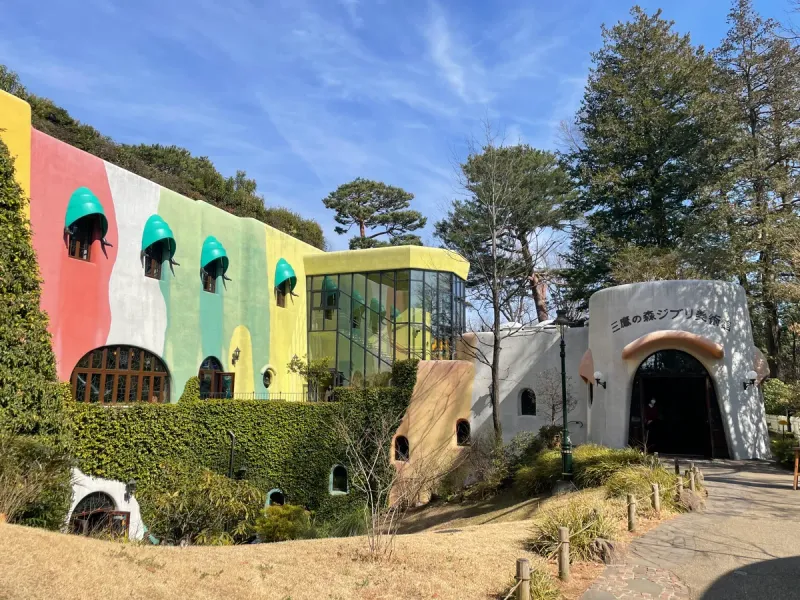
What's inside. On the ground floor, five rooms called 'Where a Film is Born' are set up as an animator's workplace, with desks, sketches and the books and toys that fed the films. In the basement is the Saturn Theater, a cinema of about 80 seats where you watch one original Ghibli short film (one screening per visit). On the second floor is the Cat Bus room, a slightly smaller-than-film-size Cat Bus children can climb into, for children of primary-school age and younger. A spiral staircase from there leads up to the roof garden and the five-metre Robot Soldier from Castle in the Sky. There's also a special exhibition room, a reading room, the Straw Hat Café, and the shop, MAMMA AIUTO!, named after the sky pirates in Porco Rosso.
What's on. The current special exhibition is 'The Studio of Yuriko Yamawaki: Treasure from an Artist's Clutter', running until May 2027 (tentative). Yamawaki illustrated the children's books behind two of the theatre's films. The film schedule is: Treasure Hunting (9 minutes) from 19 November to 26 December 2026, then The Day I Bought a Star (16 minutes) from 3 to 31 January 2027, both marked tentative. Your ticket itself is a strip of real 35mm Ghibli film, swapped for your booking at the entrance.
How tickets work. Every visit is booked in advance for a set date and entry time. Tickets for each month go on sale at 10am Japan time (JST) on the 10th of the month before. So December 2026 tickets go on sale on 10 November, January 2027 tickets on 10 December, and February 2027 tickets on 10 January. In winter, 10am JST is 1am in London and 8pm the evening before in New York. No tickets or bookings are sold at the museum, and tickets bought to resell are banned: the museum says resold tickets won't get you in.
Buying from outside Japan. The museum's English ticket page gives two official ways. (1) Lawson Ticket's English site, linked from that page, is the main one. (2) A Sunrise Tours (JTB) Ghibli bus tour from Tokyo, which includes museum entry, original tour-only merchandise, a visit to the Edo-Tokyo Open Air Architectural Museum and lunch; its price and dates are on Sunrise Tours' own page. Buy through one of those, not a reseller.
Buying in Japan. Japan residents book on Lawson Ticket's Japanese site and choose either an e-ticket shown on their phone or a paper ticket printed at a Lawson convenience store's Loppi machine. Residents of Mitaka and its neighbouring cities also have their own ticket allocation, sold through the Mitaka tourism association.
New this month: QR tickets and a ¥110 fee. The museum's Japanese notice of 6 October 2026 says that from November 2026 entries (the tickets that went on sale on 10 October), it has moved to a new QR-code ticket system, and Lawson Ticket now adds a system fee of ¥110 per ticket. The English ticket page doesn't mention the fee yet, so expect it at checkout.
Prices. Ages 19 and over ¥1,000, 13 to 18 ¥700, 7 to 12 ¥400, 4 to 6 ¥100. Children aged 3 and under are free and don't need a ticket. There are no group or advance-purchase discounts. Payment for tickets is on Lawson Ticket; inside, the shop, café and reading room take yen cash, the main credit cards and Japanese transport IC cards such as Suica.
Entry times and hours. The museum opens 10am to 6pm. Entry times are on the hour, from 10am to 4pm, and you need to go in within an hour of your entry time. There's no set exit time, so once you're in, stay until closing, but you can't come back in after you leave.
Closures through January 2027. The museum closes every Tuesday, plus other days that change each year. From Wednesday 4 to Wednesday 18 November 2026 it's closed for maintenance, reopening on Thursday 19 November with its Christmas decorations. The museum's calendar shows December closures on the 1st, 8th, 15th and 22nd, then 27 to 31 December, and January closures on the 1st, 2nd, 12th, 19th and 26th, so it's open on Tuesday 5 January. Opening days, hours and entry times can change without notice.
No photos inside. The museum asks visitors not to take photos or videos inside. Its reasoning, from its own rules: the museum is the entrance to a story, and to become the hero of that story you should see the space with your own eyes rather than through a camera, then keep the memories in your heart. It's one of the reasons the place feels calm.
The other house rules. Keep your phone off inside. No eating or drinking in the museum; food from the café, or your own, is eaten in the café or on its deck. Prams go in the pram area. The roof garden can close in bad weather, and there's no re-entry. The whole site is non-smoking.
Lockers and luggage. There are 96 coin lockers for small bags: they take a ¥100 coin and give it back when you collect your things. For anything bigger, ask the staff. There's no visitor parking, but there's space for about 100 bikes.
Getting there from Mitaka (the usual way). Take the JR Chuo Line rapid service from Shinjuku to Mitaka, about 20 minutes. Leave by the south exit. From there it's about a 15-minute walk along the Tamagawa Josui canal, with signposts along the canal pointing the way.
The community bus. If you'd rather ride, the Mitaka City Bus (run by Odakyu Bus; some of its buses were designed by Studio Ghibli) leaves from stop 9 at Mitaka south exit and takes about 5 minutes. Fares are ¥230 for adults (cash or IC card) and ¥120 cash or ¥50 by IC card for children aged 7 to 12. The museum says it runs about every 15 minutes during opening hours. The bus doesn't run on days the museum is closed, and the old return ticket is no longer sold.
From Kichijoji. The museum is also about a 15-minute walk from Kichijoji station (JR Chuo Line and Keio Inokashira Line) and from Inokashira-koen station on the Keio Inokashira Line, most of it through Inokashira Park (below). Buses from Kichijoji's south exit towards Chofu run every 2 to 5 minutes; the stop for the museum is Mansuke-bashi.